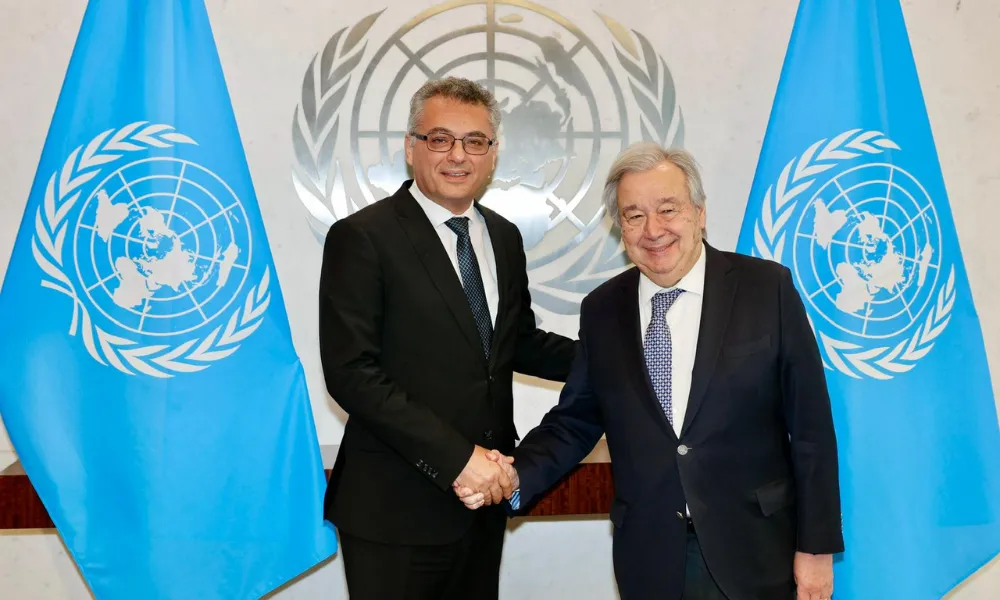
Turkish Cypriot leader Tufan Erhurman held talks with United Nations Secretary-General Antonio Guterres at UN headquarters in New York on Wednesday, presenting a four-point methodology aimed at restarting long-stalled negotiations on the Cyprus issue.
The meeting, described as taking place in a “positive atmosphere,” focused on both the decades-old Cyprus dispute and broader regional developments, according to Türkiye Today. Erhurman outlined his proposed framework for resuming formal talks and briefed Guterres on recent steps related to confidence-building measures between the island’s two communities.
Turkish news agency Anadolu highlights Tufan Erhurman's statement, following the meeting, that the next round of negotiations to solve the Cyprus problem "must not follow the patterns of previous attempts". Evaluating his first meeting with United Nations Secretary‑General Antonio Guterres, he pointed out that “this time it must be different”.
A UN readout confirmed the meeting, describing it as an introductory encounter in which the two leaders “discussed the way forward on the Cyprus issue.”
Erhurman urges end to isolation
During the talks, TC leader Erhurman reiterated that “unjust and unlawful isolations imposed on the Turkish Cypriot people should be lifted without further delay,” Türkiye Today reported.
Politicians in the north have long argued that restrictions on trade, travel and international engagement unfairly penalise Turkish Cypriots and undermine prospects for a sustainable settlement. The issue remains central to the Turkish Cypriot side’s position in any renewed negotiation process.
The four-point methodology
Reports on the meeting in New York did not include any further details on Erhurman’s four-point methodology. However, in his contribution to the UNSG's report on the Good Offices mission in Cyprus, Erhurman detailed the four steps that need to be followed to pave the way for the resumption of talks.
Erhürman clarified that the first, a commitment to political equality, includes a rotating presidency and effective participation (with at least one favourable vote). The other steps are: acceptance of past convergences leading up to Crans-Montana, ensuring the new process will be results-oriented and time-framed; and ensuring that Turkish Cypriots “will not be condemned” to their current status if the process fails despite their best efforts.
“This methodology constitutes, in no way, a set of pre-conditions,” he said in the report, while also noting that a new process “can only start once we agree in principle on our 4-point methodology in its entirety”.