The reference in the joint communiqué of the Christodoulides–Erhürman–Olguín meeting to a solution of the Cyprus issue within the agreed framework makes today’s meeting of the UN Secretary-General’s personal envoy with the Turkish Foreign Minister particularly significant, rather than merely formal. What is at stake for the next moves of those involved in the Cyprus issue? This is a serious concern for both sides, centered on the acceptance of last Thursday’s trilateral meeting with Christodoulides and Erhürman in the presence of María Ángela Olguín.
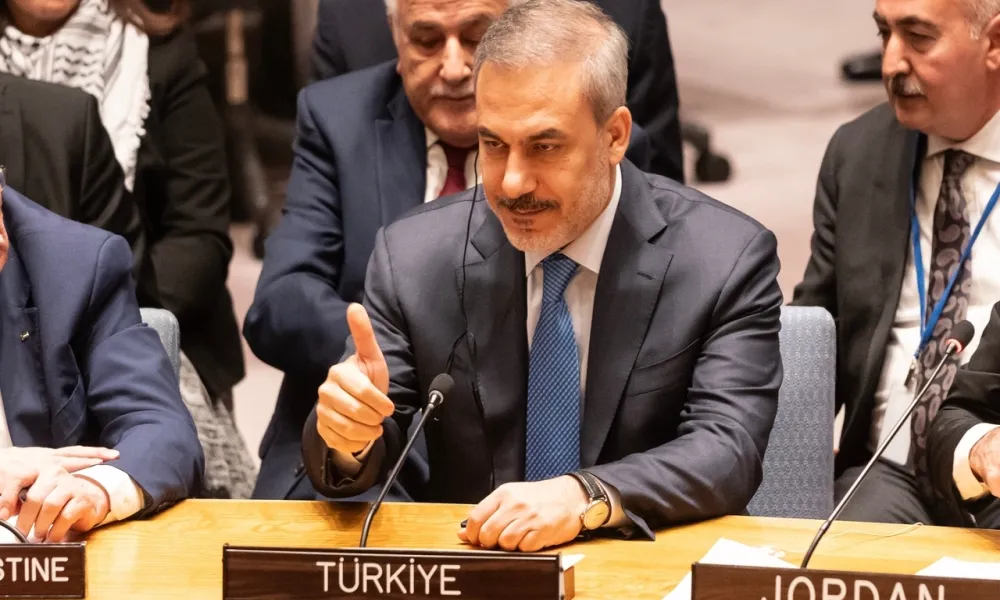
Before any attempt to answer this question, the personal envoy of the UN Secretary-General, who is today in Ankara, the last and crucial stop of her regional tour, will meet with Foreign Minister Hakan Fidan. From this meeting and the statements that will follow, Ankara’s position on the reference in the joint communiqué of the Christodoulides–Erhürman–Olguín meeting to a solution of the Cyprus issue within the agreed framework will be awaited with interest. In other words, whether the rhetoric of a two-state solution will be abandoned.
It is worth noting that Fidan, speaking on December 9 in the Turkish Parliament about the budget, referred to the Cyprus issue by stating: “Our mission is to ensure that the ‘Turkish Republic of Northern Cyprus’ claims its rightful place in the international community and that the inhumane embargo against the Turkish Cypriots is lifted,” without elaborating further.
The big question is whether, through the general position as defined in last Thursday’s meeting, namely, the effort to resolve the issue on the basis of the agreed framework and UN resolutions, with all the vagueness that phrase entails, it is possible to open the field on the ground for creative negotiations.
Obviously, this will be particularly difficult to answer, given that there was neither discussion nor acceptance, nor even reference, to what convergences have been achieved in the past and what led to the 2017 talks.
Avoidance 1
Based on available information, Nikos Christodoulides, both in his meeting with Erhürman and in his briefing to the National Council, avoided giving continuity to what he considers productive regarding the position that the sides should proceed from where the talks stopped. He therefore did not present his positions when asked both by Olguín and at the National Council about where exactly the sides had left off and what agreements and convergences existed, as he perceives them. Beyond general references to political equality, Christodoulides was not ready to expand discussions on issues such as rotating presidency, weighted vote or positive vote, effective participation, etc.
Avoidance 2
In the same pattern, though with different content, Tufan Erhürman also avoided making reference to the communiqué’s mention of a bizonal, bicommunal federation solution, since his interlocutor avoided giving substance to what had been agreed—namely, where the previous substantive talks had left off. After the trilateral, he stated that the solution was “highlighted on the basis of political equality.” No term referring to a specific model of solution (such as bizonal, bicommunal federation) was used. The concept of political equality was taken into account according to UN Security Council agreements. He added that the approach of common areas of sovereignty was also discussed, which presupposes joint decision-making.
Interpretations and Readings
In short, there are two parallel moves by the sides in the antechamber of negotiations, beginning with the next five-party meeting:
-
Clarification is needed in the coming period as to where the talks left off, so this can be recorded in relation to the core concerns of both sides.
-
It is evident from her contacts that the UN envoy will attempt to clarify, with precision, the moves of both sides. Her goal is to understand, since the logic of sovereign equality has been surpassed and both sides agreed with UN resolutions on political equality, which convergences can serve as the driving force for her next steps. From the UN’s approach, it is clear that the envoy is not merely seeking agreement on confidence-building measures. Given the limited time available to António Guterres, these talks must become more productive, seeking the starting point of substantive negotiations rather than general references to political equality and parallel avoidance of the content of that term.
-
As diplomatic sources told Politis, what matters is not hiding behind generalities about accepting UN resolutions as if that alone creates productive forces for a solution. The real issue is deepening the discussions as they have evolved, without rejecting the convergences that have emerged.
The Dangerous Logic
According to the same sources, if there are no clear clarifications, there is a risk of “simply returning to the definition of political equality in its generality, as adopted by the UN Security Council in 1991, and remaining there as a tragic regression.”
The important thing is not merely the reference to accepting a decision devoid of content from more than 25 years ago, ignoring the acquis of negotiations over the past two decades. The real issue is whether the convergences from long consultations can reduce the distance, as the Greek Cypriot side has noted all this time, and as the Turkish Cypriot side also interprets through Tufan Erhürman.
In Ankara for Consensus
Within this reasoning, María Ángela Olguín is keeping to her timetable and, after Athens, is traveling to Ankara for talks with Turkish Foreign Minister Hakan Fidan, seeking consensus in an effort to bring the process back to a point where substantive continuity can exist.
According to information obtained by Politis from diplomatic sources in Nicosia, Olguín’s contacts, mainly with the Turkish Foreign Minister, may lead to clarification of certain issues which appear to have changed in content, but Turkey’s stance is clearly awaited.
The reference point is the joint communiqué of the trilateral on a solution within the framework of UN resolutions, with explicit mention of political equality, despite the different interpretations by the Turkish Cypriot leader. Notably, Tufan Erhürman argued that while reference was made to the main objective of resolving the Cyprus issue, with the solution sought on the basis of political equality, “no formula of solution has been adopted.” This statement is made pending clarification of Ankara’s real intentions.