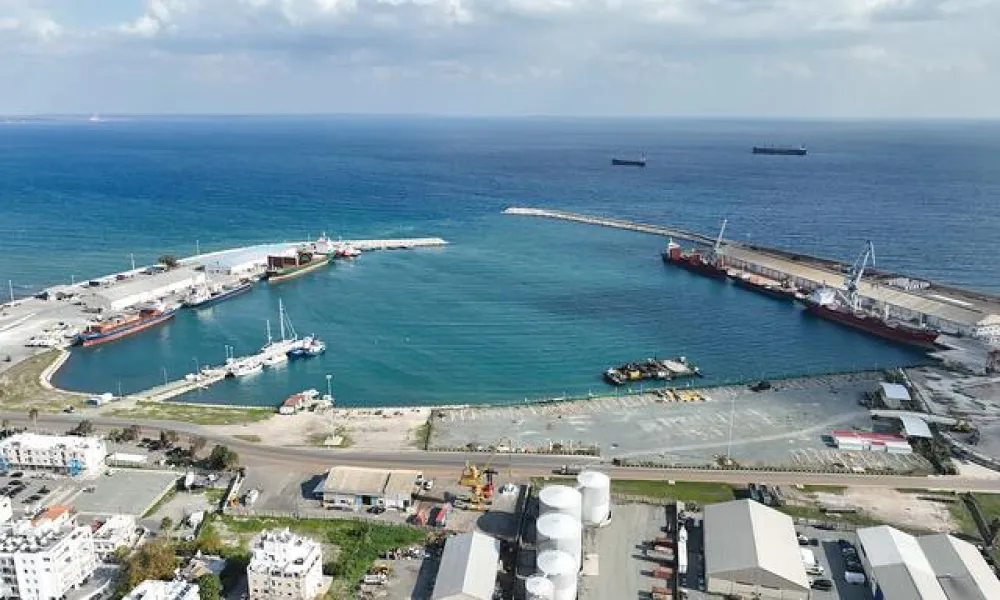
Larnaca is at a critical juncture for its development, with the city’s largest projects concentrated along the coastal zone around the port. Despite fifteen years of discussions and repeated setbacks, a final decision on the future of Larnaca’s port and marina is expected next month, charting the next phase of a project that has remained unfinished for years. The city, the government, and local authorities are seeking common ground, with Larnaca insisting that development must be comprehensive and deliver tangible benefits to residents. Meanwhile, the government is considering various scenarios for the port, and the business community views the marina optimistically, hoping for a project that will create new jobs and enhance the city’s image. One point on which all parties agree: another failed project is not an option.
At the same time, in the same area, the Land of Tomorrow project is progressing steadily, transforming the old refineries into a mixed-use development intended to become a vibrant new neighbourhood. This is a major 350,000-square-metre investment set to begin soon and expected to take around fifteen years to complete.
Three scenarios for the port
Regarding the marina and port development, after the termination of the contract with the company previously responsible for the unified project, Transport Minister Alexis Vafeadis told Politis that various alternatives are being considered. He explained that the government “hopes to find a solution to move the project forward as quickly as possible,” noting that the proposals currently on the table involve separate approaches for the marina and the port.
This direction arose following expert recommendations, who argued that different expertise is required for the two components. As for the port, Vafeadis said the planning aims to “meet the country’s needs until 2055.” He outlined three main scenarios:
- Maintain the current state with repairs and possible rearrangement or expansion of infrastructure. However, he stressed that keeping the port as it is “is not an option,” noting studies showing that within the next one to two years, the port will not be able to meet rising demands.
- Maintain the current layout without expanding infrastructure, but with internal reorganisation. Under this plan, the northern quay would host commercial activities, while the southern section would accommodate tourism, including cruise ships. A new terminal in the south would facilitate connections via the marina to Finikoudes. Vafeadis said this setup addresses a long-standing issue: the “crossing” of commercial and tourist uses, which has been risky. With proper equipment and investment, the port could meet projected needs until 2055. While it requires investment “in the tens of millions,” he emphasised that it does not involve demolishing existing structures. He also welcomed the possibility of the state taking over the project.
- A more ambitious commercial approach linked to trends in shipping and e-commerce. Vafeadis argued that Cyprus could attract large companies if it provides the right infrastructure. The port, available storage space, and proximity to the airport create opportunities for commercial development. This scenario may require demolishing the northern quay and building new infrastructure further out, which would entail significantly higher costs.
Mayor Vyras sets red lines
Larnaca Mayor Andreas Vyras has made it clear that the city will not accept a solution that leaves out comprehensive development of the port, marina, and surrounding land. Speaking to Politis, he acknowledged that the termination of the contract with Kition made a setback inevitable but firmly outlined the municipality’s red line: “We will not accept a solution that does not develop the port, the land, and the marina.” He stressed that Larnaca seeks development that creates jobs and leaves a lasting impact, and this position will be presented at both the pan-municipal meeting and discussions with the Transport Minister.
Within the next four weeks, the Ports Authority is expected to announce its decision on how to proceed with the project, as discussed at the pan-municipal meeting. Following this, the city will determine its stance. Vyras emphasised that the key issue for Larnaca is not which entity will take charge, but that the project moves forward: “We will make sure the project gets back on track, in the way we believe it should be done.”
Business community optimistic
The city’s business community appears positive, at least regarding the marina, after the new study was presented. Nantis Antoniou, President of the Larnaca Chamber of Commerce (EBEL), said the chamber has already met with the Transport Minister and carried out preparatory internal work to define its priorities. A working group exchanged views and recorded the main priorities of the business community. With this process now complete, the chamber has defined “what we want and what needs to be done.” The next step is coordination with other local stakeholders to present a unified position to the Ministry of Transport.
Land of Tomorrow: A new neighbourhood
While the marina and port remain unresolved, the Land of Tomorrow project is advancing. Andreas Lefkaritis, project lead, explained that parceling of the large development, previously occupied by refineries, is underway. Construction of the first phase is expected to begin as soon as the required permits are issued. Soil remediation has already started for the 24,000-square-metre first phase, and property pre-sales have begun.
The full project spans 350,000 square metres and is expected to be completed over fifteen years. Lefkaritis described the development as “another city centre,” a new neighbourhood for Larnaca. The plan includes restaurants, shops, squares, and pedestrian streets, aiming to create “a space alive with activity,” not just a cluster of buildings.
The project’s location was chosen by the Petrolina family, major landowners in the area, to ensure development aligns with Larnaca’s culture. Lefkaritis emphasised the space will remain largely open to the public, with only minor areas fenced.
Commenting on Larnaca’s overall development, Lefkaritis described the prospects as very positive, anticipating job creation and city beautification. He added that Larnaca “may be the last city in Cyprus to have fallen behind,” and stressed that the marina and port must also proceed, as they will make a significant contribution. He concluded confidently that the city “will do very well in the coming years” and development must move forward “as it deserves.”
This article was originally published on the Greek-language Politis website.