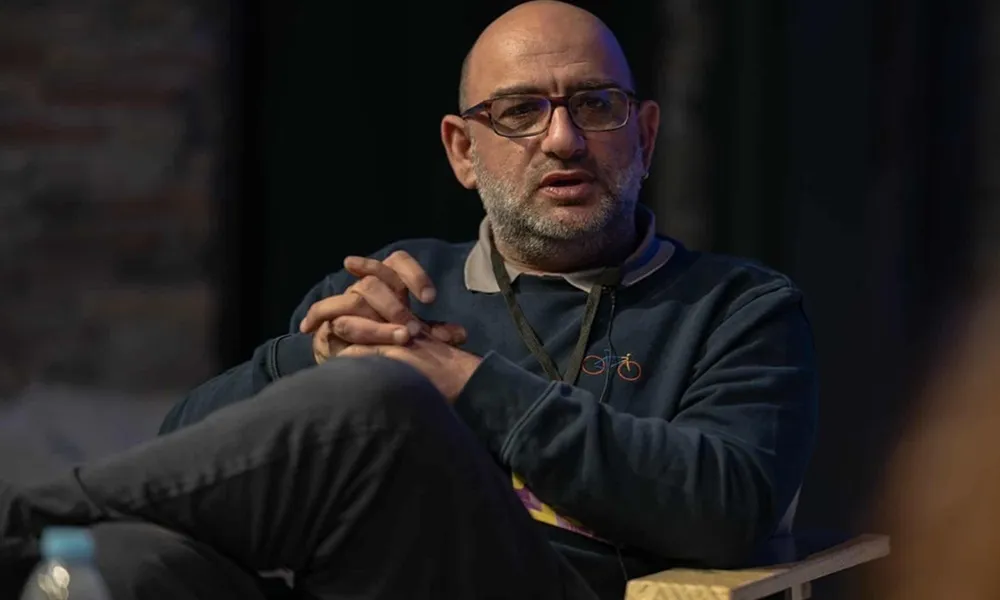
Seven weeks before the parliamentary elections, Cyprus’s party system appears to be in a phase of transformation, marked by increased fragmentation and fluidity. The rise of new parties, the strengthening of civil society, and the influence of social media are reshaping the relationship between citizens and politics. At the same time, a crisis of trust and rising abstention raise critical questions about the quality and future of democracy in Cyprus. On the occasion of the elections of 24 May 2026, Associate Professor of Political Science at the University of Nicosia, Giorgos Charalambous, analyzes for “Politis” the country’s political landscape as it has developed so far.
Is the political/party system in Cyprus changing?
The party system in Cyprus has already undergone significant transformation, both in its structure and in how it functions. The increased number of parties inside and outside parliament, combined with more fluid forms of political competition and cooperation, points to a shift from a relatively stable model of limited multipartism to a more fragmented and volatile political environment. This development is linked to the weakening of traditional party identification and the reduced ideological attachment of citizens to major parties. Crises such as the 2013 financial crisis, the pandemic, and repeated instances of party officials and state actors being implicated in corruption scandals have undermined trust in the political system. New or newly prominent issues—such as transparency, the environment, and migration—have encouraged the emergence of new political formations seeking to fill representation gaps. At the same time, the system’s “political engineering” has changed significantly. Election campaigns rely increasingly on social media and personalized messaging, while voting behavior has become less stable and more unpredictable. The result is greater voter mobility and a looser relationship with parties.
Deep suspicion
What is the relationship today between society and politics/parties?
On the one hand, the relationship between society and politics/parties appears healthier compared to twenty years ago, as a stronger and more multidimensional civil society has developed—from NGOs and volunteer organizations to social movements and citizens’ associations. Increased access to information through the internet and social media has fostered a more transparent, open, and participatory form of political mobilization, both collectively and individually. As a result, there is more intensive and meaningful interaction between party and non-party actors.
However, despite increased mobilization, social reactions, and expressions of solidarity, a deep suspicion toward institutional political processes continues to grow. This suspicion is fueled by recurring phenomena of impunity, procedural bypassing, favoritism, and social inequality, and is reflected in low levels of trust in parties and state institutions.
Crisis or renewal?
Will the quality of democracy improve with the entry of new political formations into political life and parliament?
The reconfiguration of a party system through the entry of new formations can function both as a symptom of a crisis of representation and as a mechanism of renewal. More specifically, it signals a crisis because institutional trust is at very low levels, while new forms of political participation are developing through digital networks and platforms. On the other hand, it also acts as a renewal factor, as it broadens representation and introduces new demands, social groups, and political agendas into public debate. The quality of democracy can improve to the extent that government–opposition relations are balanced, parliamentary oversight becomes stronger, issues of justice are more prominently highlighted, and social rights are more forcefully raised. Moreover, the presence of new parties may strengthen accountability, increase political competition, and limit inertia or clientelist practices. However, if fragmentation becomes excessive, there is a risk of instability and difficulty in decision-making. Therefore, the impact depends on whether renewal is accompanied by institutional maturity, programmatic consistency, and meaningful political participation.
How do voters vote today (young and old)?
In general, there is a partial de-ideologization of voting behavior, as reflected, for example, in the popularity of Fidias Panayiotou and the idea of direct democracy, where there are no clear and coherent ideological positions or traditional party identities. Party identification had already begun to erode in the 2010s. Voters—especially younger ones—seem to be moving away from classic ideological divides (e.g., Left–Right) and placing greater emphasis on personalities, authenticity, and direct communication via social media. The influence of social media favors political figures who communicate directly and with simplified messages, without necessarily having fully developed policy programs. Broader disappointment with the effectiveness of political systems reinforces a tendency toward “anti-system” choices. Overall, modern voters (both young and older, but especially the young) tend to vote based on more fluid and multi-factor criteria: the candidate’s image, credibility, current issues, and personal identification, rather than strictly ideological criteria as in the past.
Insufficient political education
Does this mean ideological differences between parties no longer exist? Or that voters are not interested in them?
Ideological differences between parties certainly still exist and are clearly visible along the main axes of Greek Cypriot political competition. Available data from relevant studies show substantial differences between parties such as AKEL and DISY, as well as among presidential candidates. The legislative process has also been highly confrontational between Right and Left, especially on controversial bills that reveal the ideas and interests behind positions, such as cooperative banking, NATO, civil partnerships, foreclosures, and positions regarding Israel’s actions in Palestine. De-ideologization concerns not so much the parties themselves as a segment of society, particularly younger voters. It is also linked to factors such as insufficient political education and the limited cultivation of critical thinking within the education system, which restricts the ability to understand ideological differences. Disappointment with the political system and recurring scandals further reinforce indifference or cynicism toward ideology.
Are we at the end of Left and Right?
Although many younger voters do not perceive politics in Left–Right terms, this does not mean that the fundamental axes of the party system have changed. Despite shifts in priorities and forms of political expression, core ideological divisions have not disappeared. The Left–Right distinction retains its enduring structural importance, as it continues to organize competition around fundamental issues. What is changing is the thematic axis of “new politics,” which in Cyprus had until recently been dominated by the Cyprus problem and national identity. This is now evolving due to the normalization of division among Greek Cypriots, generational change, and the growing importance of issues such as migration, the environment, democracy, sexuality, and urban space. These emerging themes do not replace the traditional divide but complement and reshape it, giving it new content in a changing social and political environment.
To what extent are voters interested today in political discourse and dialogue as expressed by parties and individuals?
Political discourse and dialogue still interest voters, but to a lesser and more selective degree than in the past. Many citizens do not systematically follow traditional party discourse (such as speeches, party programs, and congresses), but are exposed to fragmented and often simplified versions of it through social media. As a result, interest has shifted toward more immediate, brief, and personality-driven forms of communication. Consequently, politics itself has become, to some extent, more performative. Younger voters are not necessarily “apolitical,” but they often engage with politics differently, being more influenced by current issues, value-based topics (such as rights and the environment), and the image of political figures, rather than by coherent ideological frameworks or in-depth political dialogue.
Personality-driven forms
How do you interpret the gradual weakening of traditional parties in recent years?
It is a process shaped by multiple factors, some relating to the parties themselves and others to the party system as a whole. At the system level, three main reasons stand out: first, the generalized crisis of trust toward institutions and parties; second, the weakening of party identification and the increase in electoral fluidity, with undecided voters now approaching 30%; third, socio-economic and technological changes, especially the rise of social media, which favor more personality-driven forms of political expression. At the party level: AKEL bears wear from its period in government (2008–2013) and the difficult decisions of the crisis. EDEK has been weakened by internal conflicts and splits. DISY, in the post-Klerides era, faces an identity crisis and losses accompanied by fragmentation on the Right. DIKO has been affected by cohesion problems and splits, such as the creation of DIPA. Overall, the weakening of traditional parties is the result of structural changes and internal weaknesses that reinforce electoral fluidity and political uncertainty.
Democratic crisis
How close are we today to permanent fragmentation of the Cypriot party system?
We are already there, or at least very close. The transformation of the Cypriot system, currently underway, reflects broader social phenomena—economic (e.g., inequality), political (e.g., corruption, democratic deficits), and technological (e.g., social media and new modes of information). As such, the consequences of the democratic crisis affect both the balance of forces in the political arena and the nature of political representation and participation. Fragmentation does not necessarily mean instability, but rather a transition to a new, more polycentric model of political competition. The question is whether this new model will be accompanied by stronger democratic accountability and representation, or by further disconnection between citizens and institutions. We are in a transitional phase toward a more fluid but also more demanding democratic formation, whose final shape remains uncertain.