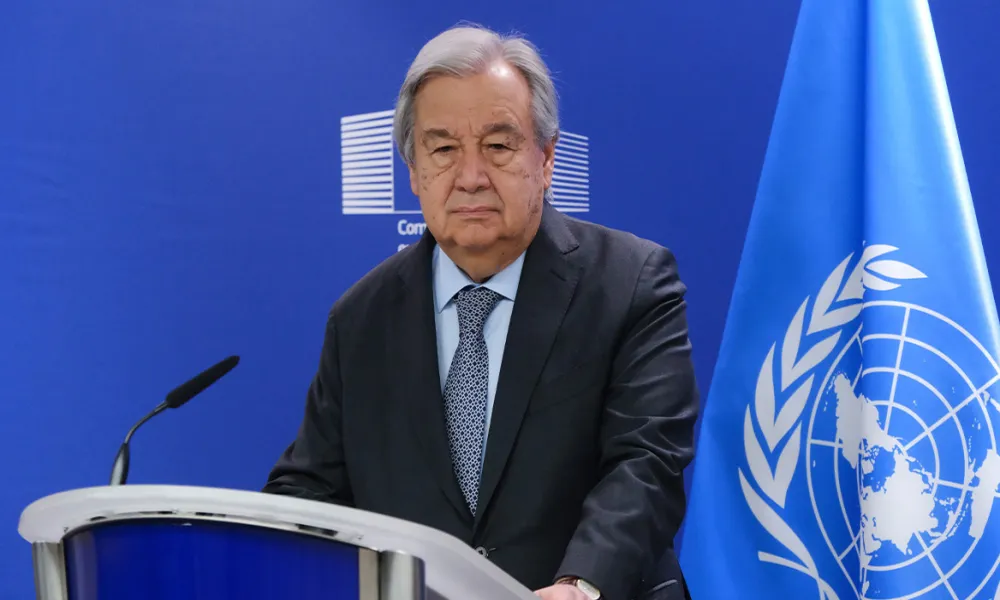

It cannot be ruled out that Guterres wants to make one final effort. His term is nearing its end and he will hand over the role in December. If nothing substantial changes on the island, what will he pass on to his successor?
Guterres has shown considerable patience with the Cypriots. In January, his personal envoy, María Ángela Holguín, suspended her visits to Cyprus with the intention of returning after the Cypriot presidency of the EU. In February, Guterres invited Turkish Cypriot leader Tufan Erhürman to New York. Later, in March (12/3), he discussed the Cyprus issue with Recep Tayyip Erdoğan in Ankara and a few days later met Christodoulides in Brussels.
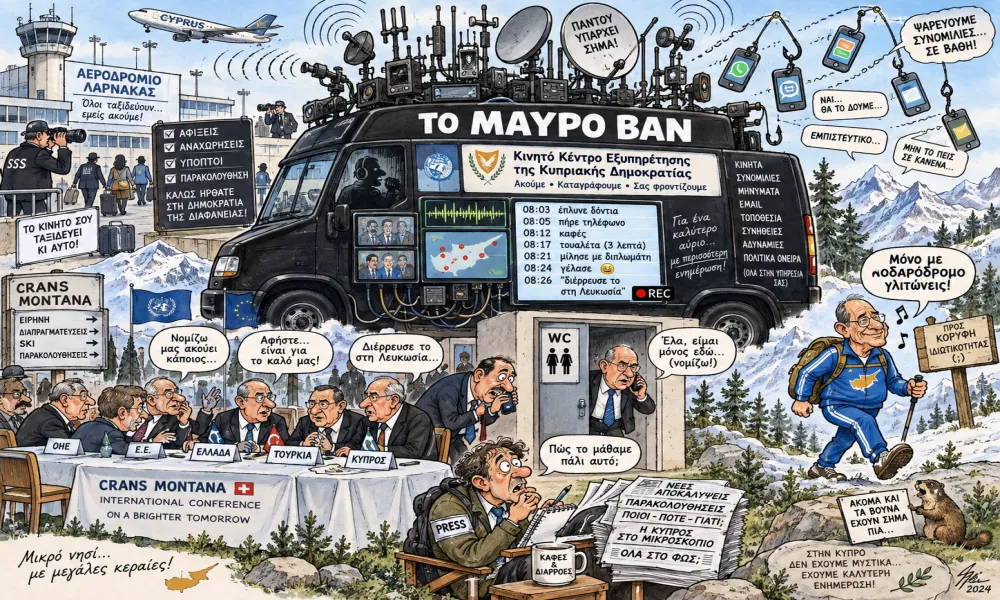
The sequence of meetings suggests that some groundwork is being carried out. However, the public discourse of Christodoulides does not clarify what is at stake. It often remains focused on the domestic audience, with references to anniversaries and memorial events. In the news, what stands out are exchanges of accusations between Christodoulides and Erhürman and familiar allegations within the “blame game” over the situation in the buffer zone.
There is little indication of a genuine willingness to pursue confidence-building measures, such as new crossing points, trade cooperation or infrastructure projects, even though both the United Nations and the European Union place particular emphasis on these initiatives. The result so far is modest. A limited agreement is expected in the coming days on the supply of recycled water from the bicommunal Nicosia wastewater treatment plant to the government-controlled areas. The issue has been pending since 2011.
Speculation
A possible “resumption of talks” is a declared objective of Christodoulides, though it would be a process without commitments or timelines. Such a step might help explain how the situation reached a complete impasse, when in 2017 the parties were described as being “five minutes” away from a solution, a phrase used by Christodoulides himself.
Within the Presidential Palace, assessments are reportedly being made on how best to manage the issue. Despite the collapse of negotiations, Guterres has never abandoned the Cyprus question. A broader conference and full-scale negotiations would be a dramatic development. However, he has repeatedly made it clear that guarantees of success are necessary in order to avoid worsening the situation further.
Using earlier proposals as a basis, various ideas continue to circulate on the island, including a “joint declaration”, a “framework”, or a “summit agreement”. Erhürman suggested on 26 April that developments might be possible by July, with confidence-building measures to be agreed in Nicosia.
Key issues
Guterres has considerable experience and is familiar with the key elements required to break the deadlock, but he has struggled to find a response. The Greek Cypriot leadership appears to be experimenting with ways to avoid committing to specific arrangements for implementing political equality.
Because of this approach, and dating back to the presidency of Nicos Anastasiades, the framework for a strategic agreement, known as the six Guterres points, was effectively dismantled by the Greek Cypriot side. To this day, Christodoulides has not accepted them, preferring instead to return to earlier convergences.
This dismantling over the years risks undermining the negotiating gains related to security, including the termination of guarantees and the withdrawal of troops, which correspond to the first two points of the Guterres framework. As a result, Turkey has not given the green light for a broader conference on Cyprus, while the Turkish Cypriot leader insists that political equality must first be clarified so that it will not again become subject to negotiation.
Guterres’s envoys have continued to travel to Cyprus over the past nine years. Four of those years were during the tenure of the moderate Mustafa Akinci, and since October the interlocutor has been Erhürman. The United Nations encounters presidents who often speak in hints, referring to ideas such as a return to the 1960 Constitution, a loose federation or a single Turkish Cypriot vote amounting to a veto.
Christodoulides has never fully revealed his position, which is why Guterres continues to doubt his intentions. Under these circumstances, it seems unlikely that the UN Secretary-General will bring Turkey back to the negotiating table for formal talks.
Political manoeuvres
Christodoulides continues to pursue what appears to be a counterproductive scenario, placing obstacles and disincentives before Turkey in its relations with the European Union. Six months ago, he reportedly asked European leaders, including Friedrich Merz and Emmanuel Macron, to mediate so that progress on the Cyprus issue could move in parallel with developments in EU-Turkey relations, including the customs union and visa liberalisation.
No progress has been recorded since then.
At the same time, amid instability in the Middle East, Cyprus has increasingly aligned itself with Israel. The country appears to be acting beyond its capabilities as geopolitical competition intensifies. On the one hand, it rightly demands Turkey’s withdrawal, the end of the occupation and the termination of guarantees. On the other hand, with half of its territory still occupied, it offers itself as part of the broader geopolitical rivalry involving Turkey.
More recently, Christodoulides has invoked the EU’s mutual assistance clause. This clause provides flexibility for defence purposes but must remain compatible with the obligations of member states within NATO. No EU member state is committed to treating Turkey as a source of threat.
For Cyprus, it may be more useful to consider incorporating the EU solidarity clause into a strategy for resolving the Cyprus issue, one that would involve Turkey rather than exclude it.