
By Mike Spanos
We find ourselves once again, as is almost always the case, in a phase of political double-speak.
Political double-speak is the "art" of presenting the same events differently to different audiences, so that each side feels, and appears, vindicated. The real problem arises when deliberately misleading interpretations are promoted in order to serve short-term political interests.
Where we stand now
In reality, the Cyprus issue remains exactly where it stood before the visit of the United Nations Secretary-General, both procedurally and substantively, without in any way diminishing the significance of his initiative.
The two sides remain committed to their long-standing positions. The Greek Cypriot side continues to seek the resumption of talks from the point at which they were interrupted at Crans-Montana following the dinner of July 5, 2017. The Turkish Cypriot side, on the other hand, continues to regard the fulfilment of two basic preconditions as necessary: the implementation of Confidence-Building Measures and agreement on a clearly defined process with a specific timetable and predetermined objectives.
It is true that the efforts of our side, combined with international developments, have generated momentum. Momentum, however, is not necessarily synonymous with progress, nor does progress automatically translate into action capable of producing meaningful results.
More broadly, Cyprus needs greater focus on its objectives and, above all, a stronger ability to achieve the desired outcome at the right time and at the right cost. Too often, we give the impression that we devote ourselves to managing the process rather than achieving the result, and this applies to almost every issue.
What the Secretary-General achieved
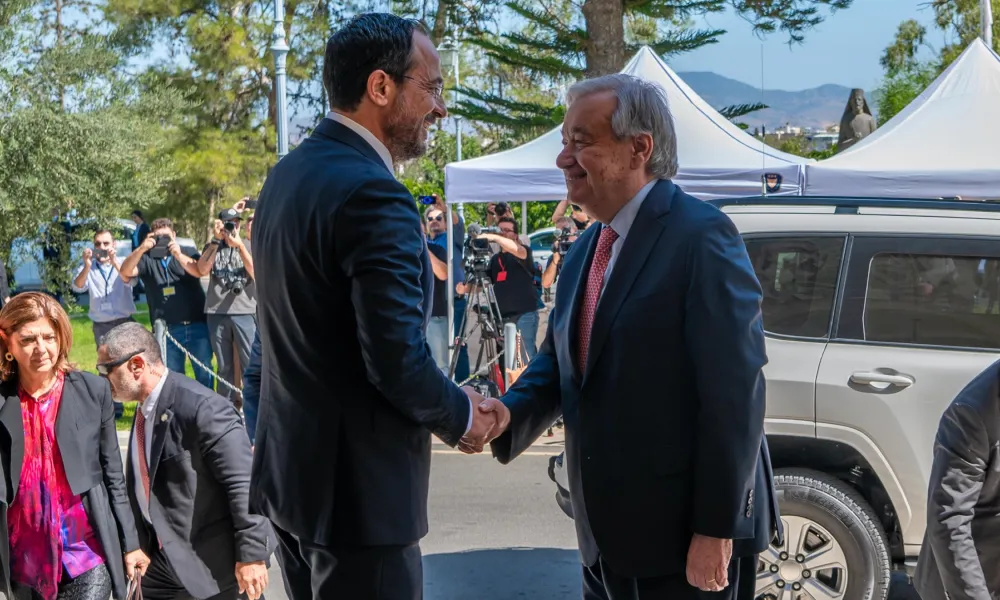
The UN Secretary-General succeeded in keeping the process alive, albeit with difficulty.
He did not, however, succeed in moving it to the next stage.
Antonio Guterres came to make yet another attempt to bring order to an endless process characterised by activity but lacking effectiveness. Indeed, he made it clear, albeit indirectly, that no new expanded meeting would take place merely for the sake of holding one.
What type of solution he appeared to have in mind
In my view, his intention was to steer developments towards a practically workable settlement based on a federal structure with a high degree of autonomy for the constituent states, political equality translating into effective participation in agreed areas of governance, and a system tailored to Cyprus' particular circumstances.
Examples of federations with a high degree of autonomy for their constituent states include Switzerland, the United States, Canada, Belgium and the United Arab Emirates.
My view
In my opinion, this is also the most realistic direction.
Such an arrangement would be based on two politically equal constituent parts, with the federal government safeguarding a single international personality, a single sovereignty and a single citizenship, while exercising a limited but critical set of powers.
These would include immigration, external representation, relations with the European Union, the single economy and macroeconomic coordination, matters of state and energy security, and the management and joint exploitation of natural resources such as natural gas on the basis of a fair distribution of revenues.
At the same time, environmental protection, public health, particularly in cases of pandemics, and sport are sectors in which close cooperation can and should be developed regardless of constitutional arrangements.
What the EU's role should be
To strengthen this prospect, the European Union must become a key player, not an extra.
Its role should not be auxiliary. It should be leading, with the primary aim of safeguarding the political, legal, economic and security future of a federal Republic of Cyprus that would constitute the evolution of the existing Republic of Cyprus.
What is needed is the development of a serious and comprehensive "Marshall Plan".
That said, I unfortunately do not believe that the European Union, with its slow and cumbersome procedures, currently possesses the capacity to envision, design and comprehensively implement a plan of such magnitude.
Nevertheless, in my view, this is the appropriate course of action, rather than sporadic, fragmented and superficial efforts.
An architecture of mutual incentives
There is no stronger incentive than mutual benefit. Creating win-win conditions is essential. The development of a broader architecture of mutual incentives is indispensable.
For this reason, it is particularly important that the European Union respond, where appropriate, to Turkey's reasonable expectations, such as the upgrading of the Customs Union, visa liberalisation and Ankara's participation in the European SAFE defence framework.
In any case, the gradual Europeanisation of Turkey, across all sectors and levels, would serve the interests of everyone.
The geopolitical risk
Another element that could not go unnoticed during Antonio Guterres' visit was his clear warning about the geopolitical risks facing Cyprus.
Specifically, he stated:
"If Cyprus does not resolve its problems, it will become much more vulnerable to the dangers in a region in flames."
This warning should be taken very seriously, both in relation to efforts to resolve the Cyprus issue and in shaping the foreign policy of the Republic of Cyprus.
In any event, efforts should not be confined to the starting point, nor exhausted in managing the process.
The real objective must always be the destination, and that destination can only be a comprehensive, functional, sustainable and resilient settlement of the Cyprus issue, for the benefit not only of the entire Cypriot people but also of the wider region.