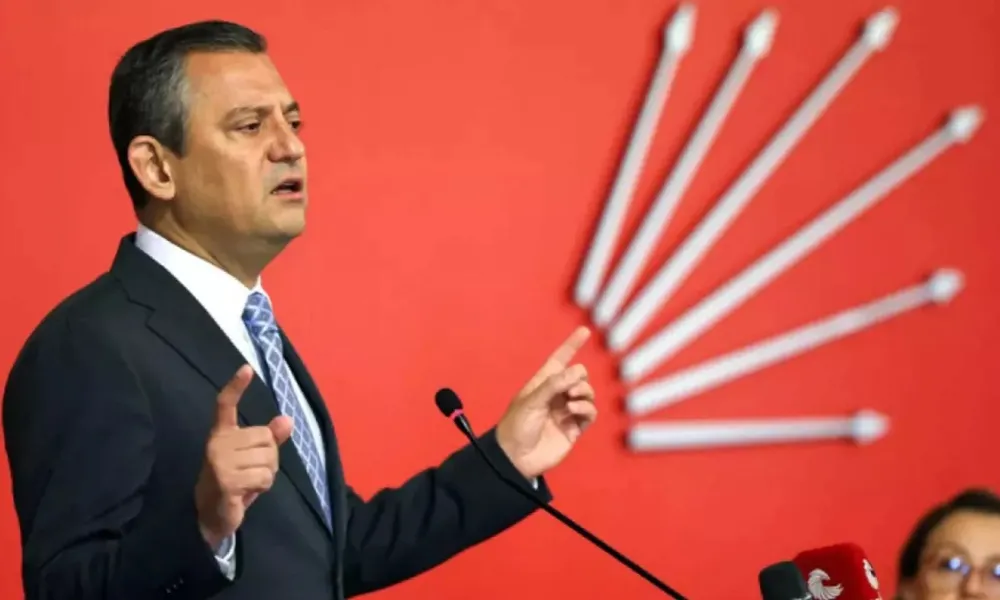
Turkish riot police stormed the Ankara headquarters of the Republican People’s Party (CHP) on Sunday, firing tear gas and rubber bullets to forcibly remove ousted party leader Özgür Özel and supporters who had barricaded themselves inside the building for three days. The dramatic intervention, broadcast live across international networks and social media platforms, triggered a wave of alarm abroad, with major global outlets portraying the scenes as a critical turning point in Türkiye’s democratic trajectory.
What has drawn particular international attention since the raid is Özel’s decision to march toward parliament immediately after being removed from party headquarters. The image of the leader of Türkiye’s main opposition party being expelled from his own headquarters by riot police and then leading MPs and supporters through the streets of Ankara toward the Grand National Assembly has rapidly become one of the defining political images of the year.
The raid and the political crisis behind it
The confrontation had been escalating since Thursday, May 21, when a Turkish appeals court annulled the CHP’s November 2023 congress, where Özel had defeated former chairman Kemal Kılıçdaroğlu to become party leader. The court cited unspecified irregularities under the legal doctrine of “absolute nullity” and reinstated Kılıçdaroğlu, who led the party for 13 years without securing a national election victory.
Özel rejected the ruling outright, describing it as a “judicial coup,” and refused to surrender party headquarters. Together with CHP officials, lawmakers and supporters, he remained barricaded inside the building while thousands gathered outside in solidarity.
On Sunday morning, lawyers representing Kılıçdaroğlu formally requested that Ankara police take control of the building. The Ankara Governor’s Office subsequently authorised the intervention. By early afternoon, riot police units had broken through the headquarters’ iron gates and entered the compound.
Television footage carried by Turkish and international media showed tear gas filling the courtyard, riot police moving through corridors and stairwells, and CHP supporters attempting to resist using fire extinguishers before being overwhelmed. Journalists inside the building reported smashed doors, damaged furniture and broken ground-floor windows as security forces cleared the premises.
Minutes before police reached the upper floors, Özel released a three-minute video statement on social media.
“We are under attack,” he said. “Our crime? Making our party Türkiye’s number one party after 47 years. Our crime? Defeating the Justice and Development Party.”
He added: “We will resist here until the end. And if they forcibly remove us, we will continue our march in the public square.”
Hours later, after being escorted from the building, Özel fulfilled that promise. Accompanied by CHP parliamentarians, municipal officials and supporters, he began marching toward parliament, more than five kilometres away, in a symbolic act of political defiance that international wire services immediately highlighted.
How the international media reacted
Coverage from international media outlets converged around a common theme: that the crisis surrounding the CHP is no longer simply an internal opposition dispute, but part of a much broader struggle over the future of democratic competition in Türkiye.
The broadest international exposure came through the Associated Press, whose reporting was rapidly republished by outlets including ABC News, NBC News, the Times of Israel, Coast Reporter, Guelph Today and numerous regional American newspapers. AP described the events as “a violent end to a standoff” between CHP supporters and a court-backed leadership change, while emphasising Özel’s subsequent march toward parliament as a symbolically explosive development.
AP also noted that the police operation took place at the start of the nine-day Eid al-Adha holiday, when much of the Turkish public is away from major cities, a timing several commentators interpreted as politically calculated.
NBC News stressed that the overwhelming majority of the CHP organisation had rallied behind Özel and placed the raid within what it called a broader judicial campaign against the opposition. The outlet wrote that many observers see the legal cases against the CHP, most of them linked to corruption allegations denied by the party, as an effort to weaken the opposition ahead of future elections. The government continues to insist that the judiciary acts independently.
Reuters, whose coverage was syndicated globally through outlets including Al-Monitor, Arab News and numerous regional broadcasters, was among the first international agencies to report the eviction order issued by the Ankara Governor’s Office. Reuters described the court ruling as having “fuelled a political crisis” and highlighted Özel’s call for a new CHP congress “as soon as possible.”
WFTV, an ABC affiliate in the United States, offered some of the most detailed scene-by-scene reporting, noting that Özel, in his first election as CHP leader, had overseen the opposition’s sweeping municipal election victories in 2024 and inflicted what it described as a major electoral defeat on President Recep Tayyip Erdoğan’s ruling Justice and Development Party (AK Party).
The Times of Israel republished AP reporting while adding broader political context, reminding readers that imprisoned Istanbul Mayor Ekrem İmamoğlu, widely viewed as Erdoğan’s strongest potential presidential challenger, remains jailed pending trial on corruption charges. The paper noted that although the next presidential election is formally scheduled for 2028, Erdoğan retains the power to call early elections.
The Jerusalem Post adopted an even sharper editorial tone. Citing earlier BBC reporting, the paper argued that the court decision annulling the CHP congress represented “the latest legal move that helps cement President Recep Tayyip Erdoğan’s grip on power.” Columnist Seth J. Frantzman described Türkiye as standing “at another crossroads,” linking the political turmoil to growing economic fragility. The paper also highlighted social media speculation suggesting that some individuals involved in clashes outside CHP headquarters may have acted as provocateurs.
Al-Monitor, one of the region’s leading independent platforms covering Middle Eastern politics, had already framed the CHP crisis in the context of what it described as “a wave of probes, detentions and dismissals targeting opposition-run municipalities.” The publication prominently quoted a statement shared through İmamoğlu’s X account: “It is a coup against Türkiye, against democracy, against the republic. It amounts to destroying the constitutional order. It is time for the nation to stand up for Türkiye.”
Arab News published the full Reuters dispatch accompanied by AFP photographs showing CHP supporters camping overnight outside the besieged headquarters before the raid.
ANF News, meanwhile, followed the police operation in real time, providing a minute-by-minute chronology and reporting that the intervention began shortly after the governor’s evacuation order.
A broader narrative of democratic erosion
International coverage of Sunday’s events has been remarkably consistent in placing the CHP headquarters raid within a wider pattern of escalating judicial and political pressure on Türkiye’s opposition.
The European Parliament had already declared earlier this year that democratic standards in Türkiye were in “ongoing deterioration” and kept the country’s EU accession process effectively frozen. Members of the European Parliament condemned what they described as “relentless suppression of critical voices” and characterised legal action against İmamoğlu as politically motivated and aimed at preventing a legitimate electoral challenger from competing for the presidency. The European Parliament warned that Türkiye was moving “towards a fully authoritarian model.”
US News & World Report, covering Thursday’s court ruling, observed that the CHP, currently polling roughly level with Erdoğan’s ruling party, has faced what it called an unprecedented judicial crackdown since 2024, with hundreds of party members, mayors and elected officials detained.
The BBC, whose analysis was repeatedly referenced by other international outlets, framed the annulment of the CHP congress as “the latest legal move that helps cement President Recep Tayyip Erdoğan’s grip on power.”
Reuters, in earlier dispatches widely circulated internationally, summarised what has increasingly become the dominant international interpretation of events: that the legal campaign against the CHP, officially centred on corruption allegations denied by the party, is viewed by opposition figures as an attempt to eliminate electoral threats to Erdoğan and weaken Türkiye’s opposition movement before future elections. The government firmly rejects those accusations and insists that Turkish courts operate independently of political influence.