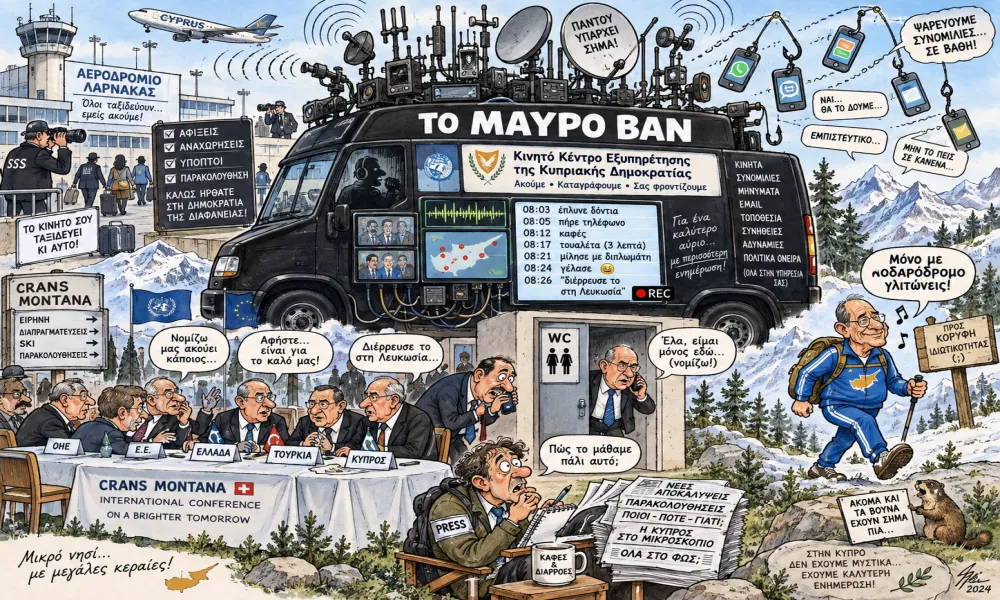

While the United Nations prepares a renewed diplomatic push through María Ángela Holguín Cuéllar’s upcoming shuttle diplomacy, the real risk may no longer be the collapse of negotiations alone, but the gradual erosion of belief that a solution is still possible.
For years, the Cyprus issue was treated as one of the international system’s “manageable frozen conflicts.” It remained unresolved, periodically revisited at diplomatic tables, yet rarely elevated into a true strategic priority. That reality is now changing fundamentally. Cyprus is no longer merely a historical dispute between two communities. The island is increasingly being pulled into the center of a much broader geopolitical fracture line.
The reason is not simply the long-standing diplomatic and military convergence pursued by the Republic of Cyprus and Greece, a strategy which at times has evolved into what critics describe as an emerging regional bloc politics. The deeper driver is the harsh realpolitik imposed by the global conjuncture itself. Following the Iran war, the Eastern Mediterranean has rapidly transformed into one of the world’s most sensitive security and logistical theaters. Energy supply security, LNG terminals, submarine data cables, military resupply corridors, port infrastructure, cyber-security architecture and the restructuring of NATO’s southern flank are now increasingly viewed as interconnected components of the same strategic equation.
Today, the Eastern Mediterranean is no longer discussed solely in terms of natural gas reserves. Europe’s post-Russia energy anxieties, emerging Gulf-Europe trade corridors, the Mediterranean extensions of Indo-Pacific rivalry, Washington’s strategic pivot toward China and Israel’s expanding security doctrine stretching from Gaza to Lebanon, Syria and Iran are all converging across the same geography.
Cyprus therefore is no longer seen merely as an “unresolved island problem.” It is increasingly viewed as a strategic platform situated at the intersection of energy security, military access, maritime control and regional influence competition.
The crises surrounding the Strait of Hormuz after the Iran war reinforced just how fragile global maritime trade routes have become. As a result, Eastern Mediterranean ports, military facilities, energy terminals and logistics networks acquired even greater strategic significance. The Greek Cypriot administration’s growing visibility inside the European Union’s emerging security architecture, alongside its expanding defense partnerships with France and other European actors, forms part of this broader transformation.
It is precisely for this reason that what unfolded at the summit of the Organization of Turkic States in Turkistan carried significance far beyond diplomatic symbolism. The issue is no longer merely the international visibility of the Turkish Cypriot people. It increasingly concerns how Cyprus itself will be positioned inside a rapidly changing regional and global order.
Erhürman’s Turkistan message
The presence of Tufan Erhürman on the same diplomatic platform as other heads of state in Kazakhstan’s historic city of Turkistan carried meaning far beyond protocol choreography. It reflected the emergence of a more systematic, institutionalized and long-term effort by Ankara and the broader Turkic world to enhance the international visibility of the Turkish Cypriot people.
Yet the more striking aspect was the substance of Erhürman’s message itself.
Erhürman reminded participants that the Turkish Cypriot side consistently demonstrated political will for a settlement, from the 2004 Annan Plan referendum to the 2017 Crans-Montana negotiations. He emphasized that the Eastern Mediterranean should become a region of cooperation rather than confrontation and argued that the continued isolation of Turkish Cypriots had become politically and morally unsustainable.
These were not merely diplomatic talking points. They reflected the emergence of a new political psychology in northern Cyprus.
What is taking shape in the north today is not a classic ideological “leftward shift.” It is better understood as a pragmatic societal repositioning driven by economic exhaustion, isolation fatigue, criticism of governance failures and growing anxiety among younger generations regarding the future.
The rise of Erhürman and the center-left therefore rests on a broader social demand extending beyond constitutional formulas alone. Turkish Cypriots are no longer discussing only federation. Increasingly, they are demanding governability, legal predictability, institutional seriousness, international connectivity and economic normalization. Permanent crisis is no longer viewed as sustainable.
Shrinking political space in the south
The political atmosphere in the south is evolving in the opposite direction.
Ahead of the May 24 elections in the Republic of Cyprus, the political center continues eroding while the far-right ELAM party steadily gains strength. Migration fears, Middle Eastern instability, energy insecurity and broader economic anxieties are pushing Greek Cypriot society toward a more defensive political posture.
Within this atmosphere, Nikos Christodoulides is navigating an increasingly dangerous political line.
On one hand, he continuously projects optimistic expectations to the public, speaking of an approaching settlement process, an enlarged conference and a strengthening UN initiative. Yet on the other hand, mounting far-right pressure prevents him from openly preparing society for the difficult realities genuine negotiations would require: political equality, power-sharing, governance mechanisms and security arrangements.
This contradiction risks trapping Christodoulides in an increasingly unavoidable political deadlock.
He is effectively selling expectations to society while avoiding the political groundwork necessary to sustain those expectations.
More importantly, the Greek Cypriot side does not yet appear to have fully internalized how profoundly the regional environment has changed.
As the Eastern Mediterranean securitizes, space for compromise narrows
The Eastern Mediterranean of today is no longer the Eastern Mediterranean of 2004 or even Crans-Montana.
In the post-Iran war security environment, maritime corridors, energy terminals, military access points, ports and digital infrastructure have acquired strategic significance on an entirely different scale. The Greek Cypriot administration is increasingly viewed not merely as a small EU member island, but as part of Europe’s southeastern security architecture.
Yet herein lies the paradox.
Every crisis that becomes securitized pushes societies further away from compromise.
While a “security first” mentality deepens in the south, the north increasingly embraces the opposite logic: without sovereign equality, there can be no lasting security.
This is why the Cyprus issue today is no longer simply about federal formulas. It has become directly connected to the future security architecture of the Eastern Mediterranean itself.
Holguín returns, but expectations remain cautious
Against this increasingly fragile backdrop, the United Nations is now preparing a renewed diplomatic effort.
UN Secretary-General António Guterres’ personal envoy María Ángela Holguín Cuéllar is expected to return to Cyprus around June 6 before continuing consultations in Ankara around June 15 and later in Athens as part of a renewed round of shuttle diplomacy aimed at assessing whether conditions exist for a possible enlarged “five-plus-one” meeting involving the island’s two sides, the three guarantor powers and the UN secretary-general.
Yet whether Holguín’s renewed contacts can realistically generate sufficient common ground for such a conference remains, for now, the one-million-dollar question.
Diplomatic sources increasingly acknowledge that while none of the parties wishes to be blamed for collapse before talks even begin, neither side currently appears politically prepared for the compromises that a meaningful negotiation process would require.
For the United Nations, the challenge is no longer merely procedural. It is strategic.
The core issue is whether enough minimum political trust still exists to justify moving toward a new conference format after years of accumulated disappointment, changing geopolitical realities and deepening societal divergence between the two communities.
The timing itself reflects the complexity of the moment. Holguín’s planned visits come precisely as the Eastern Mediterranean is entering a far more militarized and security-driven phase shaped by the aftershocks of the Iran war, expanding regional defense alignments and growing competition over maritime corridors and strategic infrastructure.
Under such conditions, diplomacy becomes simultaneously more necessary and more difficult.
Even if a five-plus-one conference eventually materializes later this summer, expectations are likely to remain significantly more restrained than during previous rounds such as Crans-Montana. Quietly, many diplomats now speak less about a historic breakthrough and more about preventing irreversible strategic drift.
What risks being lost is no longer merely a negotiating table
Years ago, following the collapse of Crans-Montana, Mustafa Akıncı issued a warning that now sounds almost prophetic. What was being lost, he argued, was not merely a negotiation round, but the very hope of a solution itself.
Today, that warning carries far greater weight. The issue is no longer only whether a federal settlement remains achievable. The deeper question is whether the two communities are gradually losing the capacity to imagine a shared future at all.
In the north, there remains a pragmatic search for settlement, integration and international normalization. In the south, however, the political atmosphere is becoming steadily more securitized, inward-looking and nationalist.
For that reason, the greatest danger today is not merely that a settlement may once again be delayed.
It is that the idea of settlement itself may slowly cease to exist as a credible political horizon. And perhaps for the first time in many years, what risks being lost in Cyprus is not simply another diplomatic opportunity, but the very possibility of a common future.