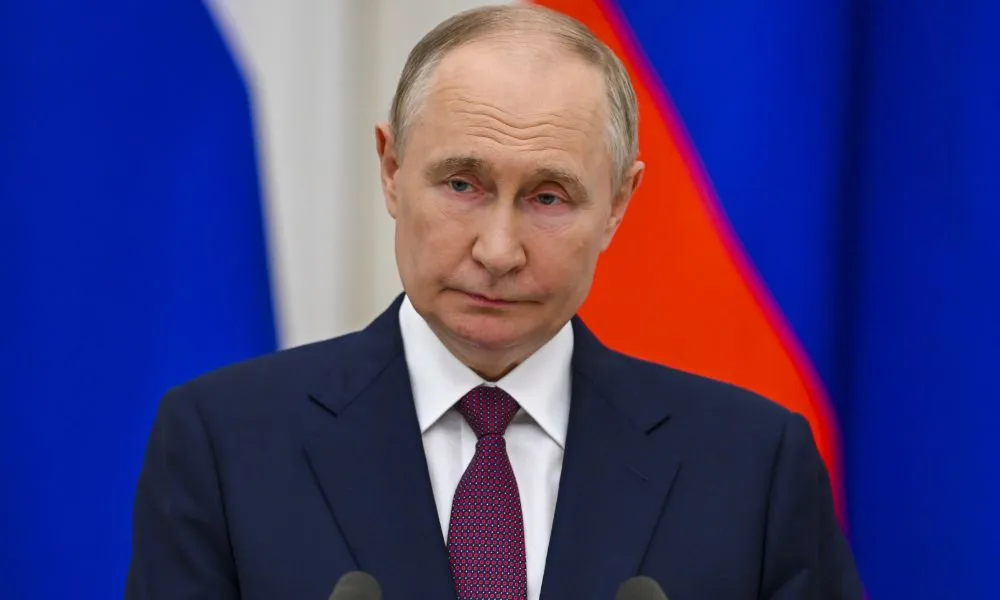

Vladimir Putin has accused today's West of pursuing the same geopolitical aims he attributes to Napoleon and the Nazis. In his reading of history, past military campaigns sought to weaken and subjugate Russia, and he argues that Western powers are now pursuing the same goal through their support for Ukraine.
At the same time, the Russian president sent an indirect but clear message to the Phanar by reviving the theory of the "Third Rome". Through it, he claims for Moscow the role of spiritual guardian of the Byzantine heritage, in direct contrast to the positions of the Ecumenical Patriarchate.
An interview for Patriarch Kirill's 80th birthday
Putin made the remarks in an interview with Emir Kusturica, the film director and two-time Palme d'Or winner. The interview was recorded for Kusturica's documentary on Patriarch Kirill of Moscow, marking the 80th birthday of the head of the Russian Orthodox Church.
The interview was published by the Kremlin on 20 November. It goes far beyond a discussion of faith and Orthodoxy, setting out at length Putin's geopolitical, historical and religious worldview.
Putin's message to Ukrainians
Asked by Kusturica what message he would like to send to Ukrainians, Putin invoked the policy of "divide and rule". He argued that whenever Russia grew stronger, forces emerged that sought to fragment and subjugate it.
He placed Napoleon's invasion, the First and Second World Wars and the Nazi invasion of the Soviet Union in the same historical framework. He went as far as to argue that ideological factors were of secondary or even tertiary importance, attributing these conflicts primarily to geopolitical interests.
After reviewing the fragmentation of ancient Rus, he linked his argument directly to Russia's current confrontation with the West.
"And what we are seeing now is the continuation of the same policy of 'divide and rule'," he said.
He accused the forces supporting Ukraine today of acting not in the interests of Ukrainians but of seeking to divide, weaken and subjugate the two peoples to serve their own interests.
Putin does not equate today's West with Nazi Germany ideologically, but he attributes the same geopolitical aims to it. This explains his effort to play down the ideological factor even in the case of the Nazi invasion. His reading sets aside both the racial and expansionist character of Nazi ideology and the fact that, in the current conflict, it was Russia that invaded Ukraine in February 2022.
Moscow as the "Third Rome"
Putin's revival of the "Third Rome" theory is of particular interest, above all for the Ecumenical Patriarchate. The idea has deep roots in the Russian imperial tradition.
"Moscow is the Third Rome, and there will be no fourth," the Russian president said.
In Putin's historical reading, after the fall of Rome and of the Byzantine Empire, Moscow became the spiritual guardian of the Christian heritage.
It is not the first time he has used the phrase. In May 2025, in a documentary shown on Russian state television marking 25 years of his leadership, Putin also stated that Moscow is the "Third Rome".
Origins of the theory
The theory dates back to the early 16th century and the Russian monk Philotheus of Pskov. His epistle to Grand Prince Vasily III, written between 1514 and 1521, proclaimed that with the fall of Constantinople, the second Rome, Moscow had become the third and last Rome.
Over the centuries, the theory acquired political and imperial dimensions, linking Orthodoxy to the notion of a special historical mission for Russia.
Bartholomew's position and the rift with Moscow
Putin's reference carries particular weight in the dispute between Moscow and the Phanar. In 2024, Ecumenical Patriarch Bartholomew rejected the "Third Rome" theory as a geopolitical construct, stressing that there are only the Elder Rome and the New Rome of Constantinople.
Bartholomew linked the "Third Rome" to the "Russian World" ideology, which he described as the main instrument for a "spiritual" legitimisation of the invasion of Ukraine. "There is only the Elder Rome and the New Rome-Constantinople," he said.
Without naming Bartholomew, Putin is reviving a theory that runs counter to the positions of the Ecumenical Patriarchate, at a time when the rift within Orthodoxy remains deep.
The Moscow Patriarchate broke communion with the Phanar in 2018 over the process of granting autocephaly to the Orthodox Church of Ukraine. The Holy Synod of the Russian Orthodox Church took the decision on 15 October 2018, after the Ecumenical Patriarchate's synod announced on 11 October that it would proceed with granting autocephaly. Bartholomew signed the tomos establishing the Orthodox Church of Ukraine on 5 January 2019.
Russian civilisation as an "ark of salvation"
Asked by Kusturica whether Russian civilisation could serve as an ark of salvation for those who believe in Christ, Putin answered without hesitation: "It can. Absolutely."
He cited cases of Europeans who have settled in Russia, he said, to raise their children according to traditional family and religious values. He acknowledged, however, that this is not a mass phenomenon.
He extended the notion of the "ark" beyond Christianity, referring to the Muslims, Jews and Buddhists living in Russia.
He also accused Western Christian churches of moving away from their traditional rules, arguing that their efforts to adapt to modern social attitudes are weakening their influence.
By contrast, he presented Orthodoxy's commitment to traditional values as the reason it continues to attract new believers.
The historical unity of Russians and Ukrainians
Putin also returned to his theory of the historical unity of Russians and Ukrainians, calling on the two peoples to join forces.
He clarified, however, that he was not necessarily referring to a single state, without specifying what form this unity might take.
He blamed Ukraine's political leadership for the country's deindustrialisation and demographic decline since the dissolution of the Soviet Union. In doing so, he sought to separate this situation from the destruction caused by Russian strikes.
Addressing Ukrainian soldiers, he deliberately avoided the word "surrender", which he described as humiliating for people who are still fighting. He called on them, however, to cross over to Russia's side, which he presented as the right side of history.