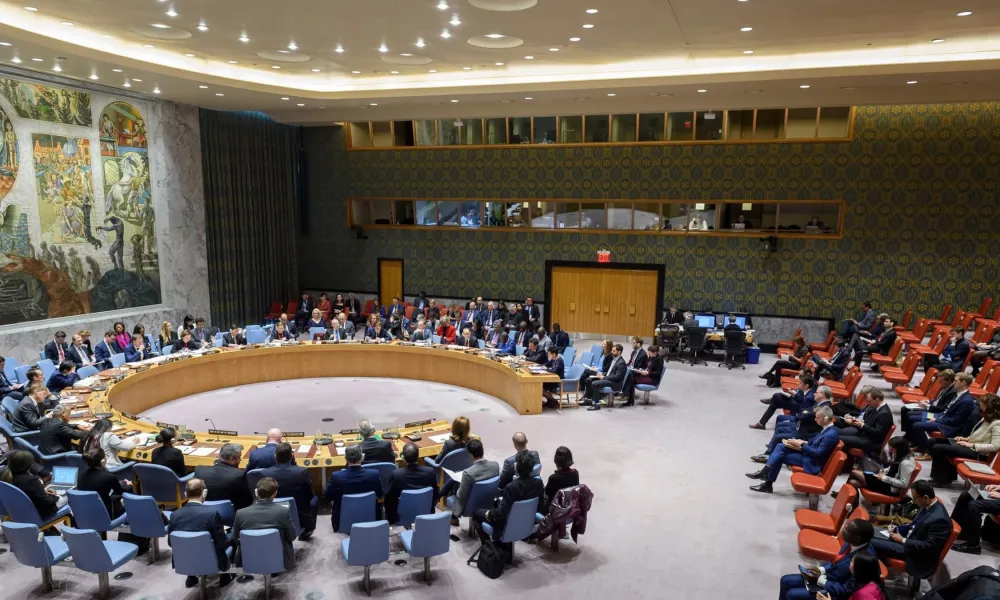

The race to become the next United Nations Secretary-General remains highly competitive, with a seventh informal ballot of the UN Security Council set to take place on Friday under the presidency of Greece.
The latest round follows the entry of Lana Zaki Nusseibeh of the United Arab Emirates, bringing the total number of candidates to seven.
The ballot is scheduled for 1.30pm New York time and will be conducted using unified ballot papers, without distinguishing between votes cast by the council's five permanent members and its ten elected members.
The move marks a return to the procedure used before the sixth round, during which colour-coded ballots were used to separately identify the positions of permanent members.
Informal polls are designed to measure levels of support before the Security Council submits its formal recommendation to the UN General Assembly, which appoints the Secretary-General under Article 97 of the UN Charter.
Vote counting will be overseen by Latvia and the United Kingdom.
Seven candidates in the running
The candidates expected to participate are:
- Ivonne A-Baki (Ecuador)
- María Fernanda Espinosa Garcés (Ecuador)
- Rafael Mariano Grossi (Argentina)
- Rebeca Grynspan (Costa Rica)
- Lana Zaki Nusseibeh (United Arab Emirates)
- Olara Otunnu (Uganda)
- Carolyn Rodrigues-Birkett (Guyana)
Former Senegalese president Macky Sall withdrew his candidacy on 17 October after receiving five encouragement votes and ten discouragement votes in the sixth round, including three from permanent Security Council members.
Scrutiny over Nusseibeh's late entry
Nusseibeh was officially nominated by the UAE on 21 October and addressed both the General Assembly and Security Council this week to present her vision for the organisation.
According to reports from Security Council Report, the decision to revert to unified ballots was discussed after her Security Council dialogue.
The Bahrain, Russia and the United States reportedly favoured retaining colour-coded ballots, while most council members supported the return to a single-ballot system.
Diplomats from Colombia and Panama reportedly argued that Nusseibeh had not been tested through the same number of voting rounds as other candidates and expressed concerns that entering directly at the colour-coded ballot stage could have raised questions of transparency and fairness.
There have also been questions regarding her independence because of the UAE's positions on issues including Somaliland and the conflict in Sudan.
Responding to such concerns, Nusseibeh cited Article 100 of the UN Charter, stressing that the Secretary-General must remain independent of national governments.
Latin America pushes regional claim
Countries of CELAC, the Community of Latin American and Caribbean States, continue to argue that it is now their region's turn to hold the UN's top diplomatic post.
The group reiterated that position in a joint statement before Nusseibeh's appearance before the General Assembly.
No consensus candidate yet
The sixth voting round failed to produce a clear favourite among the permanent members of the Security Council.
Rebeca Grynspan, Carolyn Rodrigues-Birkett and Rafael Mariano Grossi each received two discouragement votes from permanent members.
Grynspan and Rodrigues-Birkett each secured three encouragement votes from permanent members, while Grossi received two encouragement votes and one neutral vote.
Rodrigues-Birkett recorded the strongest improvement compared with the fifth round, gaining three additional encouragement votes while reducing discouragement votes by the same number.
Grynspan and Grossi also improved their standings, but none of the candidates has yet secured the level of support normally associated with an emerging consensus candidate.
Turkish candidacy reportedly possible
Official results from Friday's vote are not expected to be released publicly.
Greek UN ambassador Aglaia Balta, in her capacity as president of the Security Council for October, is expected only to confirm that the ballot took place.
As in previous rounds, however, voting figures are widely expected to leak shortly afterwards.
According to reports, Turkey may also decide next week whether to put forward the candidacy of Feridun Sinirlioğlu, depending on the outcome of the latest informal vote.
The possible entry of the veteran Turkish diplomat could further complicate an already crowded and highly competitive contest to succeed the current UN Secretary-General.
Source: ANA-MPA