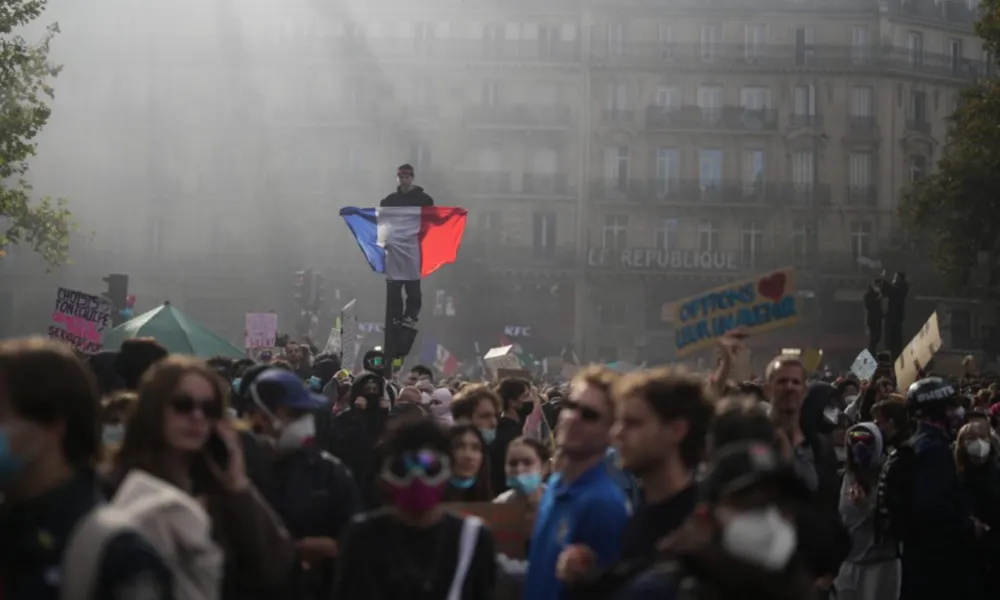

Fresh protests began in France on Saturday, 24 October, with early reports suggesting police intervention in Lyon as authorities prepared for another day of demonstrations across the country.
According to a post by the Conflict Monitor account on X, police were attempting to disperse demonstrators in the city. The report has not yet been independently verified.
In Paris, between 60,000 and 120,000 people are expected to take part in the latest demonstrations, according to police intelligence estimates reported by French newspaper Le Monde.
Hundreds of rallies have been planned nationwide, involving trade unions, university students, school pupils and the Yellow Vests movement, as discontent continues to spread over education, the cost of living, public services and social inequality.
Paris court rejects challenge to march route
The Administrative Court of Paris rejected a legal challenge brought by protest organisers on Saturday morning against the police decision to change the planned route of the capital's demonstration.
An initial agreement between trade unions and police had provided for a gathering at Place de la Bastille, followed by a march towards Place de la Nation.
🇨🇵Protests have started again in France. Police are trying to disperse the demonstrators gathered in Lyon. #France #Paris https://t.co/OP2a2amShW
— Conflict Monitor (@ConflictM0nitor) October 24, 2026
However, the Paris Police Prefecture announced on Friday that the route would be prohibited on public safety grounds. Authorities instead proposed an alternative route from Porte d'Italie to Porte de Vincennes, along the outskirts of the capital.
Following the court's ruling, the alternative route remains the only authorised option, according to Le Monde. The demonstration is permitted to take place between 1pm and 7pm local time.
Trade unions have criticised the last-minute change, arguing that it was imposed despite their previous agreement with the authorities. Representatives of the General Confederation of Labour (CGT) said the revised route would be more difficult to police and could cause confusion among demonstrators.
Thomas Vassern, a CGT official, told French broadcaster BFM-TV that trade unions were consulting on how to proceed following the court's decision.
🇫🇷🚨Breaking: Hours before the new protests, many opticians, clothing stores, and banks are barricading themselves, as here in the 9th arrondissement of #Paris , #France https://t.co/777GXEKL9G
— World_Breaking_News03 (@Breaking2003) October 23, 2026
Left-wing parties challenge restrictions on protests
The dispute over the demonstrations has also taken on a political dimension, with parties on the French left criticising restrictions on public gatherings.
According to Le Parisien, seven left-wing parties, including the Socialists, France Unbowed, the Greens and the Communist Party, had appealed to the Council of State over President Emmanuel Macron's remarks concerning restrictions on demonstrations not organised by trade unions.
The Council of State rejected the appeals on Friday evening, ruling that the president's statements did not, in themselves, constitute a binding decision imposing a general ban on demonstrations.
🚨🇫🇷 PAU : Les manifestants sont dispersés par les forces de l’ordre à l’aide de grenades. https://t.co/ZtMcM2YocD
— Cpasdeslol (@cpasdeslol_X) October 24, 2026
It also clarified that local prefects must assess potential threats to public order on a case-by-case basis before deciding whether to prohibit a protest.
70,000 police officers and gendarmes deployed
The French government has deployed approximately 70,000 police officers and gendarmes nationwide, an increase of 10,000 compared with the previous Saturday.
According to Reuters, the security operation includes specialised police units, armoured vehicles, helicopters and water cannon, as authorities seek to prevent a repeat of the previous week's unrest.
Officials are particularly concerned about a recurrence of the violence seen on 17 October, when more than 550,000 people took part in demonstrations across France, according to official figures.
Tensions are escalating in Lyon, France, as police and protesters clash in the streets. Authorities face a challenging situation as unrest unfolds. Further developments are awaited. 🇫🇷 #France #Lyon #BreakingNews #FranceNews #Protests https://t.co/DjS8gLbygM
— Gianl1974 (@Gianl1974) October 24, 2026
The protests were accompanied by widespread destruction, with authorities reporting that more than 3,000 shops were damaged or looted.
Businesses and cultural institutions take precautions
The demonstrations initially grew out of school pupils' protests over problems in the education system but have since developed into a broader movement reflecting social and economic discontent.
Participants have raised concerns about rising living costs, pressure on public services and social inequality, bringing together a range of groups in demonstrations across the country.
« Une manœuvre de police est en cours pour vider la place de la bastille de tout piéton. Quittez les lieux ». 12h13 https://t.co/TynSAwkfpT
— Laurent Valdiguié (@Valdiguie) October 24, 2026
In Paris, several businesses have introduced additional protective measures ahead of the protests. Major cultural institutions, including the Louvre and the Musée d'Orsay, have also suspended operations amid the demonstrations.
With thousands of security personnel on duty and large crowds expected in the capital, authorities are seeking to contain tensions and prevent further damage as the latest wave of protests unfolds.
🚨 PARIS: Police flood Place de la Bastille, where protests were banned last night. Protesters were ordered out and pushed toward Place d'Italie, the only authorized site. This follows the violent riots of October 17. More to come. Follow us on X. https://t.co/sl4j6vsskq
— Alexandra Lavoie (@ThevoiceAlexa) October 24, 2026