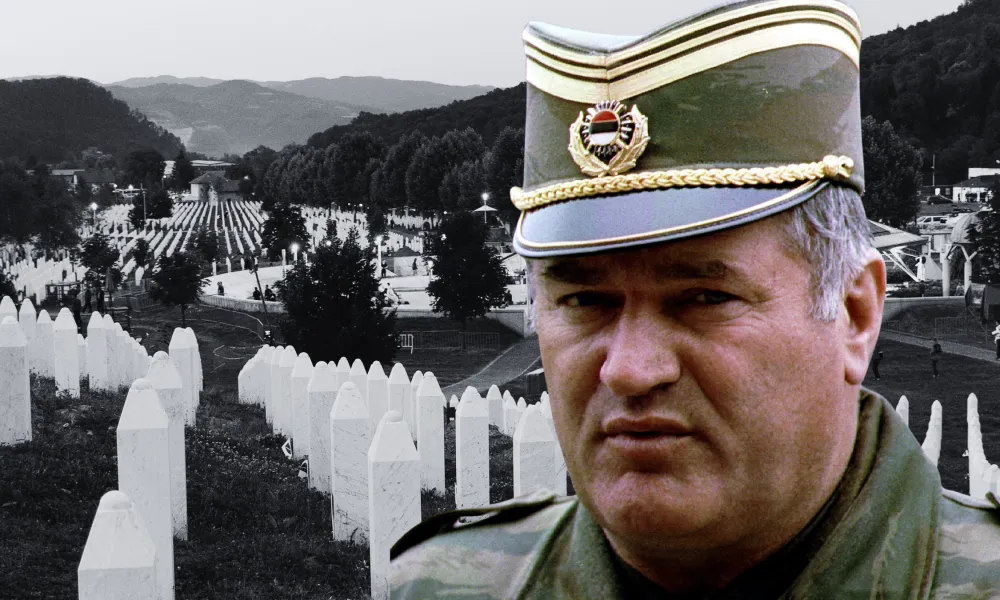

Ratko Mladic, the former Bosnian Serb general known as the Butcher of Bosnia and held responsible for the killing of around 8,000 Muslim men and boys at Srebrenica in 1995, has died at the age of 83, The New York Times reported, citing Serbian state media, which announced his death on Thursday.
According to the newspaper, Mladic was captured in May 2011 in a farming village north of Belgrade after nearly 16 years as a fugitive, in one of the longest manhunts in modern history. He was convicted by an international tribunal in 2017 on charges of genocide, crimes against humanity and war crimes, and sentenced to life in prison. Presiding judge Alphons Orie said at the time that Mladic's crimes ranked "among the most heinous known to humankind." Mladic appealed the verdict, which was upheld in 2021, the newspaper reported.
Rise during the Balkan wars
The New York Times recounted how the Balkan wars erupted as Yugoslavia broke apart into independent states, with Serbian nationalist leader Slobodan Milosevic seeking to build a Greater Serbia and reigniting old ethnic and religious divisions in wars pitting Serbs against Slovenes, Croats, Bosnian Muslims and Kosovo Albanians. Roughly 100,000 people died in the conflict and more than 2.5 million were displaced, the newspaper said.
Mladic, an officer in the Yugoslav People's Army, led Bosnian Serb forces from the early 1990s. According to the newspaper, on the eve of the Srebrenica massacre he vowed to avenge the Ottoman conquest of Serbia centuries earlier. Over the course of ten days, his soldiers hunted down, captured and summarily executed thousands of Bosnian Muslims, binding their hands before shooting them, while women were raped and international calls for restraint went unheeded. Serb forces later exhumed and rescattered the remains in an organised effort to conceal evidence of the killings, the newspaper reported.
Trial and conviction
Mladic's trial was among the last major proceedings at the International Criminal Tribunal for the Former Yugoslavia in The Hague, which tried nearly 100 people over Balkan wars atrocities, including Mladic's superior, Bosnian Serb political leader Radovan Karadzic. Karadzic, arrested in 2008, was convicted in 2016 on similar charges, with his sentence extended to life in prison three years later, The New York Times noted.
The newspaper described Mladic's arrest as a significant moment in Serbia's effort to move past its status as a pariah nation, removing an obstacle to its long-pending EU accession bid. When finally located, he was found hiding in a cousin's house and reportedly in such financial difficulty that he repeatedly asked for his frozen military pension to be restored.
According to the newspaper, Mladic appeared visibly diminished during his trial, his right arm impaired by strokes suffered while a fugitive, leaving him unable to take notes as witnesses gave harrowing testimony. Flashes of his old defiance remained, however. At his first court appearance in June 2011 he dismissed the charges as "obnoxious" and "monstrous," and he was later removed from a session after shouting at the judges.
In addition to Srebrenica, the newspaper reported that Mladic was convicted over the nearly four-year siege of Sarajevo, in which 10,000 people died, including 1,500 children, with his forces shelling the city from surrounding hills and terrorising residents with sniper fire, in what The New York Times described as the longest siege in modern warfare. Judges also found him guilty of persecuting and exterminating non-Serbs across large parts of Bosnia.
A legend to some, a monster to others
Within Serbia, the newspaper said, Mladic's military reputation remained legendary, with his biographer, Ljiljana Bulatovic, describing him as regarded by many Serbs as "the mythical protector of the Serbian people." But the scale of the crimes attributed to him, and the suffering inflicted on Bosnians and Croats driven from land intended for Serbs, provoked international outrage and a $14 million bounty for his capture, never claimed after Serbian investigators seized him themselves, according to the newspaper.
A former general who served under him, Ratko Skrbic, later attributed his endurance as a fugitive to a military code that forbade surrender, the newspaper reported.
Early life and personal tragedy
The New York Times reported that Mladic was born into poverty in the village of Bozanovici on 12 March 1943, then part of the Nazi-aligned Independent State of Croatia. His father, a Serb partisan fighter, was killed when Mladic was a toddler, leaving his mother to raise him and his two siblings, an experience the newspaper said instilled in him a lasting fear that Serbs would face persecution unless they held power. He trained as a metalworker before pursuing a military career, rising quickly through the Yugoslav army.
According to the newspaper, Mladic initially embraced Josip Broz Tito's brand of communism, which rejected nationalism in favour of Yugoslav unity, before aligning himself with Milosevic's nationalist cause as Yugoslavia began to fracture in the early 1990s. His forces began the siege of Sarajevo in 1992, a month after Bosnia declared independence.
The newspaper reported that in 1994, Mladic's daughter, Ana, a medical student in her early twenties, took her own life using his military pistol, reportedly distraught over her father's actions in the war. A family friend who performed her autopsy said Mladic asked him to cut a lock of her hair and remove the bullet from her head as keepsakes, and friends said he was never the same afterwards, with Zoran Stankovic recalling that he never again saw "brightness in his eyes, only sadness."
Chilling warnings before the massacre
The New York Times recounted an episode before the Srebrenica killings in which Mladic summoned the Dutch commander of the UN peacekeeping force protecting the town's Muslim population and had his men slit the throat of a tied-up pig in front of him, declaring, "That's how we deal with our enemies." Days later, with cameras rolling, his bodyguards distributed sweets to Bosnian Muslim children as he reassured terrified women and children that no harm would come to them, even as his soldiers prepared for the mass killings that followed.
According to the newspaper, the international outcry after the massacre prompted a NATO bombing campaign that broke Bosnian Serb resistance and led to the Dayton Accords ending the war in December 1995, though conflict in the former Yugoslavia resumed in 1998 over Kosovo. The Hague tribunal indicted Mladic on genocide and war crimes charges that same year.
The New York Times reported that Mladic, protected for years by Milosevic and later by allies in Serbia's military and intelligence services, moved between barracks and continued visiting his daughter's grave for several years while evading capture, appearing in public on at least one occasion, at a football match in Belgrade in 2000. Milosevic's fall from power that year, and his subsequent arrest and transfer to The Hague, where he died in 2006 before his trial concluded, left Mladic increasingly isolated, the newspaper said.
He is survived by his wife, Bosiljka, and son, Darko, who had unsuccessfully sought to have him declared dead during his years as a fugitive, according to the newspaper. When he was finally captured, he was found alone with two loaded pistols and surrendered without resistance, reportedly telling the arresting officers, "I'm the one you've been looking for."
Source: The New York Times