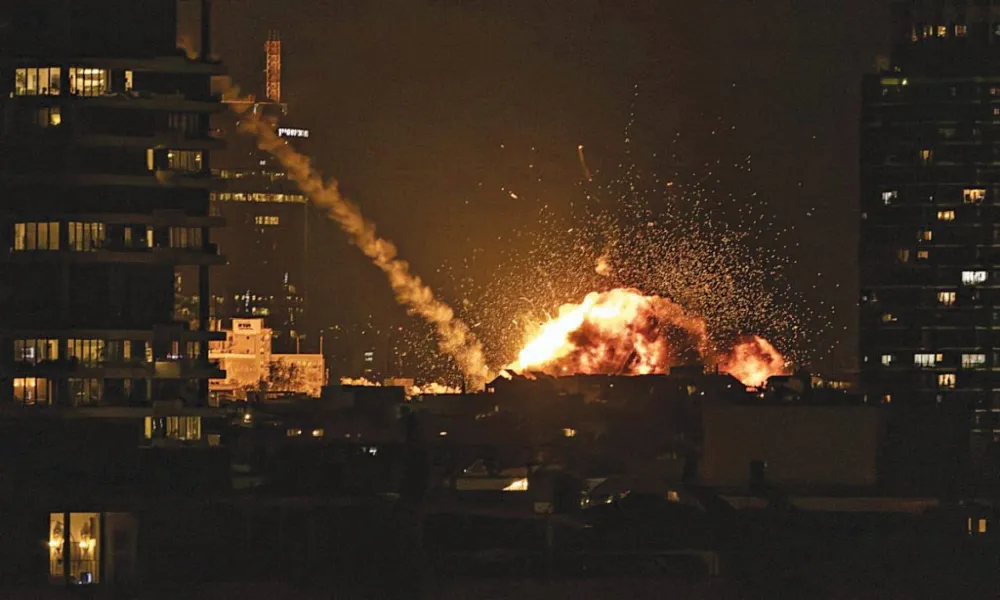

The military confrontation between the United States and Iran is entering a dangerous new phase, with both sides carrying out significant attacks and retaliation across the region.
Iran's Atomic Energy Organisation announced that the United States struck the Darkhovin nuclear power plant, currently under construction in southwestern Iran, on Sunday.
In a statement carried by state television, the organisation said US forces had attacked the facility with a number of missiles, describing the strike as an aggressive act that violated international law.
The attacks formed part of what the US military described as its eighth consecutive night of operations against Iran.
According to the US Central Command (CENTCOM), the strikes targeted Iranian coastal surveillance facilities, air defence systems and members of the Islamic Revolutionary Guard Corps (IRGC) linked to attacks on American personnel in Jordan on 17 July.
Earlier, Washington announced a new wave of airstrikes against Iran aimed at punishing the Revolutionary Guards following the deaths of two US soldiers in Jordan on Friday.
CENTCOM said the strikes were ordered by US President Donald Trump and were intended to further degrade Iran's ability to threaten commercial shipping in the Strait of Hormuz.
Iranian news agencies MEHR and Tasnim reported American bombardments in Sirik, a port city near the Strait of Hormuz, while state news agency IRNA reported a strike near Hajiabad in Hormozgan province.
On Saturday, CENTCOM confirmed the deaths of two American soldiers, the first known US military fatalities since hostilities resumed on 7 July. A third service member remains missing following what Washington described as an Iranian missile and drone attack in Jordan.
According to official US figures, the number of American military personnel killed since the outbreak of the regional conflict on 28 February has risen to 16.
'Unforgettable lessons'
Iran's Supreme Leader Mojtaba Khamenei warned that Tehran and what he described as the "axis of resistance" would deliver "unforgettable lessons" to the United States.
In a message broadcast by state television, he said repeated violations by Washington of the Islamabad Memorandum of Understanding, signed on 17 June to secure a ceasefire, demonstrated that "the signature of the American president carries no value."
According to Iran's Health Ministry, US airstrikes have killed at least 50 people and injured more than 500 since 27 June.
On Saturday, Tehran announced that it had struck a military airbase used by the United States in Jordan, as well as military facilities and civilian infrastructure in Kuwait. Bahrain, home to the US Fifth Fleet headquarters, was also reportedly targeted.
Damage reported in Kuwait
Iran's military said on Sunday it had attacked two military bases in Kuwait in retaliation for US strikes.
State television reported large-scale drone attacks against a US ammunition depot at Camp Udairi, as well as radar and Patriot air-defence systems at Ali Al Salem Air Base.
Kuwaiti authorities said the attacks caused serious damage to a strategically important oil installation and knocked out a desalination and power-generation facility.
Tensions remain high in Hormuz
Alongside the exchange of airstrikes, tensions continue to simmer in the Strait of Hormuz.
Although the reopening of the vital maritime corridor was a key achievement of the 17 June agreement, commercial shipping traffic has once again slowed dramatically.
The Revolutionary Guards warned that operations would continue until what they described as calm is restored along Iran's southern coast and in the Strait of Hormuz.