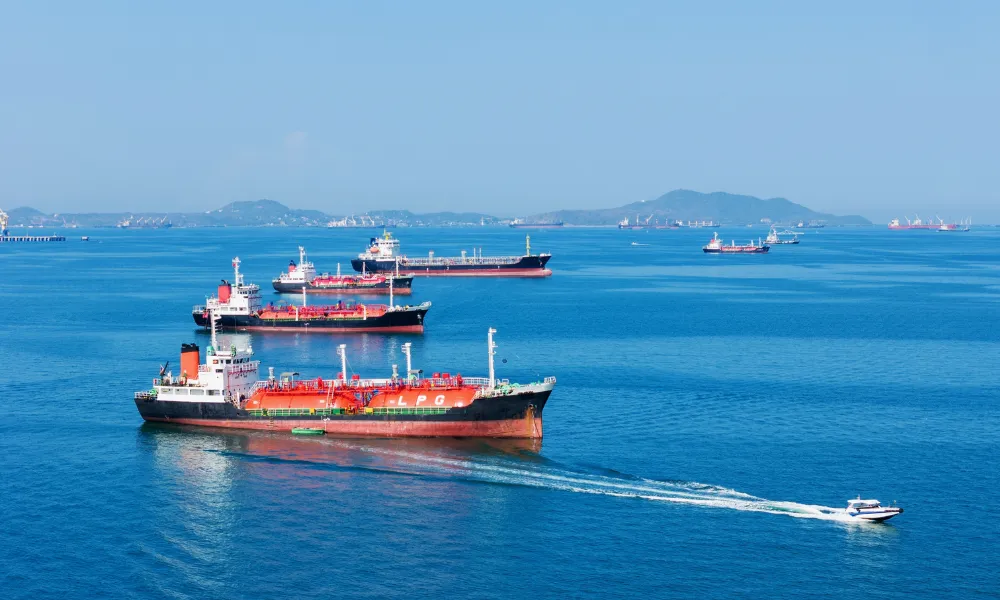
Iranian media are claiming that a last-minute change to the US-Iran framework agreement inserted language that could allow Tehran to collect fees linked to shipping services in the Strait of Hormuz, one of the world’s most important energy routes.
The semi-official Fars news agency, citing an unnamed source, reported that the wording of the memorandum of understanding was amended in the final minutes of negotiations to underline “clearly and unequivocally” what it described as Iranian-Omani sovereignty over the strait. According to Fars, the reference to “maritime services” in the final text means that the United States has accepted a mechanism under which fees would be paid to Iran.
The claim has not been independently confirmed and no official US text has yet been published. It also appears to sit uneasily with comments by US President Donald Trump, who said the agreement would allow the full reopening of the Strait of Hormuz without transit fees, once the deal is formally signed and the area is cleared of mines.
A fragile opening after months of war
The dispute over the wording comes after Washington and Tehran confirmed that they had reached a preliminary agreement aimed at ending the war in the Middle East, including military operations linked to Lebanon. Pakistan, which played a key mediation role, was the first to announce the breakthrough, before both the US and Iran publicly confirmed it.
The signing ceremony is expected to take place in Geneva on June 19. Trump said the agreement with Iran was now “completed”, while Iranian Deputy Foreign Minister Kazem Gharibabadi told state television that the deal provides for the immediate end of war and military operations on various fronts. He added that negotiations on a final settlement are due to begin within 60 days.
Those talks are expected to focus on sanctions relief, Iran’s nuclear programme, reconstruction and economic development, as well as the creation of a monitoring mechanism to ensure that commitments are implemented. Iranian media have also reported that the framework includes the release of $24 billion in frozen Iranian funds during the negotiation period, although this has not been officially confirmed.
International reaction and Israeli unease
UN Secretary-General Antonio Guterres welcomed the agreement as a critical step towards a peaceful resolution of the conflict. European governments also signalled readiness to consider easing some sanctions, provided Iran takes clear and verifiable steps on its nuclear programme.
The announcement helped ease pressure on oil markets, which had surged after the Strait of Hormuz was closed during the war. Under normal conditions, the route carries around a fifth of the world’s oil and gas flows, making its reopening central not only to the region but also to the global economy.
Israel, however, remains deeply wary of any compromise that does not address its concerns over Iran’s nuclear and missile programmes. Israeli Defence Minister Israel Katz warned that Israeli forces would not withdraw from areas they control in Lebanon and said Israel would respond if Iran attacked in connection with events there.
Trump also criticised an Israeli strike in southern Beirut shortly before the agreement was announced, telling Axios he was angry over the timing of the attack and had raised the issue directly with Prime Minister Benjamin Netanyahu.
The agreement is now expected to dominate discussions at the G7 summit in Evian, France, where leaders will examine its implications for Lebanon, the reopening of Hormuz and the prospects for a broader deal on Iran’s nuclear and ballistic missile programmes.
Source: AMNA