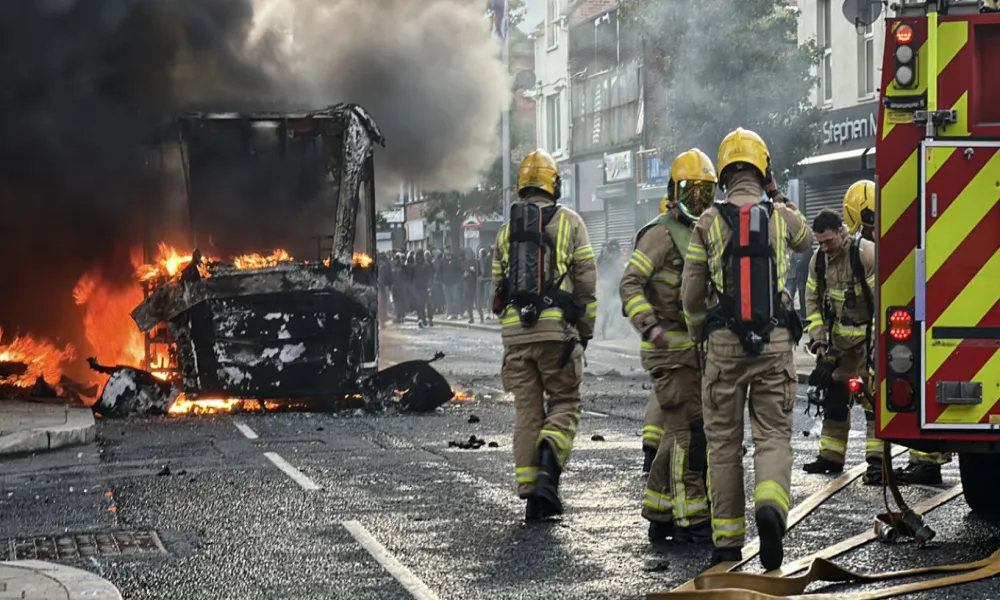
Scenes of widespread violence and arson unfolded on Tuesday night in Belfast and other parts of Northern Ireland, just hours after a 30-year-old Sudanese man was charged with attempted murder following a brutal knife attack on another man.
Angry demonstrators set fire to a bus, homes and vehicles, while houses occupied by migrants were targeted, with families being evacuated from their homes under police protection. Political leaders condemned the incidents, describing them as racist violence and calling for restraint, as the case against the alleged attacker proceeds to court on Wednesday. Charges include attempted murder, possession of a bladed weapon in a public place and making threats to kill.
Tensions began to subside shortly after 2am on Tuesday.
🚨 BREAKING: A bus has been set on fire in Belfast amid protests over the attempted beheading of a man pic.twitter.com/FX8maCMalK
— Politics UK (@PolitlcsUK) June 9, 2026
Scenes from Belfast
Despite calls from authorities for calm, hundreds of people took to the streets of Belfast on Tuesday night. Many were masked and attacked houses where migrants were living.
🚨WOW: In Belfast masked men burn a Glider bus to the ground on Newtownards Road, East Belfast.
— The British Patriot (@TheBritLad) June 9, 2026
The police have been deployed across the city. pic.twitter.com/JBwbwnZj1i
Protesters set fire to bins and threw objects at police van, before later torching cars and a bus that was engulfed in flames. No injuries were reported in those incidents.
Videos posted on social media show rioters entering multi-occupancy migrant housing (Houses in Multiple Occupation – state-supported accommodation for asylum seekers) and setting them on fire. Fires were reported in several parts of the city.
A large group rioters is attacking migrant HMOs (Houses in Multiple Occupation, a form of taxpayer-funded housing for asylum seekers) in Belfast. pic.twitter.com/o9yjynArd4
— Visegrád 24 (@visegrad24) June 9, 2026
In an eastern Belfast neighbourhood, the BBC reported that around 100 masked individuals moved through the streets, smashing doors and windows while shouting that they were “driving out foreigners.”
Anti-immigration protests were also reported in other UK cities, from London to Glasgow.
Despite extensive efforts by firefighters, several migrant homes were completely destroyed.
BREAKING:
— Visegrád 24 (@visegrad24) June 9, 2026
Rioters are breaking into migrant HMOs (Houses in Multiple Occupation, a form of taxpayer-funded housing for asylum seekers) in Belfast and setting them ablaze.
It’s a difficult night for firefighters in Belfast with fires reported in several parts of the city. pic.twitter.com/lOlgBXzOH7
🚨🇬🇧 At Parliament Square, people have began chanting ‘England For The English.’
— VoxPopuli (@vpopulimedia) June 9, 2026
Protests have erupted across the UK after a Sudanese migrant attempted to behead a 40-year-old man in Belfast. pic.twitter.com/ae4VssSx22
The attack: graphic footage
The incident took place at 22:30 on Monday in north Belfast. It remains unclear exactly what led to the attack, but the suspect was found standing over the victim, who was lying in the middle of the road, with a knife at his throat.
Footage of the attack shows the suspect raising his arm and shouting at passers-by. Authorities praised members of the public who intervened at personal risk to assist the victim and restrain the attacker.
The attack was ultimately stopped by bystanders.
Protestors are now setting cars on fire and hijacking them in Belfast. pic.twitter.com/PjZS6sZLc4
— WarMonitor🇺🇦🇬🇧 (@WarMonitor3) June 9, 2026
What we know about the suspect and victim
At a press conference on Tuesday afternoon, it was confirmed that the victim, a man aged between 40 and 50 whose identity has not been disclosed, is in serious condition with injuries to his eyes, back and face caused by a knife.
Witnesses said the victim was heard screaming before being taken to hospital by ambulance with his head covered in bandages. A kitchen knife, believed to be the weapon used, was found near the scene.
Authorities say there is no indication that the attack was terrorism-related, though they acknowledge that questions remain.
The suspect is reportedly aged between 30 and 40, of Sudanese origin, and holds a UK residence permit. He is believed to live near the area where the attack occurred. He previously lived in Dublin, Ireland.
It is believed that – at an unspecified time – he travelled from Sudan to Paris, then from Paris to Dublin, before taking a bus to Belfast in February 2023. He immediately applied for asylum and was later granted permission to remain in the UK in September 2023.
Previous incidents
Similar unrest occurred in Northern Ireland in 2024 and 2025.
In August 2024, the trigger was the killing of three girls by a young man of Rwandan origin. Migrants and minority-owned businesses were targeted.
Last year in Ballymena, widespread unrest followed the sexual assault of a teenage girl by two 14-year-old boys from Romania. Masked individuals again attacked migrant homes and vehicles. More than 100 people were arrested, while around two-thirds of the Roma population in the area left.
The charges against the boys were later dropped.