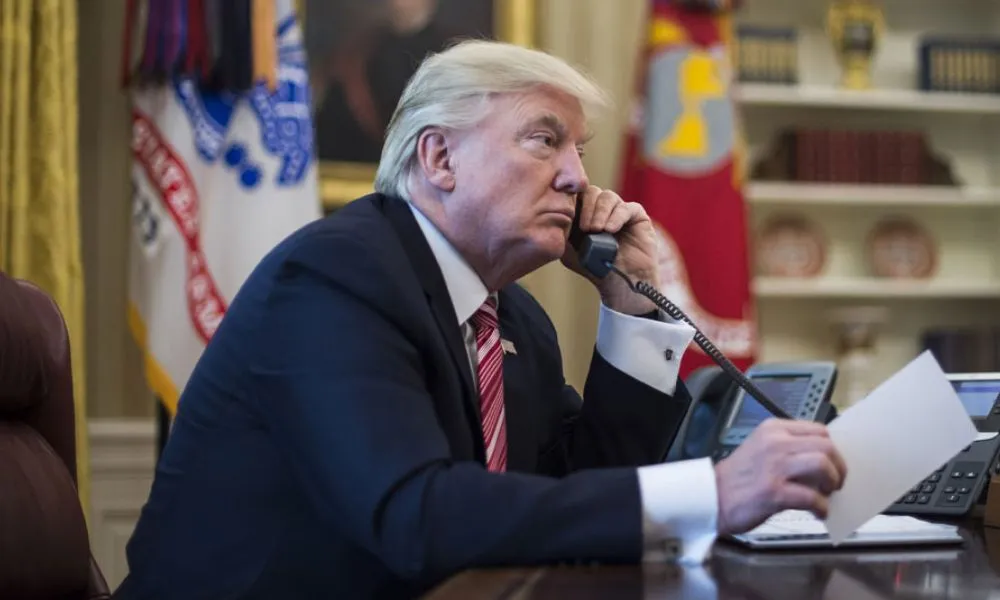
Iran has ruled out revising its proposals in an effort to reach a compromise to end the war in the Middle East, prolonging the diplomatic deadlock after US President Donald Trump dismissed Tehran’s position as “completely unacceptable.”
“There is no alternative option other than the acceptance of the rights of the Iranian people, as outlined in the 14‑point proposal. Any other approach will be entirely futile,” said Mohammad Bagher Ghalibaf, chief negotiator of the Islamic Republic, in a post on X. His comments came more than a month after the declaration of a fragile ceasefire.
There is no alternative but to accept the rights of the Iranian people as laid out in the 14-point proposal.
— محمدباقر قالیباف | MB Ghalibaf (@mb_ghalibaf) May 11, 2026
Any other approach will be completely inconclusive; nothing but one failure after another.
The longer they drag their feet, the more American taxpayers will pay for it.
Ghalibaf, a former major general in the Revolutionary Guards and now Speaker of Parliament, warned that “the longer the Americans drag their feet, the higher the price US taxpayers will pay,” pointing to persistently high oil prices.
His remarks appeared to respond directly to Donald Trump’s rejection of Iran’s counter‑proposal, with the US president likening the ceasefire in place since 8 April to a patient “on life support.”
The content of Washington’s initial proposal to Tehran has not been made public. According to media reports, it included a draft agreement to end hostilities that have claimed the lives of thousands of people, the majority in Iran and Lebanon, since the war began on 28 February, as well as a framework for negotiations on Iran’s nuclear programme.
Tehran’s demands and regional tension
In its response, Tehran demanded an immediate end to the war across the region, including in Lebanon, where exchanges of fire between the Israeli army and the Shiite movement Hezbollah continue, despite a separate ceasefire theoretically being in effect.
Iran also called for the lifting of the blockade of its ports by the US Navy and the release of Iranian funds frozen abroad, according to the foreign ministry.
On the other side, President Trump warned on Monday that he could order the resumption of escort operations for commercial vessels seeking to transit the Gulf via the Strait of Hormuz, which Iran has effectively shut down.
Despite Trump’s repeated assurances that Iranian armed forces have been severely weakened by US‑Israeli strikes, Tehran retains significant missile capabilities, according to US intelligence officials speaking anonymously to the New York Times. Iran reportedly keeps 30 of its estimated 33 missile launch installations operational along the Strait of Hormuz and has preserved roughly 70 per cent of its pre‑war missile arsenal.
Oil prices and humanitarian toll
The prolonged paralysis in the Strait of Hormuz, a strategic maritime artery for global energy trade, has further driven up fuel prices, with Brent crude approaching $108 per barrel around midnight.
“Iran must not use the strait as a weapon to exert pressure,” said Qatar’s Prime Minister Sheikh Mohammed bin Abdulrahman al‑Thani, whose country is particularly affected by the blockade.
Thomas Juneau, a professor at the University of Ottawa, said Tehran appears to believe Trump will lose patience as fuel prices rise ahead of the US midterm elections on 3 November. Meanwhile, according to the Pentagon, the cost of the war is nearing $29 billion.
In Lebanon, the other main theatre of the conflict, the Health Ministry reported on Tuesday that 13 people, including a soldier and two rescuers, were killed in Israeli air strikes on three locations in the south of the country. Five people were killed in a strike on Nabatieh, among them two civil defence members. Four others were killed in Zibtsit, including a soldier and a Syrian national, while four civilians, including a woman and a child, were killed and 12 injured in an attack on Bint Jbeil.
Before the latest strikes, Lebanon’s Health Ministry said at least 380 people had been killed and 1,122 injured since 17 April, when a ceasefire was announced. Israel has reported the deaths of five soldiers in fighting in southern Lebanon.
Diplomatic efforts stall
New talks, intended to pave the way for peace negotiations, are scheduled for Thursday and Friday in Washington between the two governments. However, Hezbollah Secretary General Naim Qassem said the issue of disarming the group, as demanded by Israel, will not be discussed “in negotiations with the enemy.”
Attention has now turned to Beijing, where President Trump is expected to meet Chinese President Xi Jinping. The US administration says it intends to press China, Iran’s main importer of oil, to use its influence on Tehran.
Trump initially said he expected a “long discussion” with Xi about the war, before backtracking minutes later, saying, “We have many things to discuss. And I would not say Iran is one of them.” He also insisted he does not need Beijing’s help regarding Iran.
Meanwhile, Chinese Foreign Minister Wang Yi urged Pakistan to intensify its mediation efforts between the United States and Iran, while reaffirming Beijing’s support for the initiative. Pakistan’s Foreign Ministry said both sides stressed the importance of maintaining a lasting ceasefire and ensuring safe navigation through the Strait of Hormuz.
The diplomatic process mediated by Pakistan has reached an impasse.
Regional escalation revealed
Reuters reported on Tuesday, citing western officials and Iranian government sources, that Saudi Arabia carried out numerous previously undisclosed air strikes against Iran in late March, in retaliation for Iranian attacks. If confirmed, this would mark the first known instance of direct Saudi military action against the Islamic Republic.
It remains unclear what the targets were. Riyadh did not confirm the operations when asked for comment, while Iran’s foreign ministry also declined to respond.
The Wall Street Journal reported that the United Arab Emirates also conducted strikes against Iran, indicating that the conflict gradually acquired a broader regional dimension.
Iran’s foreign ministry additionally condemned the arrest of four Iranians in Kuwait, who allegedly “confessed” to being members of the Revolutionary Guards, claiming they entered Kuwaiti waters accidentally due to a navigation system malfunction. Tehran also denied Kuwaiti claims that it was planning hostile actions against the country.
Source: CNA