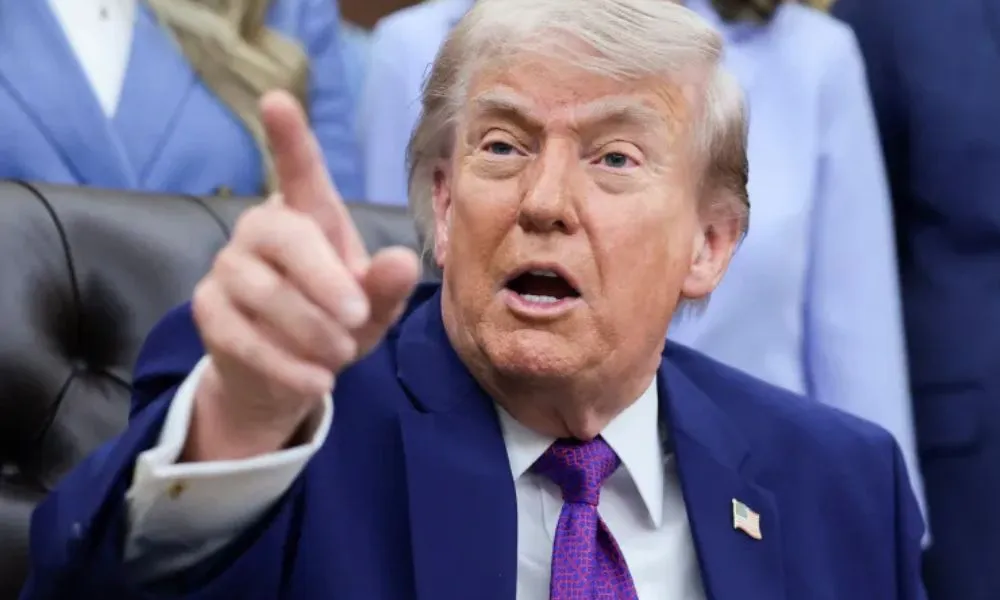
Donald Trump said yesterday that the ceasefire between the United States and Iran is “on life support,” sharply criticising Tehran’s response to a US proposal aimed at securing a lasting end to the war. Iran, for its part, said it is ready to retaliate if attacked.
After more than a month of truce, the diplomatic process between Washington and Tehran appears to have reached an impasse. The two sides have been exchanging proposals through Pakistan in an effort to stabilise the ceasefire, but so far without success.
Iran’s counterproposal to the latest US offer is “for the trash,” Trump told reporters at the White House. “The ceasefire is on life support, like when a doctor comes in and tells you, ‘sir, your loved one has exactly a one per cent chance to live,’” he added.
On the other side, the speaker of Iran’s parliament, Mohammad Bagher Ghalibaf, said Iran’s armed forces are ready “to retaliate” and to “teach a lesson” in response to any attack, adding that anyone who strikes “will be surprised.”
In a telephone interview with Fox News, Trump also said he intends to resume the escort operation for ships seeking to leave the Gulf through the Strait of Hormuz, which Iran effectively closed after the launch of the US–Israeli war against it on 28 February. He had announced the suspension of the operation on 5 May, a day after it began, citing “major progress” in negotiations with Iran towards an agreement, before reversing course yesterday.
The Wall Street Journal also reported that the United Arab Emirates carried out military operations against Iran in April, targeting oil facilities on Lavan Island, Iranian territory in the Gulf. Direct involvement by the Emirates, which has not been confirmed by Abu Dhabi, could mark a turning point in the regional escalation. Until now, none of the Gulf Arab monarchies had officially been recognised as a party to the conflict. Only the United States and Israel were known to be involved in attacks against Tehran.
“Legitimate rights”
“The only thing we have asked for is respect for Iran’s legitimate rights,” said Iran’s foreign ministry spokesperson Esmail Baghaei yesterday. He went on to list the Islamic Republic’s demands, including an end to the war in the region, Lebanon included, the lifting of the US blockade on Iranian ports, and the release of “assets belonging to the Iranian people that have been unjustly frozen for years.”
According to the Wall Street Journal, citing informed sources, Iran’s proposal envisaged a gradual reopening of the Strait of Hormuz alongside a simultaneous lifting of the US blockade. The newspaper also reported that Iran refers to negotiations on the country’s nuclear energy programme after 30 days.
Tehran offers to dilute part of its highly enriched uranium stockpile but refuses to destroy its equipment or accept a 20‑year moratorium on enrichment. The United States, Israel and other Western governments accuse Iran of seeking to acquire nuclear weapons, a claim Tehran has denied for decades, insisting it will not relinquish its right to a civilian nuclear programme.
The deadlock over the closure of the Strait of Hormuz, which is strategic for global hydrocarbon supplies, pushed oil prices higher again yesterday. At the close of trading, a barrel of North Sea Brent was up 2.88 per cent at 104.21 dollars. At around 4.00 am local time, West Texas Intermediate for June delivery was trading at 98.69 dollars, up 0.69 per cent.
Risk of humanitarian crisis
For the head of Saudi oil giant Aramco, the war, which has claimed thousands of lives, mostly in Iran and Lebanon, has caused the “largest energy shock” the world has ever experienced. “Even if the Strait of Hormuz were to open tomorrow, it would take months for the market to rebalance,” Amin Nasser said, predicting that markets would not return to normal before 2027.
Beyond hydrocarbons, Hormuz is a critical artery for fertiliser transport, with one third of global volumes passing through it. The blockade risks triggering a new major humanitarian crisis within a few weeks, warned Jorge Moreira da Silva, the Portuguese head of a UN task force responsible for ensuring the free movement of these critical raw materials.
Tehran shows no indication of surrendering and instead appears to be calculating that rising global oil prices and product shortages will force Trump to end the war without securing the major concessions he seeks, particularly on Iran’s nuclear programme, according to the US‑based Soufan Center.
In Lebanon, the other main theatre of the war, where a ceasefire has supposedly been in place since 17 April, Israel and the Iran‑aligned Hezbollah movement continue to exchange strikes. New talks, which in theory could pave the way for peace negotiations between the Israeli and Lebanese governments, are expected to take place on Thursday and Friday in Washington.