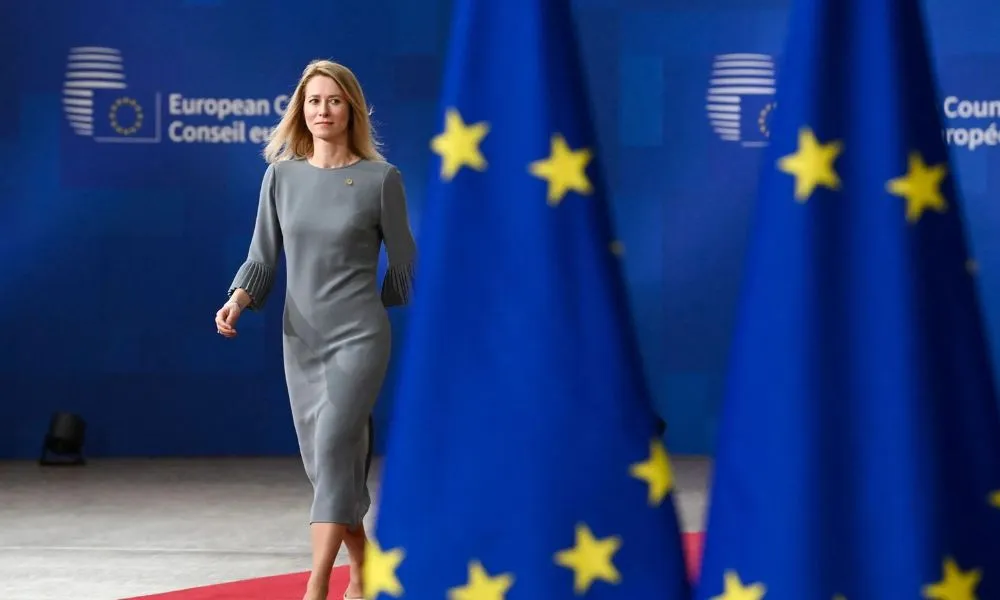

The European Union’s High Representative for Foreign Affairs and Security Policy, Kaja Kallas, said she expects a political agreement on imposing sanctions against violent Israeli settlers in the occupied West Bank. Speaking ahead of Monday’s meeting of the EU Foreign Affairs Council, she said she hoped progress could be made, noting that such proposals require either unanimity or a qualified majority from member states, depending on whether they concern individuals and entities or the trade regime.
The sanctions would target individuals allegedly involved in attacks against Palestinian civilians in the West Bank. However, Kallas cautioned that it remains unclear whether member states are willing to move in this direction.
Ukraine, Russia and new EU sanctions
The war in Ukraine will also feature prominently on the agenda, with Kallas accusing Russia of using a recent ceasefire “very cynically, only to protect the parade,” while continuing attacks against civilians. She said Ukraine had respected the ceasefire, as it has in the past by offering an unconditional cessation of hostilities, but that Russia had not responded in a meaningful way.
She also revealed that the EU is preparing a new package of sanctions aimed at individuals and entities involved in the transfer of children from occupied areas of Ukraine to Russia. “What is happening to these children is horrific,” she said, adding that the international community is examining ways to facilitate their return to their families.
Western Balkans, Syria and European security
Turning to the Western Balkans, Kallas said the EU is seeking closer cooperation to counter hybrid threats in the region. “Our adversaries are not sleeping. They are constantly working to increase their influence in Europe, and that is why we must remain vigilant,” she said, noting that such threats will be discussed by ministers.
She said the EU has drawn on experience from cooperation with Moldova and is now working with Armenia, while other countries have also requested support after facing similar attacks against their democratic institutions. Referring to security and defence partnerships, she cited Montenegro as an example, stressing the expectation that partner countries align with the EU’s foreign and security policy.
On Syria, Kallas said the EU is exploring ways to strengthen state institutions and political stability. “Without strong institutions, there can be no functioning state,” she said, adding that the EU is ready to assist with constitutional and legal reforms and to ensure minority participation in governance.
She also underlined that any future dialogue with Russia must be based on a common European position. “Before we talk to Russia, we must first talk among ourselves about what exactly we want to negotiate,” she said, reiterating that Europe’s core security problem remains “Russia’s continued aggression against its neighbours.”
Source: CNA