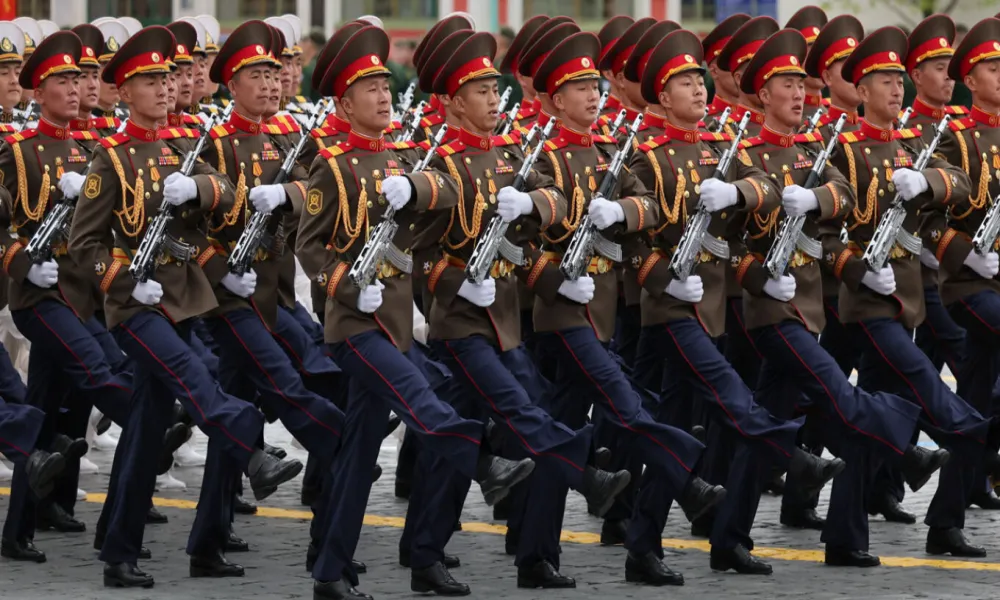
Russia marked the 81st anniversary of the Soviet Union's victory over Nazi Germany with a military parade on Red Square on Friday, but the event was held at a significantly reduced scale compared to previous years, with no tanks or heavy weaponry on display amid fears of Ukrainian drone attacks.
The most striking feature of this year's parade was the first-ever participation of a North Korean military unit, marching alongside cadets from Russia's armed forces academies. President Vladimir Putin watched from the central podium alongside war veterans and a noticeably smaller group of foreign leaders than in previous years.
The parade opened with the Preobrazhensky Regiment's colour guard carrying the Russian flag and the historic Victory Banner, the flag raised over the Reichstag in Berlin on the night of 1 May 1945 by soldiers of the 150th Idritskaya Rifle Division. Defence Minister Andrei Belousov conducted the review, with Ground Forces chief General Andrei Mordvichev commanding the march. Around 1,000 Russian soldiers who have served in what Moscow calls the "special military operation" in Ukraine also took part, including 17 Heroes of Russia.
The parade concluded with an aerial display over central Moscow. The Russkiye Vityazi aerobatic team flew Su-30SM fighters and the Strizhi team flew MiG-29s in the Kubinka Diamond formation, followed by six Su-25 ground attack aircraft trailing smoke in the colours of the Russian flag.
A shrinking guest list
Foreign leaders attending were few. Slovakia's Prime Minister Robert Fico, Belarus President Alexander Lukashenko, Kazakhstan President Kassym-Jomart Tokayev, Uzbekistan President Shavkat Mirziyoyev, Laos President Thongloun Sisoulith and Malaysia's Supreme Ruler Sultan Ibrahim were among those present. Last year, around 30 foreign officials attended, including then-Venezuelan President Nicolás Maduro before his arrest in a US operation. This year's list was a fraction of that.
Armenia's Prime Minister Nikol Pashinyan declined to attend, citing upcoming elections, days after hosting Ukrainian President Volodymyr Zelensky at an EU summit in Yerevan, provoking anger in Moscow. Putin's adviser Yuri Ushakov insisted the smaller guest list was a deliberate Russian decision not to extend invitations.
Ukraine's shadow over the celebrations
Since the start of the year, Ukrainian Flamingo missiles have struck Russian energy and military infrastructure deep inside Russian territory, more than a thousand kilometres from the front line. In recent days, drone attacks have paralysed dozens of airports. One drone struck a residential building just six kilometres from the Kremlin, a development that Kremlin officials struggled to explain away. Russia is reported to have redirected more than 40 air defence installations toward Moscow to protect the capital, leaving other regions more exposed.
Russia announced a two-day ceasefire beginning 8 May to protect the national holiday. Ukraine responded with its own ceasefire offer two days earlier, testing Russia's genuine commitment. When Moscow launched further lethal attacks on Ukrainian cities, Zelensky threatened to respond symmetrically. Russia in turn warned it would strike central Kyiv if Ukraine targeted the celebrations. Both sides ultimately agreed at the last minute to a three-day ceasefire proposed by Donald Trump on Friday evening.
Public scepticism was visible on the streets of Moscow. Asked by Russian agency Sotavision what they made of the celebrations, one middle-aged resident said: "The country is suffering defeats on all fronts. What are they celebrating?" Another offered a rare public criticism of Putin directly: "Vladimir Vladimirovich had the idea to celebrate this with grandeur. But something went wrong. Perhaps something needs to be corrected at his core."
Source: AFP