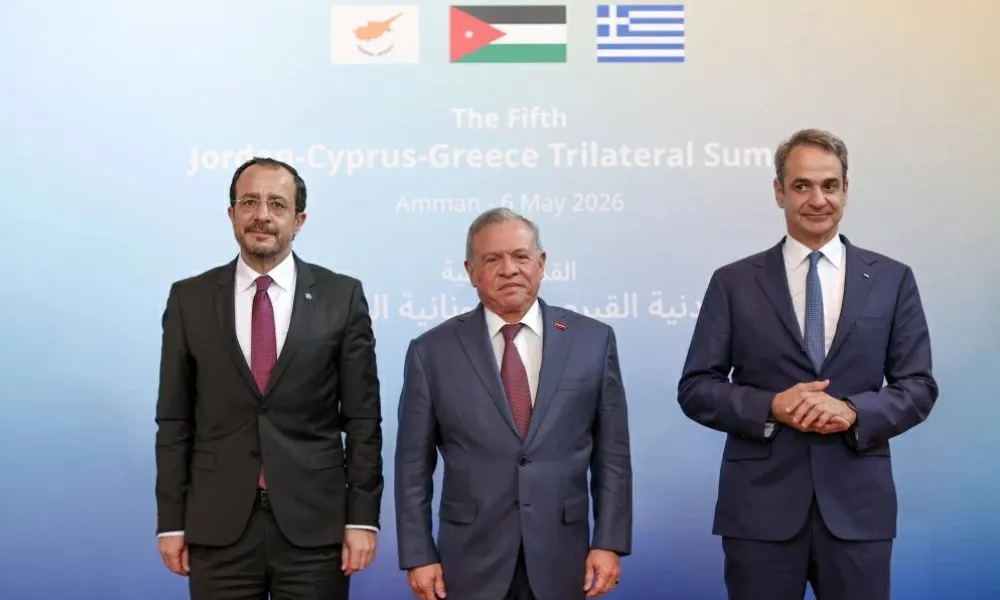

The Foreign Ministers of Cyprus, Greece and Jordan have been tasked with sustaining the momentum of their trilateral cooperation and accelerating its pace, Cyprus’ Foreign Minister Constantinos Kombos said on Wednesday during a joint press conference with his counterparts in Amman, following the Trilateral Summit held there.
“We are tasked with sustaining this momentum and accelerating its pace, affirming that the trilateral partnership gains increasing importance amid current challenges,” he said, adding that the format could serve as a positive regional platform with a clear European dimension and tangible results, including in relation to the Pact for the Mediterranean. He noted that Cyprus and Greece support the effective inclusion of Jordan in the initiative.
Crisis management and regional security
Kombos said the three countries discussed cooperation in crisis management, thanking Greece and Jordan for their support last year in dealing with wildfires. He stressed that the partnership is built on a solid foundation of respect for international law and meaningful dialogue aimed at sustained de‑escalation.
“The security of our region is closely interconnected with the security of the states that make up this region and share the values of the UN Charter,” he said, expressing Cyprus’ solidarity with Jordan and Gulf states following attacks against them.
Hormuz, Gaza and Lebanon discussed
On the Strait of Hormuz, Kombos stressed the need to safeguard freedom of maritime navigation, warning that failure to do so would have enormous and extremely negative repercussions. “The only answer is safe passage, and this is part of the core principles of international law,” he said.
Regarding Gaza and the West Bank, he described the situation as extremely fragile and urged a swift move to the second phase of stabilisation efforts, reaffirming Cyprus’ support for the two‑state solution in line with UN Security Council resolutions. He recalled that Cyprus has recognised the Palestinian state since 1988.
On Lebanon, he said the three countries fully agree on the need to support the country’s independence, sovereignty and territorial integrity, stressing that the outcome will have regional consequences.
Syria and Cyprus issue
Kombos also highlighted the importance of predictable, good‑neighbourly relations with Syria, grounded in international law, including the law of the sea, and underscored the need to safeguard the rights and security of all Syrians, regardless of religious or ethnic background.
He added that the latest developments regarding the Cyprus issue were discussed, reiterating his country’s commitment to a solution strictly within the framework of UN Security Council resolutions for a bizonal, bicommunal federation.
Greece and Jordan underline shared vision
Greek Foreign Minister George Gerapetritis said the fifth trilateral meeting comes at a critical juncture for the region and the world, demonstrating the partnership’s role as an anchor of peace, stability and prosperity. He said discussions focused on developments in the wider Middle East, including Iran, Gaza, Lebanon, Syria and the West Bank, and expressed hope for the next meeting in Athens.
Jordan’s Foreign Minister Ayman Al‑Safadi said the trilateral mechanism reflects shared political will to enhance cooperation across multiple sectors such as water, energy, culture, education and tourism. He added that the summit strongly condemned attacks targeting Jordan and Gulf Arab states and discussed efforts to stabilise Lebanon, the Palestinian issue, Syria and the Cyprus problem.
Source: CNA