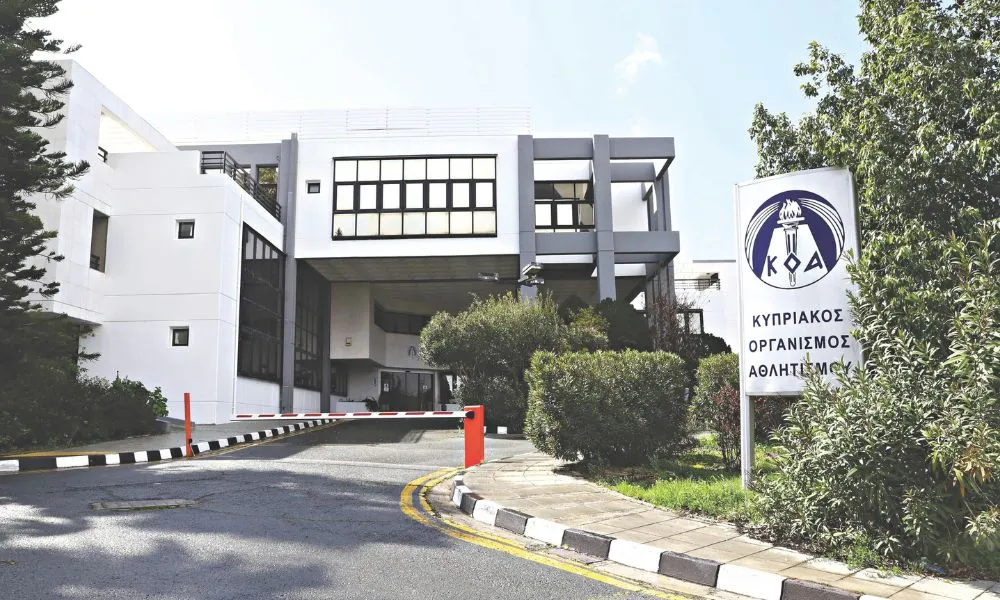

The findings point to accountability gaps, conflicts of interest, weak control mechanisms and inconsistent handling of similar cases, within a system that manages millions of euros in public funds through state grants to sports federations.
Indicatively, in 2024 alone the CSO approved grants totalling €7.13 million to 80 sports federations.
In the report’s foreword, Auditor General Andreas Papaconstantinou refers to “material weaknesses affecting the effectiveness of oversight,” while noting that “the state has over time settled into a relative inaction,” invoking the independence of sports federations as justification.
Complaints and conflicts of interest
Among the findings are cases raising issues of conflicts of interest and governance.
The Audit Office identifies board members with family ties to athletes, individuals serving simultaneously as club members and national coaches, and referees linked to federation coaches through family relations.
It also found expenses lacking sufficient supporting documentation, as well as funds received for athlete support or coaches’ salaries without confirmation that they were used for those purposes.
The report further refers to complaints of possible corruption, incompatibility, exploitation of athletes and state property, and a case concerning the selection criteria for the 2023 Games of the Small States of Europe, which had not yet been examined by the CSO at the time of the audit.
In addition, cases were identified where federation board members remained in their positions beyond the 10-year term limit set out in the code of good governance.
Inconsistent handling
The Audit Office is also critical of how the CSO handled cases involving federations under investigation or subject to complaints.
According to the findings, decisions were not shown to be based on predefined and documented criteria, while no comprehensive register of inspections exists to systematically record findings, decisions and follow-up actions.
In one case, the CSO took over the financial management of a federation after identifying a serious conflict of interest at leadership level. However, in other cases with similarly serious findings or pending investigations by the Ethics and Sports Protection Committee, no comparable measures were taken.
The Audit Office notes indications of uneven and inconsistent treatment of similar cases.
Focus also on the Cyprus Football Association
A separate section is devoted to the Cyprus Football Association (CFA), used as an example in the broader discussion on the balance between autonomy and accountability in sport.
The report notes that insufficient accountability is particularly evident in the case of the CFA and has long been a matter of public concern. It recalls that the state has consistently supported football through grants, sports facilities, betting revenues, policing of matches and other forms of direct or indirect assistance.
While acknowledging the CFA’s obligations to FIFA and UEFA, the Audit Office argues that a “misinterpreted understanding” of federation independence has taken hold in Cyprus, creating the impression that autonomy cannot coexist with accountability and oversight.
Grants and missing controls
Significant findings are also recorded in the management of state grants.
According to the report, 78 out of 85 federations failed to submit their 2023 financial statements on time, while by August 2025, 35 had still not complied. Despite this, no sanctions were imposed, as there was no relevant provision in the grant disbursement guidelines.
The Audit Office also notes that there is no documented process showing how grant amounts are determined based on a systematic evaluation of each federation’s financial data.
Even more striking is the finding regarding management audits. Although the CSO signed a contract with a private audit firm to carry out 100 audits over three years, by the end of 2025 only five audits had been completed across five federations.
The report also identifies significant weaknesses in the oversight of private fitness schools, noting that compliance with licensing requirements “is not exercised in a sufficiently effective manner,” with several schools continuing to operate without licences even after court decisions and fines.
CSO president
The president of the CSO board, Yiannis Ioannou, welcomed the publication of the report, describing it as a “bible” for the organisation.
Speaking to ANT1 Cyprus, he said the CSO accepts the findings of the Audit Office and is committed to implementing its recommendations, while noting that many of the issues identified are long-standing problems spanning decades.