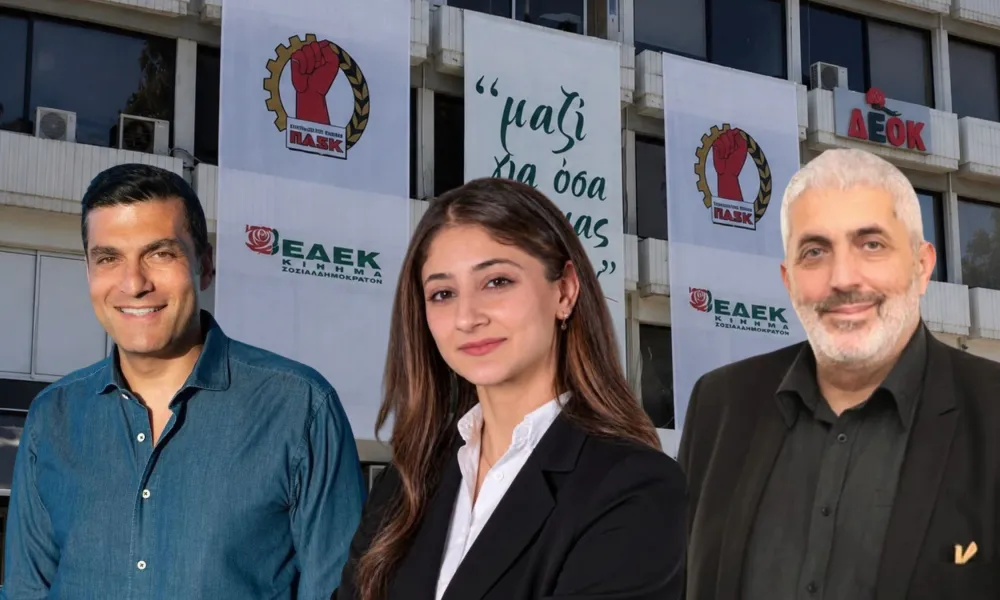

Attention within EDEK is focused on the party's Electoral Congress scheduled for 12-13 December, when members will elect a new leadership. It will be the third leadership contest in an exceptionally short period and could represent a record in Greek Cypriot party politics.
EDEK has held two internal leadership elections within 15 months and is now preparing for a third. On 1 June 2025, Nikos Anastasiou was elected party president, before resigning on 14 July 2026. He was succeeded by Sophia Christodoulou Makri, who won the presidency on 5 September.
Three contests in such a short timeframe underline the scale of the crisis that erupted within the socialist party. The key question now concerns who will seek the presidency in December. Makri has already declared her intentions, while two other prominent figures are weighing possible candidacies.
Sophia seeks a new mandate
Sophia Christodoulou Makri has publicly stated that she intends to seek re-election as EDEK president in December.
In a speech delivered at the party's Constitutional Congress, she appeared determined to continue in the role, declaring:
"The first chapter of EDEK's new page has already begun to be written. The page has turned and it will not turn back."
The message was widely interpreted as directed at those seeking to restore the old order within the party.
In the 5 September leadership election, Makri secured 53.5% of the vote, comfortably defeating Koullis Mavronikolas (35.4%) and George Kouttoukis (11.1%).
She entered that race as the favourite after receiving the highest number of preference votes on EDEK's parliamentary election ballot on 24 May, outperforming several senior party figures who had leadership ambitions.
The parliamentary election result transformed the landscape within EDEK, bringing the 27-year-old Youth Organisation president to the forefront. She capitalised on that momentum and secured the party leadership.
So far, she has managed to represent members seeking change.
However, her effort to lead the party's renewal movement has brought her into conflict with elements of the old guard.
Approximately 45 days after her election, she faced her first open challenge when 11 members of the Political Bureau expressed strong dissatisfaction with decisions relating to the Constitutional Congress and the dismissal of salaried staff.
In a joint letter, the 11 members accused the leadership of bypassing collective party bodies.
Some of the difficult decisions taken by the new president appear to have carried political costs and have led to an increasingly visible rift with the party establishment.
Hannides weighs his options
Of the 11 Political Bureau members who clashed with the president, Marios Hannides has attracted particular interest.
A forceful political figure known for expressing his views strongly, Hannides had been prepared to run in both recent leadership contests.
In the June 2025 election, he stepped aside in the interest of party unity. In the contest following Anastasiou's resignation, he ultimately backed the candidacy of Koullis Mavronikolas.
The absence of the group of 11 from the Constitutional Congress and Hannides' public criticism suggest the existence of an opposition bloc within EDEK.
The size of that bloc may become clearer in December if it decides to rally behind a candidate.
Speaking on Politis Radio's programme Second Look at the News on Friday, Hannides said he had not yet decided whether to contest the presidency.
He indicated that the decision would depend on consultations in the coming days and whether he could secure support from those opposed to Makri's leadership.
In his public statements, Hannides has repeatedly stressed that his priority is the unity and reconstruction of EDEK.
Those positions resonate particularly with members who hold previous leaderships responsible for the divisions and weakening of the party in recent years.
At the same time, he has criticised certain figures who recently returned to the party, arguing that they "attack the previous leadership and the existing Political Bureau on a daily basis".
His approach appears aimed at bridging the party's competing factions, avoiding direct confrontation with supporters of former leader Marinos Sizopoulos while also seeking a place in the party's emerging political landscape.
Costis Efstathiou emerges as third pole
The return of former Nicosia MP Costis Efstathiou has created a third political pole within EDEK, although its strength remains uncertain.
Efstathiou has voiced reservations about developments arising from the Constitutional Congress and has sought to maintain a degree of distance from the current leadership.
Speaking on Politis' POLcast, he said he would decide in the coming days whether to run for the presidency at the December congress.
Efstathiou is a well-known figure within the party. He served two terms in parliament and was also mayor of Latsia.
He retains considerable respect within EDEK despite being expelled from the party by Marinos Sizopoulos after backing George Kolokasides in the 2023 presidential election instead of EDEK-backed candidate Nikos Christodoulides.
While he is unlikely to attract support from Sizopoulos loyalists, he could find backing among members aligned with the party's reformist wing.
In recent days, Efstathiou reportedly submitted a proposal to Makri for a form of co-presidency, but did not receive a positive response.
Among the potential contenders, Efstathiou is the only one who has openly addressed the 2028 presidential election.
He has argued that EDEK should field its own candidate and develop an independent political platform.
He also stressed the importance of cooperation with parties that share similar positions on the Cyprus issue, pointing towards the Ecologists' Movement-Citizens' Cooperation, which also opposes the bi-zonal character of the proposed settlement model.
What will determine the vote?
There do not appear to be deep ideological or political differences between the current president and the two potential challengers.
As a result, EDEK members are expected to focus primarily on who is best suited to lead the party through a difficult period.
The frequency of internal elections has inevitably exhausted many party members, who are now seeking stability.
For that reason, the candidate who is most convincing in promising an end to instability and uncertainty may hold the advantage in December.
Beyond that, members will also be looking for the person they believe can rebuild and politically strengthen the party in the years ahead.