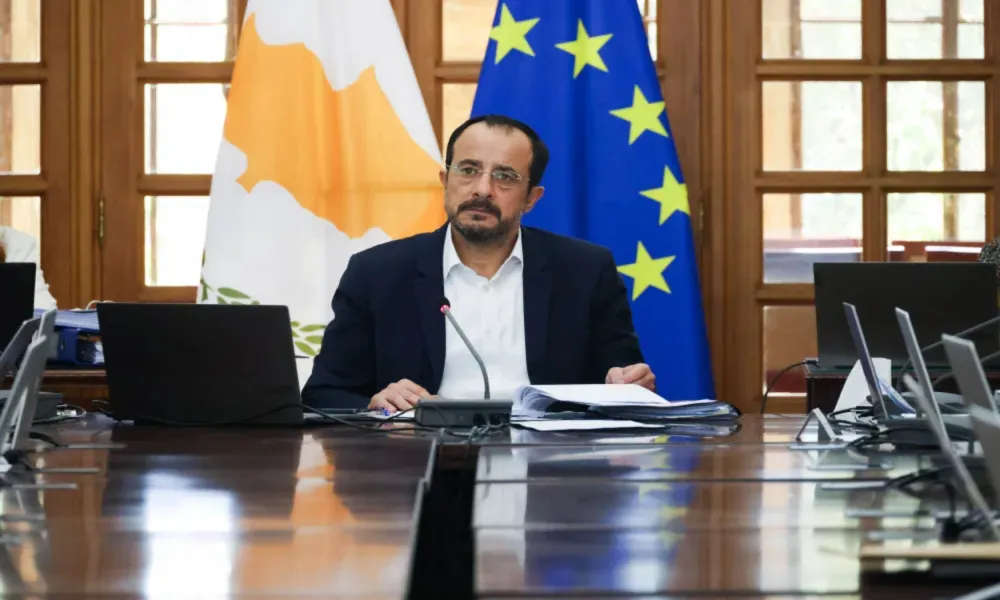

The much-discussed, but ultimately limited, government reshuffle cannot in any way be regarded as a new political starting point. Instead, it constitutes yet another indication that Nikos Christodoulides has entered a phase of political management in which his electoral planning appears to carry greater weight than the need to produce substantial government work.
The President had the opportunity to proceed with a profound restart, to acknowledge that in several areas his government failed to meet the expectations that he himself cultivated, and to present a team capable of confronting the country's major problems, even during the final third of its term in office. However, once again, he acted with the strengthening of his communications policy as his guide and the next electoral contest as his objective.
The medley of "partisanship"
The basic political promise on which he was elected was the creation of a government of the best, free from party dependencies and traditional political balances. Three and a half years later, the image being projected is almost the opposite.
The reshuffle does not signal a break with "partisanship" but demonstrates that political balances continue to determine the most important decisions of the Presidential Palace.
The President's objectives
The President's choices appear to serve two main objectives.
The first is an even closer connection with DIKO. With the appointment of additional party officials, such as Christos Senekis and Evi Tsolaki, DIKO further strengthens its presence and influence within the government. It is obvious that Nikos Christodoulides is seeking to ensure that his most important governing ally remains politically attached to his administration and, by extension, to a possible candidacy in 2028.
The composition of the new Council of Ministers gives the impression that, with respect to DIKO, it is moving in the direction he wants and seeks. Politics, however, is a fluid process and therefore nothing in this case can be regarded as definitively settled.
In short, it remains an open question whether this strategy will succeed. Political alliances are not secured solely through participation in power but also through the political prospects of each party. DIKO is now even more deeply immersed in governmental responsibility, which means it will be judged alongside the government for its results. If public dissatisfaction grows, this close identification may evolve into a political burden rather than an advantage.
Penetrating DISY
The second objective appears to have been, and still is, Nikos Christodoulides' effort to penetrate the Democratic Rally (DISY) and, more generally, the centre-right political space.
The President knows that a new electoral victory cannot be based exclusively on the parties that brought him to power. He would like the scenario of drawing support away from DISY to be repeated, as was achieved during the second round of the 2023 presidential election.
This outreach towards DISY forces has become even more pronounced following the parliamentary election results, since all three of his main allies, DIKO, EDEK and DIPA, emerged significantly weakened compared with their electoral standing in 2023. EDEK and DIPA were left out of Parliament, while DIKO also recorded losses. This has created a new political environment in which the President is necessarily seeking new reservoirs of political support.
However, the effort to approach DISY does not appear, so far, to have produced the expected results. The Democratic Rally continues to maintain its own political strategy and emerged reasonably strong from the latest electoral contest, something which, at present, does not suggest any substantial movement of party officials or voters towards the Presidential Palace.
This may effectively mean that the President risks finding himself in an intermediate situation whereby, on the one hand, he has tied his traditional allies even more closely to himself but, on the other, has failed to achieve the desired expansion into the broader centre-right political space.
What about the problems?
It is clear, therefore, that the public discussion surrounding the reshuffle revolves almost exclusively around personalities, party balances and electoral planning.
By contrast, very little discussion is taking place about policy substance. What new strategy is the government presenting to tackle the cost of living? How will it address the housing crisis, energy costs, state effectiveness, delays in the justice system, public service reform and, above all, the course of the Cyprus problem?
At present, the reshuffle and the government appointments provide no answers to these critical questions.
Evaluation and... political colours
Any evaluation of a government is not made on the basis of the party colour of its ministers but on the results it produces.
Daily life remains difficult for a large part of society, and the prevailing perception is that the government is more concerned with shaping the political alignments of the next presidential election than with solving the problems facing the country today.
In short, the Christodoulides government reshuffle appears more like an investment in the President's own political self-preservation and in his planning for the next presidential contest. If that was the President's objective, he may have succeeded in strengthening certain party balances.
If, however, the objective was to convince society that his government is changing course and acquiring new momentum, then the reshuffle can hardly be considered successful.
The real challenge for Nikos Christodoulides is not to secure his alliances for 2028. It is to prove, long before that contest arrives, that he can provide effective solutions to the problems troubling Cypriot society. That is where his administration will ultimately be judged, and not on the balances struck through a reshuffle.