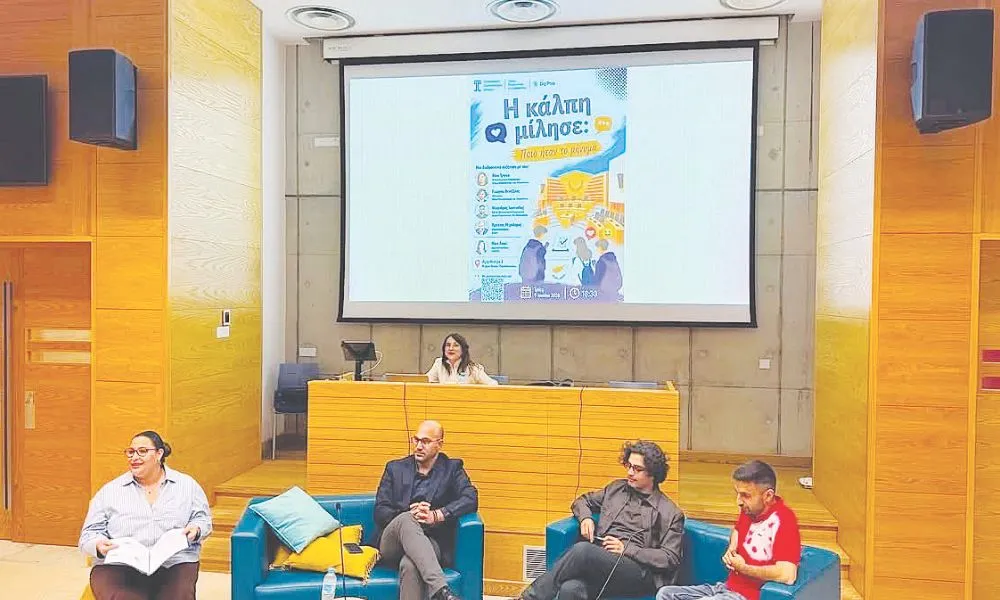

An election is measured not only by its results but also by the questions it leaves behind. Two weeks after the parliamentary elections of 24 May, the DigiPols lab of the Cyprus University of Technology presented an analysis addressing exactly these questions.
Dr Vicky Triga, associate professor, Dr Giorgos Venizelos, lecturer, and Dr Nikandros Ioannidis, from the Department of Communication and Marketing, discussed the election campaign, political illiteracy, populism and the messages emerging from the result, together with journalist Christos Michalaros.
A campaign without substance
The campaign preceding 24 May was not particularly rich in political content. Parties focused mainly on image, narratives of experience and scandals rather than clear positions that would allow voters to make comparisons. This also led to the relaunch of Choose4Cyprus, DigiPols’ online voting advice tool, which attracted thousands of users within its first 48 hours.
The tool is based on the theory of rational voting and allows citizens to answer 24 questions covering key areas of political competition. Research published in Politics and Governance shows that such tools increase participation and broaden voter choice, but do not ultimately change voting decisions. Access to information affects how people think about elections, not necessarily their final choice.
Who voted what and why
Analysis by age group reveals one of the most notable findings. For voters aged 18 to 34, the Cyprus issue is not even among the top three priorities. Rising living costs dominate across all ages, while for those over 65 the Cyprus issue rises sharply to 35%, becoming the main concern. Two generations are effectively living in different political realities.
Party-based analysis is equally revealing. Corruption was the top issue for 48% of ALMA voters and 39% of EDEK voters. The anger over corruption was widespread and not confined to one party. However, precisely because it was so widespread, it did not become a decisive electoral driver for the new political formation that centred its campaign on it.
Populism and its forms
Ideological mapping through Item Response Theory shows that Direct Democracy is positioned at the centre, almost without clear ideological differentiation. Its identity appears structural rather than thematic, defined more by how it presents itself than by what it supports.
According to Giorgos Venizelos, populism is not limited to opposition movements nor tied to a specific ideology. Its essence lies in constructing a unified “people” against a distant or corrupt “elite”. This narrative is rhetorical, emotional and adaptable.
Within this framework, ELAM and Direct Democracy represent different forms of anti-system politics. ELAM, with 10.9%, follows a European pattern of national populism, focused on migration and identity. Direct Democracy takes a different path, lacking a clear ideological position and focusing instead on challenging the political system itself.
At the same time, Venizelos highlights the risks of anti-populism, where established political forces dismiss all anti-system actors as dangerous, potentially shielding themselves from accountability.
The divides that matter
The largest ideological gap identified by Choose4Cyprus concerns NATO, with a difference of 2.59 points between parties. This is followed by policing of protests, migration and same-sex rights. The Cyprus issue appears in the middle of the list. If it is no longer the main axis of political differentiation, a key question emerges: what now distinguishes the parties?
Concerned and informed citizens
The audience showed strong interest in the discussion, which also touched on wider concerns beyond the elections. These included the influence of social media, the relationship between politicians and journalists, and the quality of public discourse.
Journalist Christos Michalaros rejected the view that democracy has collapsed, but acknowledged real shortcomings in journalism and the myth of complete objectivity. The discussion concluded that the key challenge is not only accurate information but the creation of a political environment that fosters informed and active citizens.