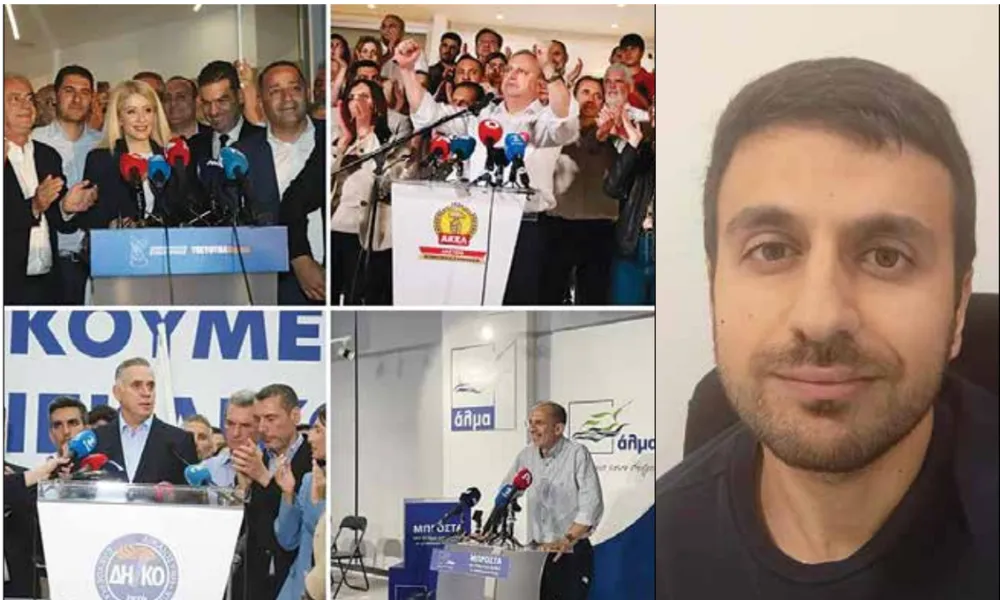
At a time when abstention is rising, political debate is shrinking, and communication often prevails over substance, the Republic of Cyprus appears to be entering a new phase: the era of “post-politics”. Political scientist and lecturer at the Cyprus University of Technology (CUT), Dr Nikandros Ioannidis, offers his own reading of the present and future of the Cypriot political system in light of the parliamentary elections of 24 May 2026.
He discusses the resilience of traditional parties, the crisis of political participation, clientelistic relations, the quality of political personnel, the impact of technology on democracy, and places at the centre what he considers the greatest challenge of the era: the gradual depoliticisation of political life.
In parliamentary elections, is the survival of so-called traditional parties an indication of institutional stability, or of the political system’s inability to renew itself?
It is primarily an indication of the resilience of party mechanisms. In the absence of a strong alternative political proposal, traditional parties continue to enjoy organisational advantages that new parties clearly do not have, and are unlikely to acquire unless they manage to remain relevant for at least a decade. The major parties have networks, cadres, access to voters, and the ability to mobilise right up to the final week before elections. They have also incorporated technology into this complex organisational process. This does not necessarily mean that society is satisfied with them. It means that, when there is no clear political dividing line or an alternative with real governing potential, the old—and now technologically advanced—mechanisms remain effective.
New tools, old practices
To what extent has the Cypriot political system adapted to the social and technological changes of the 21st century?
All parties, new and old, have adopted social media, but this does not mean they have fundamentally changed the way they produce politics. They use new tools to reproduce old practices. Political life remains person-centred, and party communication continues to focus on slogans and personal confrontations. Similarly, the “experiment” with the Direct Democracy application is not an innovation. Dozens of parties across Europe, both new and established, have created their own internal consultation and democracy apps. Research shows that the main problem is not the existence of such technological infrastructures, but citizen participation, as in most party consultation apps, only already active party officials and members participate.
Electoral threshold
Does Cyprus need institutional reforms?
Institutional reforms are needed that can genuinely change the incentives of the political system. It may sound radical, but I believe we should reconsider the electoral threshold. It could perhaps be raised to 5.4%, i.e. equivalent to three seats, or even 7.2%, equivalent to four seats. The current threshold of 3.6% encourages the continuous creation of new parties and the independent candidacy of small formations, which often lack a clear ideological identity and are more focused on participating in the distribution of power. With a higher threshold, the party system would be pushed towards broader cooperation and fragmentation of the vote would be reduced. In the last elections, 16.3% of votes went to parties that did not pass the threshold. This is a very large share of political representation left outside parliament, showing that the system produces fragmentation without necessarily producing more meaningful representation. However, the most urgent change, in my view, is the abolition of preference voting, which underpins clientelism and patronage. Preference votes turn elections into a competition of favours and impressions. Without them, voters would vote for party lists knowing in advance who will be elected depending on the number of seats won. This would limit clientelistic voting and reduce personality-driven voting, allowing politics to regain some of its substance.
Politicians and citizens
How would you assess the overall quality of political personnel in Cyprus?
I would say Cyprus has capable politicians. I would even go so far as to say that the political personnel is “of higher quality” than the electorate. The problem is that the electorate does not always reward the characteristics it should reward. It often rewards individuals with strong personal networks and the ability to provide services. It rewards knowledge, policy production, and the ability to explain difficult decisions to society to a lesser extent. So the issue is not only individual; it is broader and primarily social. The system often shapes the kind of politician who ultimately survives.
Voters or clients?
Compared to 20 years ago, does politics today function more, less, or the same through clientelistic relations and personal favours?
It has changed in form and may have diminished to some extent, but it has not disappeared. In the past, clientelistic relations were more direct, visible, and organised through party mechanisms. Today they still exist, but are often combined with or overlap with candidates’ personal networks. Digitalisation and the modernisation of the state—although progressing slowly—have in some cases reduced the value of clientelist ties, which were once necessary even for the simplest interaction with the state. We do not easily escape these practices because there is mutual benefit: politicians seeking preference votes and citizens who, within an inefficient state, feel they need “access” to solve problems. The current government’s significant inability to digitise even basic state functions sustains clientelism as a strong factor influencing electoral outcomes. I do not believe this is intentional, but rather the result of a general reluctance to implement major reforms.
Can new politicians emerge?
Can a young person without party connections succeed in Cypriot politics today and be elected to parliament?
Yes, but it is difficult. Social media and the crisis of trust in parties have opened some opportunities. A young person can gain visibility without going through party hierarchies. However, being elected—especially in parliamentary elections—still requires organisational know-how, money, and networks across the constituency. Party mechanisms therefore remain powerful. Visibility can get you into the conversation, but it is not enough to get you elected.
The cases of Fidias and Odysseas
What phenomena are Fidias Panayiotou and Odysseas Michaelides?
They are different phenomena, but share a common origin: the crisis of trust in traditional parties. Fidias represents the transformation of politics into a field of communication and personal visibility, combined with a complete absence of a political programme. Odysseas Michaelides represents a demand for oversight and transparency. They are not the same political phenomenon: one is generational, the other institutional and anti-systemic in terms of accountability. Both show that part of society—though smaller than many expected—is seeking representation outside traditional channels.
Threat to democracy
What is the greatest threat to our democracy today?
The greatest threat is the gradual depoliticisation of politics. We are slowly but steadily moving into the era of post-politics. When citizens are not interested, are not meaningfully informed, do not evaluate programmes, and do not demand accountability, democracy remains formally alive but is substantively weakened. In Cyprus, political participation has fallen to worrying levels. If we calculate turnout as a share of the entire adult population rather than registered voters, the result is stark. Participation in the recent parliamentary elections was around 53%, extremely low for a European democracy. At the same time, European surveys consistently place Cyprus at the bottom in political interest indicators, especially since 2013. Party websites also show a lack of substantive programme commitments, with only a few exceptions.
A weakened vote
When a large share of citizens abstains, can we still speak of a healthy democracy?
We can speak of a functioning democracy, but not a healthy one. Abstention reflects both apathy and an inability of part of the electorate to follow political developments, as well as the political system’s failure to convince citizens that participation matters. With turnout at around 53%, nearly half the adult population does not participate. That is a serious democratic problem. If we also consider that a large share of those who do vote do so on social or clientelistic criteria, then the real political vote is significantly weakened.
“Low level of political literacy”
Asked whether Cypriots have sufficient political education to critically evaluate parties and candidates, Dr Ioannidis replied negatively. “No, and that is clear. There is a low level of political literacy,” he said. This is evident, he explained, in how many voters assess parties and candidates: more on the basis of personalities, impressions, social relations, or fragmented issues, and less on programmes, ideological consistency, and policy positions. Based on long-term data collected at CUT since 2011, he added, Cypriot citizens often show inconsistency between their political views and their electoral choices, and a large part of society struggles to position itself on key political issues or even holds contradictory views on economic and governance matters.
Political education
Should civic education be taught differently in schools?
Today, this subject has effectively been removed from schools as a standalone course and supposedly integrated into other subjects. Civic education cannot be a small, formal component taught without proper training. It is essential not only for understanding institutions and democratic processes, but also for cultivating critical thinking. It should return to schools as an interactive subject focused on practical engagement with democracy. Without such education, we produce citizens who vote without evaluating choices politically, allowing “funeral politics”, “wedding politics”, or candidates with large campaign budgets to prevail.
“They say one thing, do another”
Why do many citizens say they are dissatisfied with parties but still vote for them?
Three reasons: party identification still exists, though weaker; lack of convincing alternatives; and the decline of political voting in favour of social or personality-based voting. In the absence of clear political divides—such as the Cyprus issue once provided—parliamentary elections become contests of personalities, local networks, and impressions.
Overwhelmed citizens
Are citizens today better informed?
They are more bombarded with information than genuinely informed. The electoral system contributes to this, encouraging new parties and creating intense competition for preference votes. Citizens are exposed to an overload of slogans, personal campaigns, advertisements, videos, and messages. The result is not better information, but information pollution. The most likely response is apathy, as it becomes impossible to process so many fragmented and often shallow political messages.