Any initiative aimed at involving citizens in the Cyprus peace process must ensure participants are provided with objective information and impartial experts, while also guaranteeing that civic assemblies are representative and free from political influence, according to findings published by the Updated Cyprus Peace Process Design (“C-Up”) project.
The findings emerged from focus groups conducted during the first phase of the project, which is funded by the European Union under the Aid Programme for the Turkish Cypriot community and led by the Cyprus Peace and Dialogue Center (CPDC) in partnership with the Interdisciplinary Centre for Law, Alternative and Innovative Methods (ICLAIM).
Examining negotiations
The C-Up project seeks to involve citizens in reviewing and updating the methodology of negotiations aimed at resolving the Cyprus problem, with the goal of addressing structural obstacles and supporting political leaders in taking difficult decisions.
Project organisers stressed that the initiative is not intended to involve citizens directly in negotiating the core political issues of the Cyprus problem, but rather in examining how negotiations are conducted and how the process itself could be improved.
The initiative includes four mono-communal civic assemblies - two in each community - alongside two AI-assisted bicommunal assemblies and one in-person bicommunal civic assembly.
Civil society engagement
According to the organisers, the project comes at a significant moment following the announcement by the two leaders on May 8, 2026 regarding plans to establish a consultative body for civil society engagement.
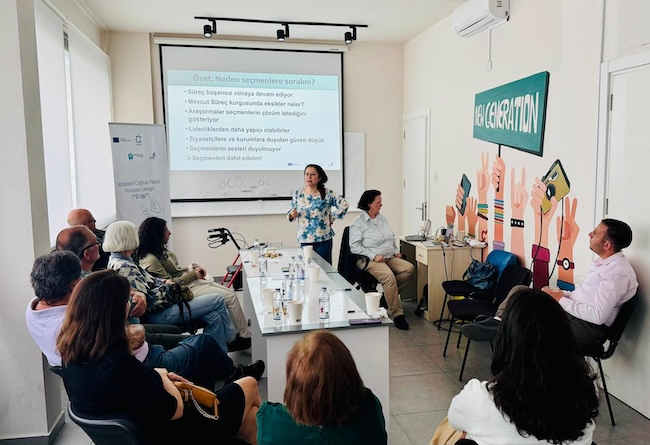
Four mono-communal focus groups have already taken place, with two held in the Greek Cypriot community and two in the Turkish Cypriot community.
The discussions provided insights into what citizens expect from deliberative democracy initiatives and civic assembly processes, while also helping shape the next phase of the project.
The project has now entered its main implementation stage, during which a representative cross-section of participants will take part in smaller mono-communal assemblies.
Deliberative democracy
Held under internationally recognised principles of deliberative democracy, participants will be given time, information and space to discuss key questions surrounding the design of the negotiation process, including how talks have been conducted so far and how they could be updated to improve the chances of reaching a successful outcome.
Following the mono-communal and AI-assisted bicommunal assemblies, organisers plan to convene an in-person bicommunal pilot assembly aimed at consolidating findings and testing the full deliberative model.
According to the project organisers, all stages of the initiative are based on principles including inclusive participation, respect for differing viewpoints, privacy protection and evidence-based discussion.
Common themes
Across the focus groups, four common themes emerged.
Participants repeatedly called for objective and unbiased information regarding previous rounds of negotiations, the history of the peace talks and the current methodology used in the negotiation process. Some participants also suggested that minutes and documents from previous negotiations should be made public.
Another strong theme was the need for broad representation and safeguards against political influence, with participants stressing that civic assemblies should reflect a genuine cross-section of society.
Political accountability also emerged as a key concern, with many participants insisting that political leaders should be required to respond to or follow up on proposals put forward by citizens.
Participants additionally highlighted the importance of involving impartial experts in any deliberative democracy process, with some proposing mechanisms aimed at ensuring the independence of those experts.