
The findings highlight not only the narrow lead of DISY or the stability of AKEL, but more importantly the gradual shift of a significant portion of the electorate towards new or anti‑system political formations, combined with the weakening of the traditional centre. This points to a clear reconfiguration of the political scene.
Turnout
The first notable finding concerns turnout. Contrary to concerns about voter abstention, the poll records a high intention to participate. Specifically, 78% of respondents say they will “definitely” vote, while a further 16% say they will “probably” go to the polls. In other words, 94% show a positive attitude towards participating in the electoral process, leaving only a small share expressing reluctance.
This is politically significant, as it suggests the outcome will depend less on overall mobilisation and more on which parties can attract undecided voters, activate less engaged supporters and limit losses. In such an environment, party discipline, organisational readiness and the ability to convert dissatisfaction into electoral choices become critical.
Voting intention
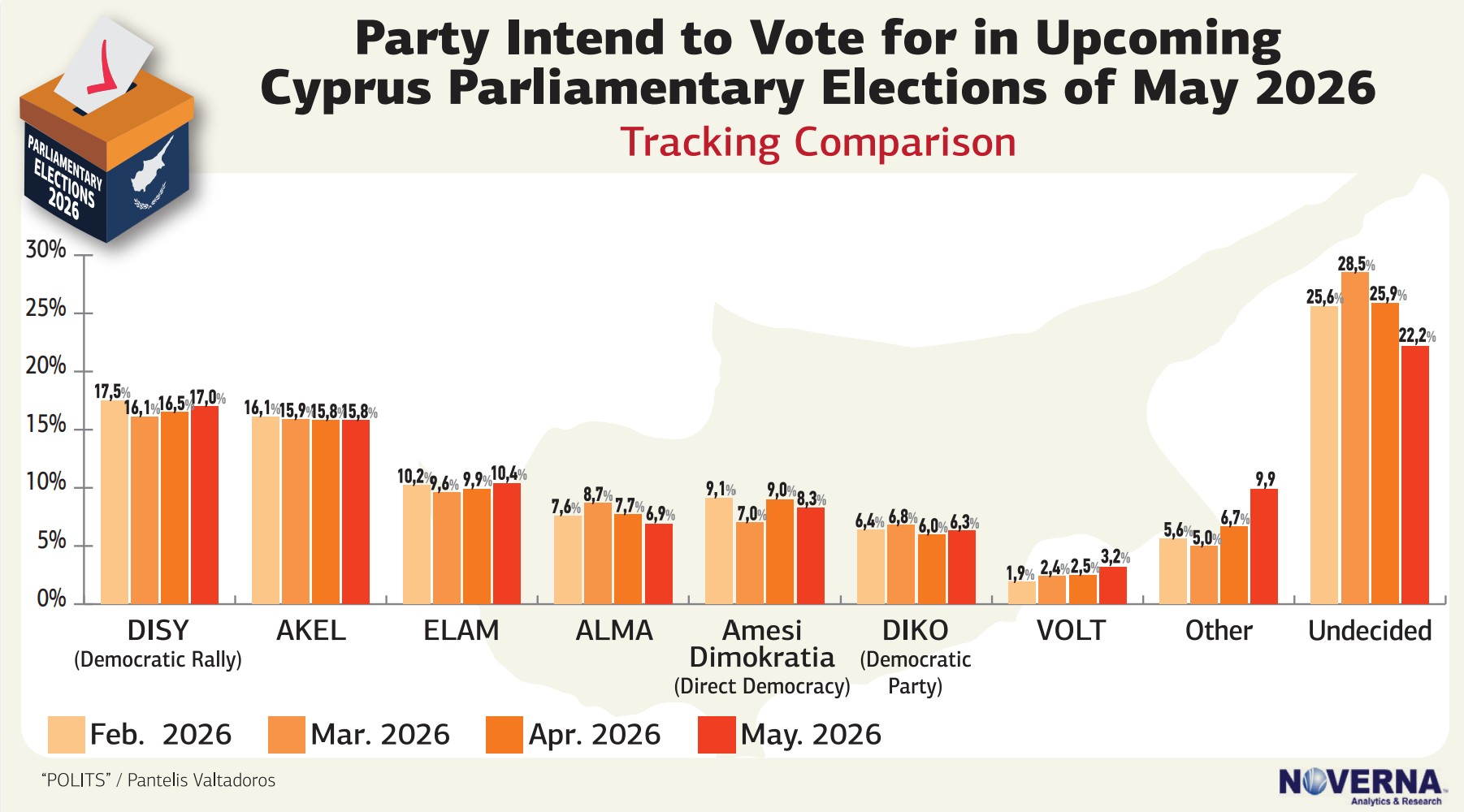
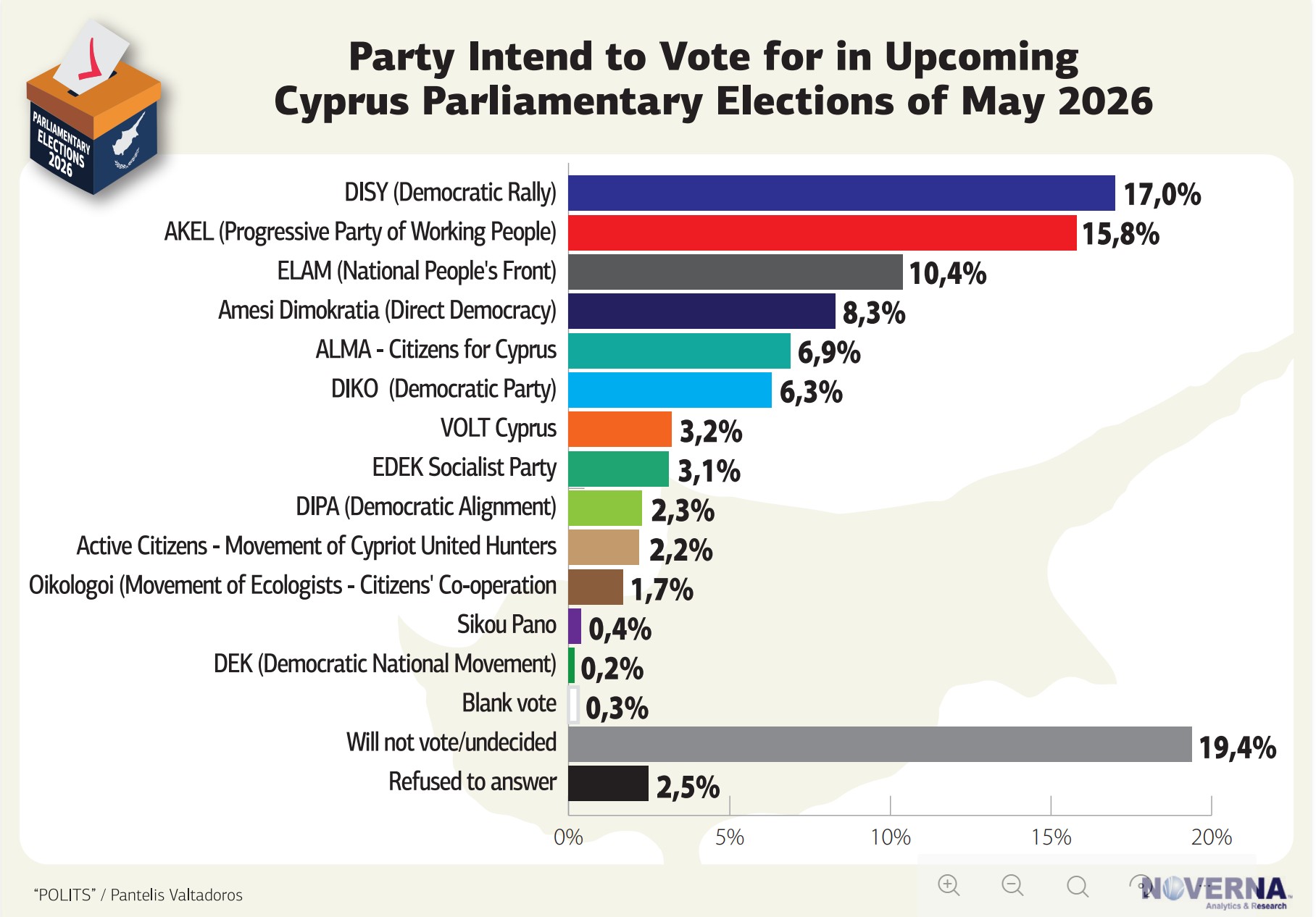
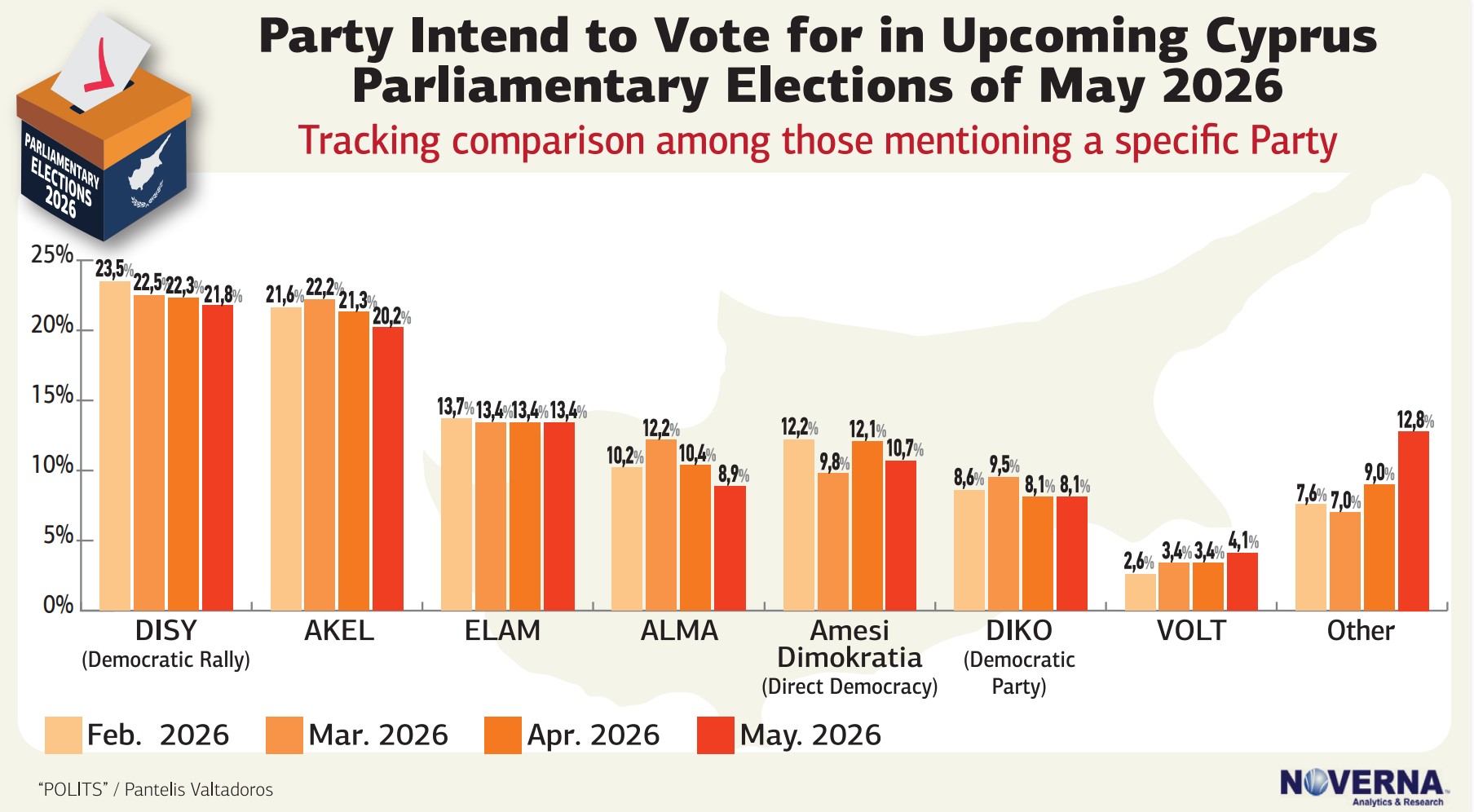
In overall voting intention, DISY ranks first with 17%, maintaining a slight lead over AKEL, which follows with 15.8%. The margin between them stands at just 1.2 percentage points, offering no clear indication of political dominance. While DISY remains the leading force, it does not appear to be generating strong momentum.
This is confirmed by trends over time, with DISY moving from 17.5% in February to 16.1% in March, 16.5% in April and returning to 17% in May, reflecting stability without clear upward movement. Party cohesion stands at 54%, meaning nearly half of its 2021 voters have either moved elsewhere or remain undecided.
AKEL presents a different picture, with its vote share remaining largely unchanged: 16.1% in February, 15.9% in March and 15.8% in both April and May. This reflects notable stability and a disciplined voter base. Its cohesion rate reaches 65%, the highest among major parties. However, this also indicates difficulty in expanding beyond its traditional base.
In the 2021 elections, DISY and AKEL together accounted for around 51% of voters. If current trends hold, their combined share falls to just above 40%.
ELAM in third place
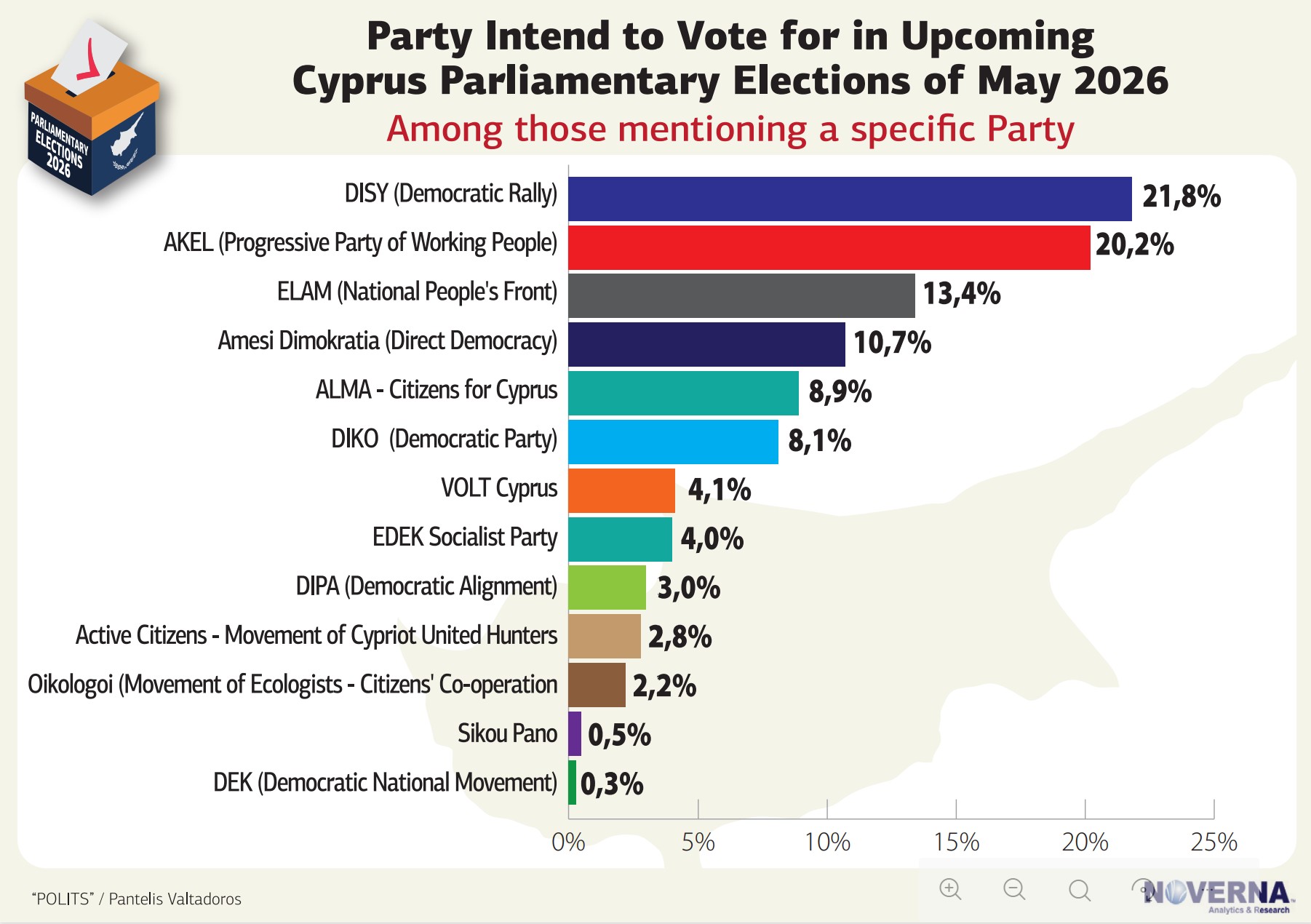
A key finding is the consolidation of ELAM as a stable political force. With 10.4% in vote intention and 13.4% among decided voters, the party shows clear strengthening. Its performance has remained consistent across recent polls, reinforcing the view that its rise is not temporary. With a cohesion rate of 58%, ELAM retains a strong base while attracting new voters, capitalising on protest sentiment and distrust of the political system.
New political formations
Another significant development is the emergence of Direct Democracy, which records 8.3% in vote intention and 10.7% among decided voters. For a new party, this is a relatively strong showing, indicating support beyond initial online momentum. Although fluctuating, its performance suggests a likely entry into parliament.
By contrast, ALMA shows a declining trend, dropping from 8.7% in March to 6.9% in May, indicating that early momentum is weakening as protest votes are spread across more parties.
The traditional centre
The traditional centre appears significantly weakened. DIKO stands at 6.3% in vote intention and 8.1% among decided voters, while EDEK (3.1%) and DIPA (2.3%) risk being left out of parliament. These figures reflect a contraction of parties that previously played a balancing role in the political system. In 2021, these parties together accounted for over 23%.
Volt gaining ground
Volt shows gradual growth, reaching 3.2% in vote intention and 4.1% among decided voters, up from 1.9% in February. While still smaller than other parties, its trend is clearly upward.
Undecided voters
Perhaps the most decisive factor for the final outcome is the large share of voters without a clear party choice. A total of 19.4% say they are undecided or will not vote, while a further 2.5% declined to answer. Overall, more than one in five voters remains politically unaligned.
This means the picture could still change, particularly among mid‑level parties and parliamentary representation. The main conclusion is not simply DISY’s narrow lead, but the ongoing reshaping of the political landscape, with traditional parties retaining presence but facing clear weakening against new or alternative political forces.
Survey details
Conducted by Noverna Analytics & Research for Politis, the poll is based on 1,014 interviews with a representative sample of voters in the government‑controlled areas. Interviews were carried out via telephone using a structured questionnaire. The sample was weighted according to demographic characteristics, with a margin of error of ±2.7% at a 95% confidence level. The fieldwork took place between 1 and 12 May 2026.