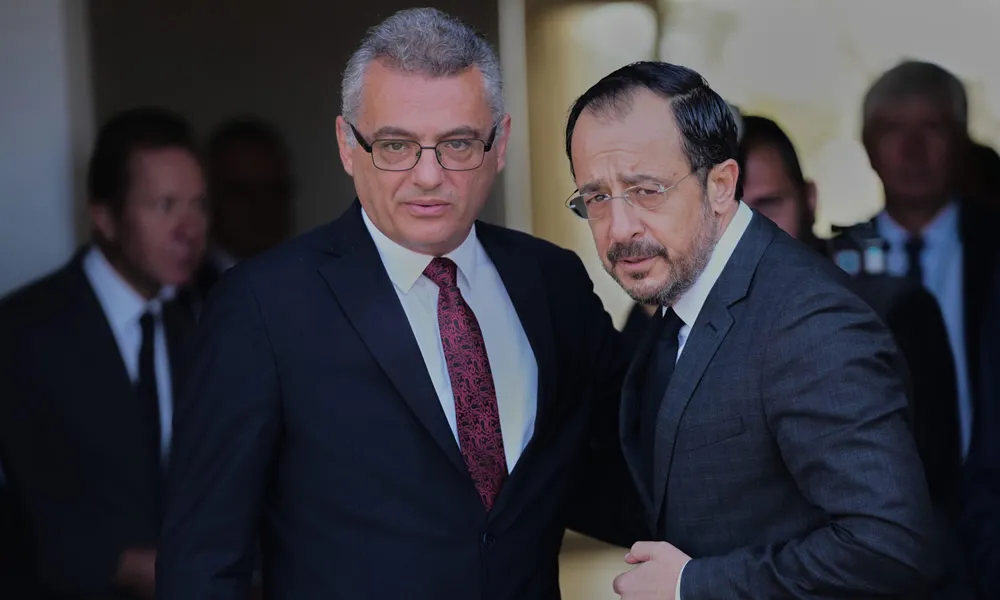
The two leaders will hold their sixth meeting on Friday at the UN-controlled, defunct Nicosia airport. It will be another tete-a-tete, without UN or other representatives present.
At their last meeting on 6 April, both leaders welcomed UN Secretary-General Antonio Guterres’ sustained commitment on the Cyprus issue and voiced support for his efforts to reengage the sides in a new process. They also hoped to conclude some of the pending confidence-building measures (CBMs) at their next meeting.
Since then, a lot has happened. The government announced Cyprus will sign a Status of Forces Agreement with France in June covering the stationing of French troops on the island for humanitarian purposes. The Turkish Cypriot leadership made their dissatisfaction clear, bemoaning recent security agreements with France, Israel and the US. They argue that Turkish Cypriots and Turkey as a guarantor should have a say in decisions, which lead to the further militarisation of the island. As one Turkish Cypriot source put it, the negative atmosphere created – including talk of NATO membership – does not help efforts to build trust.
At the same time, Turkish Cypriot ‘police’ intensified incursions in the buffer zone last month, challenging UN authority over the Pyla plateau. According to Politis sources, the situation there has calmed somewhat, with incursions now taking place only once a day as opposed to throughout the day.
To begin or not to begin
Meanwhile, President Nikos Christodoulides and Turkish Cypriot leader Tufan Erhürman continue to engage in a tit-for-tat exchange through the media, sending messages to each other but mainly to their respective constituencies. The main quarrel appears to be over whether Guterres has already started his new initiative on the Cyprus issue or whether it will start in July – after the parliamentary elections and Cyprus’ EU Presidency.
A moot point in the grand scheme of things. The big question now is whether the two leaders can make progress on their own in the more informal setting they have set up – on trust-building issues, efforts to resume formal negotiations, or both. Or whether it will take outside intervention to unlock the current stalemate.
Speaking to reliable sources on both sides, the two leaders will have several CBMs on the table ripe for agreement when they meet on Friday. Whether they choose to finalise and announce them is another matter. The zero-sum nature of the talks demands progress to be balanced. A breakthrough that appears to benefit one side must be matched with progress on a measure that benefits the other – otherwise no joy. The option of making headway on the opening of checkpoints also exists but appears less likely for now.
The two negotiators have continued to meet weekly in the intervening period, preparing the ground on certain trust-building measures, but also working on other day-to-day issues requiring their attention, including tensions in Pyla and the spread of foot-and-mouth disease across the island. Where necessary, they have also engaged with the bicommunal Technical Committees to push their work forward.
On substance
According to sources, progress on substance is unlikely to take place on Friday as the sides wait for the UNSG to undertake specific steps towards his new effort on the Cyprus issue.
While neither side has a clear indication as to how Guterres plans to proceed with his new initiative, the goal is clear – he wants to see a resumption of talks. It remains to be seen when his Personal Envoy María Ángela Holguín will return to the region to engage with all sides and prepare the ground for a meeting that could kickstart a new process. In her last open letter, Holguín made it clear she would not return until July and even that depended on the possibility of progress.
However, as a Greek Cypriot source put it, her role is to do the bidding of the UNSG. Asked how she might untie the Gordian knot that has bedevilled all sides for nine years now, the source said there are other factors, beyond CBMs, that can act catalytically in that regard. For example, Turkey has shown a revived interest in EU-Turkey relations lately, even referring to accession again. While it is clear EU accession is not on the cards for Turkey at present, enhancing strategic cooperation with the EU could act as an incentive for Ankara, said the source, suggesting participation in SAFE, a customs union upgrade and visa liberalisation. However, bearing in mind there is currently no EU special envoy, the UN envoy would have her work cut out trying to give all sides enough carrot to move forward.
Whispers
As always, where there is a gap in information, there is always talk on the grapevine. And the current talk is of Guterres pondering two options on moving forward. One, to encourage the sides to formulate a joint declaration or strategic agreement that would help jumpstart negotiations on a comprehensive settlement. Two, to seek a draft solution plan for a loose federation that could be implemented in stages.
Sources on both sides were not aware of such discussions, stating that more will become clearer when the UN Personal Envoy begins her contacts and shares the UNSG’s thinking.
The Turkish Cypriot understanding is that Guterres is ready to undertake a new initiative to solve the Cyprus issue, contingent on the two sides in Cyprus building trust, finalising what was agreed in principle in Geneva and New York and showing that the two leaders mean business.
This, of course, depends on what the leaders can achieve on their own in the next two months until the UNSG’s initiative goes into top gear. The question then is what exactly Guterres has in mind, and how the sides will respond.