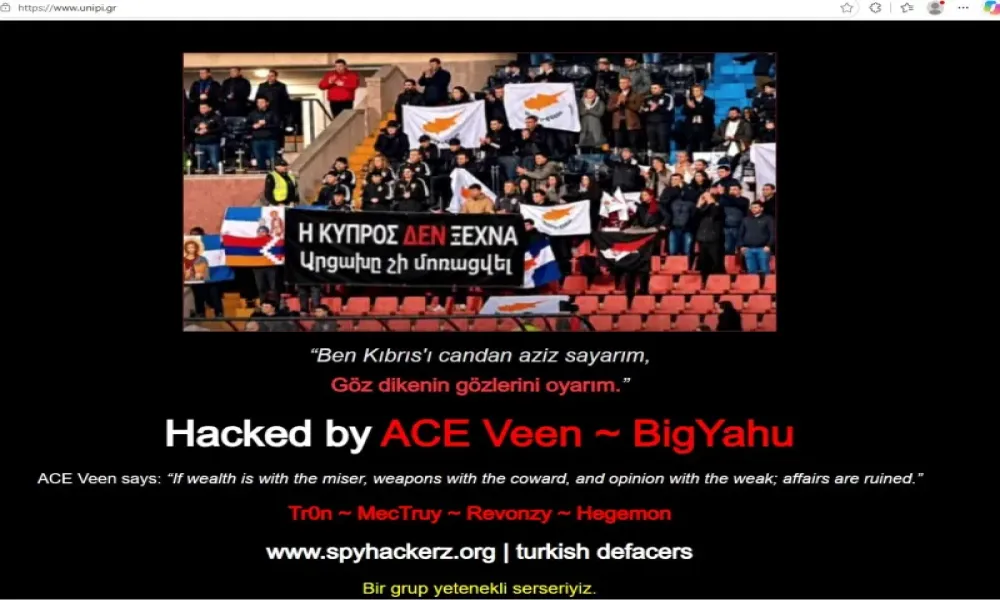

The official website of the University of Piraeus was targeted in a cyberattack, with attackers replacing the homepage content with nationalist slogans and messages referring to Cyprus and Nagorno-Karabakh.
According to reports, the individuals behind the attack signed the defacement using the aliases "ACE Veen ~ BigYahu", while the phrase "Turkish defacers" appeared on the altered webpage, indicating that the perpetrators identified themselves as Turkish hackers.
Cyprus slogan displayed
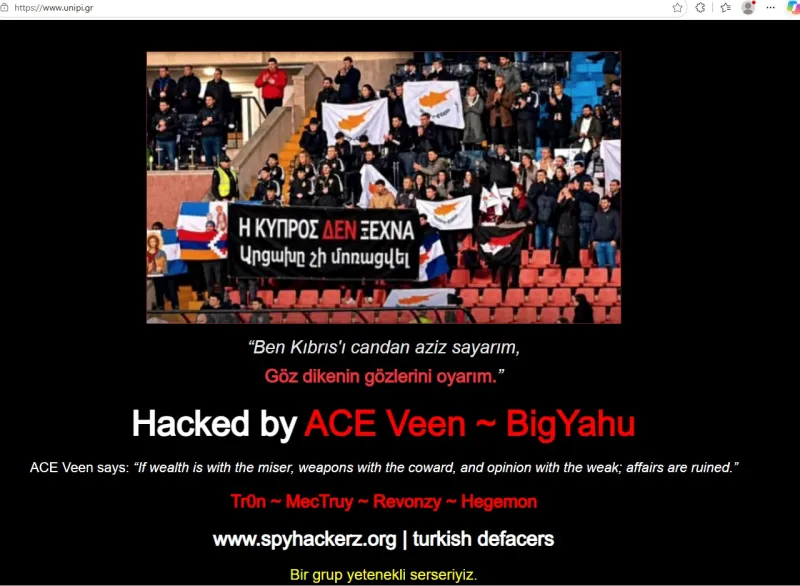
The defaced homepage featured an image of a stadium stand displaying flags and banners, including one carrying the Greek-language slogan: "Cyprus Does Not Forget."
The same image also included a message in Armenian stating that "Artsakh Has Not Been Forgotten," a reference to the Nagorno-Karabakh region.
A Turkish slogan prominently displayed on the page read:
"Ben Kıbrıs'ı candan aziz sayarım, Göz dikenin gözlerini oyarım."
The phrase translates as:
"I love Cyprus more than my own life. Whoever casts an eye on it, I will gouge out their eyes."
The altered page also displayed an English quotation relating to wealth, weapons and power, alongside the aliases Tr0n, MecTruy, Revonzy and Hegemon, as well as the web address spyhackerz.org.
What is known about the attack
The incident appears to be a case of website defacement, a form of cyberattack in which unauthorised users alter a website's content and replace it with images, messages or slogans, often to promote political or ideological views.
Based on available information, the attackers altered the homepage of the University of Piraeus website.
However, there has been no confirmation that the perpetrators gained access to personal data belonging to students, staff or other university information systems.
It also remains unclear how the compromise occurred and who was responsible. Cybersecurity experts note that claims made by attackers about their identity do not, on their own, confirm their origin.