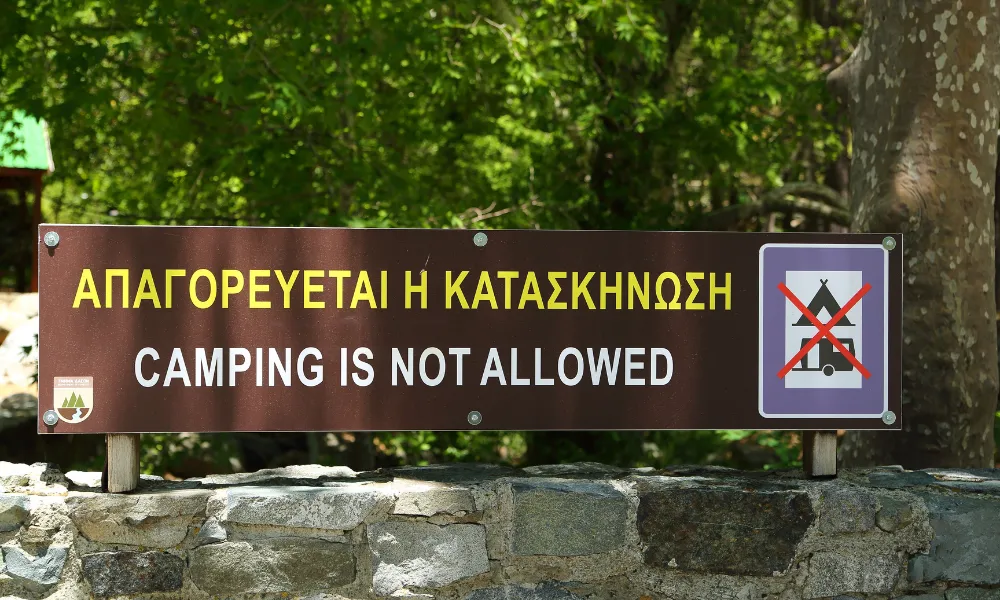

On paper, Cyprus still has a network of organised campsites across some of its best-known forests and mountain areas. In practice, most of that network has disappeared from public use.
Of the five sites on state forest land examined by Politis, only Stavros tis Psokas was operating this summer. Platania, Kambi tou Kalogyrou, Troodos and Polis Chrysochous remained closed, each caught in a different combination of redevelopment, safety work, clearance procedures and administrative approvals.
The authorities have explained why individual sites cannot currently operate. What is far less clear is when most of them will reopen, whether the different closure processes are being coordinated and where campers can find one reliable account of what remains legally available.
Five Sites, Four Different Closure Processes
The campsites are not managed through a single system.
The Forestry Department directly oversees Stavros tis Psokas, Platania and Kambi tou Kalogyrou. Troodos and Polis Chrysochous fall under separate administrative arrangements involving different local and district authorities.
That distinction matters. Each closure has produced its own notices, procedures and estimates, but no authority presents the five sites as one camping network or appears responsible for ensuring that enough organised capacity remains available while work is carried out elsewhere.
At Platania, redevelopment cannot begin until the site is cleared of caravans and other installations. At Kambi tou Kalogyrou, the physical upgrade is complete, but the operating rules required for reopening remain unapproved. Troodos has been closed over reported safety concerns, while Polis Chrysochous is undergoing a longer redevelopment expected to continue until late 2027 or early 2028.
The reasons differ. The effect does not. Four organised sites remain unavailable during the summer season, while only one has even a broad reopening window.
Platania Waits for Work That Cannot Yet Begin
When the Forestry Department suspended operations at Platania on 5 November 2025, the closure was presented as the first step in a comprehensive overhaul of one of Cyprus’s best-known camping areas.
Later that month, campers were instructed to remove their caravans, tents and other installations by 15 December 2025. The Department said the site had to be emptied before work could begin on stronger fire-protection measures, improved sanitation, designated spaces for tents and caravans, safer access for emergency vehicles and clearer evacuation routes.
The redevelopment was also intended to address the long-term occupation of pitches. According to the Department, caravans and additional structures had remained on the site for extended periods, turning parts of a public camping area into permanent or semi-permanent installations and limiting access for other visitors.
The removal deadline passed, but the site was not cleared.
By 21 June 2026, more than six months after campers had been asked to remove their property, the Forestry Department confirmed that redevelopment had yet to begin. Caravans and other installations remained in place despite additional notices and meetings with camping representatives.
The Department has estimated that the construction work will take between 12 and 18 months. That period, however, begins only after the site has been fully emptied, assessed and made available for redevelopment.
A further announcement on 29 July 2026 added to the uncertainty. The Department said Platania would cease to be considered or operated as a campsite, wording that prompted fears that the closure could become permanent. It later clarified that camping would return after the upgrade and said the announcement formed part of the legal process for removing property still on the site.
The reasons for the closure are detailed. The timetable is not.
There is still no confirmed date for the completion of the clearance process, the start of construction or the eventual reopening of Platania. The only timeframe offered applies to work that has not yet begun.
Kambi tou Kalogyrou Is Ready, but the Rules Are Not
Kambi tou Kalogyrou presents the opposite problem. It is not waiting for construction to begin. The physical upgrade has been completed, but the campsite remains closed because its operating rules have yet to be approved.
The proposed framework is intended to define how the site will operate, set out the rights and responsibilities of campers and establish common standards for fire safety, hygiene, accessibility and day-to-day management.
The Forestry Department has said that formal operating rules had not previously been in place for the campsites under its management. A common framework was therefore prepared for Kambi tou Kalogyrou, Platania and Stavros tis Psokas.
The need for clear rules is evident. Forest campsites can accommodate large numbers of visitors, including children, older people and people with disabilities, often during periods of increased fire danger. The Department has argued that reopening without an approved framework would make it more difficult to apply safety and sanitation requirements consistently.
The uncertainty lies in how long approval is taking.
In early July, a Forestry Department representative said the process was expected to be completed shortly and indicated that Kambi tou Kalogyrou could reopen within weeks, possibly sooner. Later that month, the site remained closed.
No firm reopening date has been announced, and it has not been clearly explained which stage of the approval process remains outstanding.
The result is a campsite whose infrastructure is ready but whose gates remain closed. The Department has explained what must happen before visitors can return, but not why the regulatory process was not completed alongside the upgrade or when final approval is expected.
Troodos and Polis Chrysochous Face Separate Delays
The closures at Troodos and Polis Chrysochous further illustrate the absence of a common process.
At Troodos, the closure has been linked to safety concerns in communal areas. Reporting in early July said the Limassol District Administration was expected to provide an update, while local authorities hoped the campsite could operate until the end of September or the beginning of October.
The reports reviewed by Politis, however, did not establish a confirmed reopening date.
The position is made more confusing by tourism and regional information pages that continue to describe the Troodos campsite and its seasonal operation, even as more recent reports identify it as closed. General information about the site remains available, but a visitor looking for its current operational status may not receive a clear answer.
At Polis Chrysochous, the closure is tied to a much larger redevelopment project. The campsite has been out of use since 2023, with construction activity beginning in spring 2026 after years of uncertainty.
Earlier reports suggested the site might remain closed until summer 2027. A later estimate placed its expected reopening in late 2027 or early 2028.
Polis Chrysochous therefore has a clearer broad timetable than the other closed sites, but it also shows how projected reopening dates can shift as projects move forward.
Responsibility Is Divided, but the Public Sees One Problem
The five sites may belong to different administrative structures, but campers experience their closures as part of the same problem.
The Forestry Department is responsible for the clearance and redevelopment of Platania and for the operating framework at Kambi tou Kalogyrou. Troodos has involved the Limassol District Administration and local authorities, while Polis Chrysochous is proceeding through a municipal redevelopment project.
Each authority can point to the procedure affecting the site under its control. What is less evident is whether any institution is looking across the network as a whole.
There is no publicly visible national timetable bringing together the planned works, outstanding approvals and expected reopening dates. Nor is there one official point of reference showing which authority manages each campsite and where the public should turn for current information.
The administrative responsibilities may be divided clearly on paper. Accountability for the overall availability of organised camping is harder to trace.
A Trail of Closed Gates and Mixed Messages
The absence of a central information system is not confined to government websites and public announcements.
Phivos Stavrou, who launched a petition calling for the reopening of Cyprus’s organised campsites, told Politis that Forestry Department personnel advised his group in late May to camp at Kambi tou Kalogyrou.
When they returned towards the end of June, however, they were told the campsite was closed and given 30 minutes to leave or risk a fine.
According to Stavrou, the officers said they were following instructions but could not explain why the site was unavailable. The group was then directed to Polis Chrysochous, which was also closed.
The account has not been independently verified by Politis, but it illustrates the wider confusion created by fragmented and incomplete guidance. Campers trying to establish where they can legally stay must navigate separate departmental notices, municipal statements, tourism pages and media reports, rather than consult one authoritative and regularly updated source.
Stavrou stressed that the campaign does not oppose regulation, safety work or the modernisation of ageing facilities. Its supporters want organised campsites with clear standards, equal access and reliable public information.
They also see camping as one of the few affordable ways for families and groups of friends to spend time in Cyprus’s mountain areas, and as a shared activity around which a close outdoor community has developed.
Stavrou repeatedly warned that leaving campers without organised alternatives could drive some towards unauthorised sites in forest areas, placing greater pressure on the environment and increasing the risk of wildfires.
For him, closing organised campsites does not necessarily stop people from camping. It may simply move the activity into places where it is harder to monitor and control.
More Than 1,000 People Back Reopening Campaign
Stavrou launched the petition for the reopening of Cyprus’s organised campsites, which attracted more than 1,000 signatures in just over five weeks.
Addressed to the Forestry Department, the relevant Troodos and local authorities and the House Environment Committee, the petition does not call for sites to reopen regardless of safety concerns.
Instead, it asks for campsites that can operate safely to reopen, while calling on the responsible authorities to publish clear and binding timetables for the remaining sites. It also seeks greater transparency over the money spent on Kambi tou Kalogyrou and requests a written response from the authorities within 30 days.
Behind those individual demands is a broader one: a single public plan setting out which campsites will reopen, what still stands in the way and when Cyprus’s organised camping network will be available again.