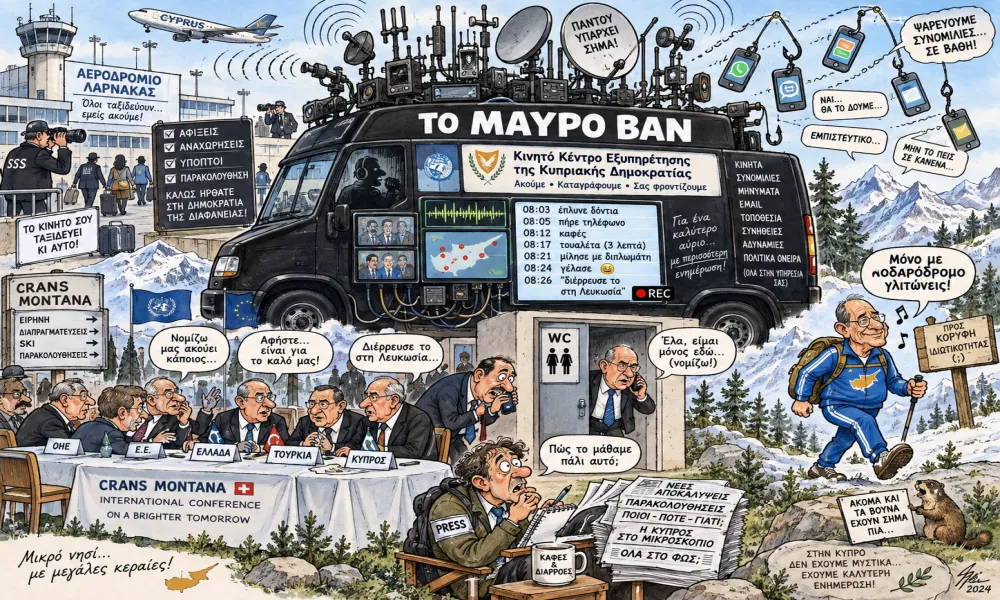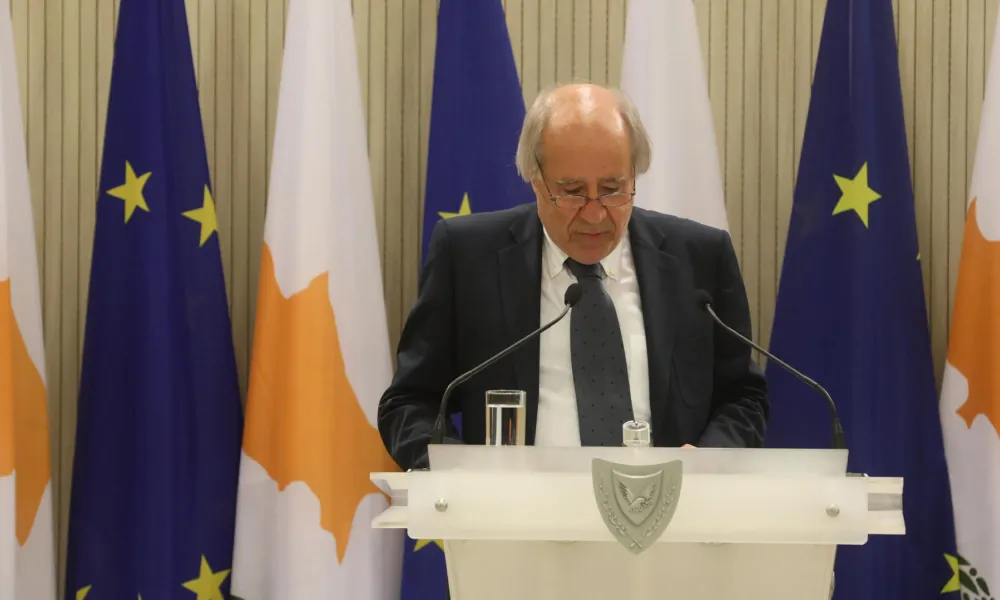

Criminal investigator Andreas Paschalidis' announcement on the Videogate case, and the clarifying statement that followed after the criticism he received, failed to close down public debate. Instead, they raised new questions over the authenticity of the material, how complete the investigation actually is, possible criminal liability, and the limits of the investigator's mandate.
On authenticity
The central contradiction concerns the description of the video as "not authentic." Paschalidis maintains that the footage made public on 8 January 2026 is not authentic because it is the product of editing. At the same time, however, he acknowledges that an authentic video exists, roughly 26 hours long, showing the same individuals and recording the meetings from which the released excerpts were drawn.
Editing or cutting a video does not automatically mean the excerpts are not genuine. Material can be selected, trimmed or spliced together without the words actually spoken being altered. The critical question is whether the editing distorted the meaning, changed the order of statements, concealed decisive context, or created an impression entirely different from the one that emerges from the full material.
The public announcement does not clearly answer this. It does not specify whether a technical alteration of the statements was found, or whether the term "not authentic" is being used simply because the released video had been edited. Two distinct concepts are therefore being conflated: the genuineness of the original material and the fidelity of how it was presented. The real issue here is not whether the video is authentic, but whether it can be presented in court. In the Syllouris case, the person who recorded the video refused to appear before the court to certify the recording. In this case, Black Cube has given testimony on the video three separate times and appears prepared to stand behind its authenticity to the end, provided the Legal Service ultimately concludes that criminal offences arise and that the case should go before the court.
Completion
The second significant inconsistency concerns how complete the investigation actually is. The original announcement has a strongly exculpatory character. It states repeatedly that nothing reprehensible was found, that the allegations were unfounded or baseless, that no corruption was established, and that no breach of the Criminal Code arises on the part of the Cypriot individuals involved.
At the same time, however, the investigation has not concluded. The criminal investigator's mandate was extended to 31 December 2026, since the client who commissioned the operation from the private intelligence firm has not been identified. It is also stated that the possibility of a breach of anti-corruption legislation was examined, but that the investigator and the police retain "a number of reservations."
The result is an investigation that the original announcement presents as simultaneously complete and incomplete. When it comes to the Cypriot individuals involved, the conclusions appear almost final. Yet when the question of publishing the full findings is raised, the argument advanced is that proceedings are continuing and that criminal prosecutions may still follow.
This leads to a further contradiction. In his clarifying statement, Paschalidis says that publishing the findings at this stage could affect the presumption of innocence in the event of prosecutions. He does not clarify, however, which individuals might be prosecuted or for which offences. If no breach of the Criminal Code arises on the part of the Cypriots involved, and if the core allegations have already been dismissed as unfounded, then the reference to possible prosecutions requires further explanation.
At the same time, invoking the presumption of innocence raises a further issue of selective disclosure. The full findings are not being made public, ostensibly so as not to affect possible judicial proceedings, yet the exculpatory conclusions and the investigator's characterisations are being made public at length. The public is told that nothing reprehensible occurred, that the allegations were baseless, and that the statements amounted to "empty talk and bluster," without having access to the material on which these judgements were based.
Financial benefits
A further inconsistency lies in how the behaviour of those involved is treated. Paschalidis maintains that what some of them said did not reflect reality, and was instead aimed at impressing others and securing personal financial gain. At the same time, it is acknowledged that two individuals signed agreements with the purported investors and did obtain financial benefits.
This raises a critical question. If someone falsely represents that they hold political influence or the ability to secure favourable treatment, and receives money on the basis of that representation, is it enough to dismiss their words as "bluster" for the conduct to be considered legally irrelevant?
The fact that the promises may never have been deliverable does not automatically erase the significance of an attempt to trade in supposed influence. The announcement itself, after all, states that the "actions, representations, promises, statements and conduct in general" of those involved were examined in light of anti-corruption legislation. It does not explain, however, precisely what the legal reservations were, or why a clear conclusion could not be reached.
The political dimension
A contradiction also emerges in Paschalidis' stance toward the political and ethical dimensions of the case. In his second statement, he stresses that his role was exclusively that of a criminal investigator, and that he had no mandate to act as an investigative committee or to assign political and ethical responsibility.
His original announcement, however, was not confined to the narrow legal finding that there was insufficient evidence for criminal prosecution. It went on to make value judgements about the character and motives of those involved, speaking of "bluster," attempts to impress others, and the pursuit of personal gain. At the same time, it adopted a broader political and geostrategic interpretation, describing the video as a form of hybrid attack against the Republic of Cyprus.
The assessment of a hybrid attack creates a gap of its own, and raises the suspicion that the investigator is aligning himself almost uncritically with the Christodoulides government's narrative. The investigator himself acknowledges that the client who commissioned the operation has not been identified. Without knowing the identity of that client, their interests or their real objectives, the conclusion that this was an attack by a foreign state or an organised operation against the Republic of Cyprus remains a working hypothesis rather than a fully established fact.
The timing of the publication, coming as Cyprus assumed the presidency of the EU Council, may raise suspicions, but timing alone proves neither the identity of the client nor the motive. This is especially so given that Black Cube maintains it was working within the context of a business dispute and names a specific company as the subject of its findings, meaning the hybrid-attack theory requires stronger substantiation. Unlike the Cypriot government and its convenient hybrid-attack narrative, the Israeli government appears not to share this position. Under the bilateral agreements between Cyprus and Israel, according to a diplomatic source, "if an Israeli company were behind a hybrid attack against Cyprus, Cyprus would be entitled to request the extradition of Black Cube's leadership, with Israel obliged to comply." Israel, by contrast, appears convinced this is a matter of business disputes, which is why it advised Black Cube to cooperate with the Cypriot authorities.
Taking it personally
Finally, Paschalidis' clarifying statement took on a markedly personal and defensive tone. His stated reason for issuing it, to protect his dignity and reputation, is understandable, particularly given insinuations that his appointment was somehow a reward. Yet his closing remark, "if anyone disputes it, let them speak now, otherwise let them be silent," sits uneasily with the institutional, detached language expected of a criminal investigator.
Overall, the problem does not necessarily lie in Paschalidis' conclusions being wrong, especially following the clarifying statements issued after the original announcement of the findings. The concern instead stems from the fact that the initial conclusions were presented with greater certainty than the announcement itself appears to support. The investigation continues, the client has not been identified, legal reservations remain, and the full material has not been made public. Despite this, definitive exculpatory conclusions were reached, extensive judgements were made about the motives of those involved, and a weighty assessment of a hybrid attack was put forward. Scrutiny of all this understandably intensified after the announcement that President Christodoulides had renewed Paschalidis' appointment at the IAIACP.
In conclusion, until the full findings are made public and the technical and legal basis for these conclusions is explained, these contradictions will continue to fuel doubt rather than contain it.