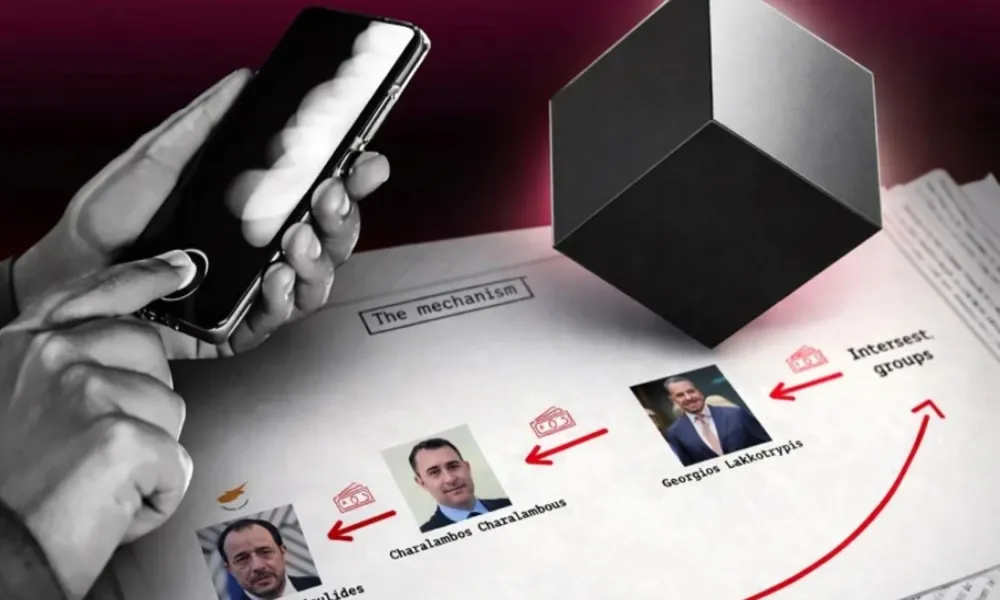

The lawyer who facilitated the delivery of the full 26-hour VideoGate recording to Cyprus authorities has challenged the conclusions of independent criminal investigator Andreas Paschalides, creating a sharp divergence over who was behind the operation and what its real purpose was.
Black Cube's link to the investigation
According to information obtained by Politis, prominent criminal lawyer Antonis Demetriou acted on behalf of Israeli intelligence firm Black Cube following the launch of the criminal investigation in January 2026 into the eight-minute video posted on X by an account operating under the name "Emily Thompson."
Demetriou reportedly informed Attorney General George Savvides that Black Cube was behind the recording and expressed the company's willingness to cooperate with Cypriot authorities in what it described as an effort to expose corruption.
In addition to arranging the delivery of the 26-hour unedited audiovisual material, Demetriou facilitated the visits to Cyprus of Black Cube's chief executive and two Israeli operatives involved in the production of the video. All three provided evidence to Paschalides and police investigators but declined to identify the client who commissioned the operation.
The Attorney General subsequently granted immunity to individuals involved in the recording and publication of the material.
Lawyer rejects hybrid attack theory
Speaking to Politis, Demetriou said Black Cube does not work for governments or states, a point which, he said, was also made by the company's chief executive during testimony.
He described Paschalides' conclusion that the operation constituted a form of hybrid attack against Cyprus as premature.
Demetriou also revealed that Black Cube required authorities to first verify the authenticity of the unedited 26-hour recording before statements were taken from company representatives.
His position contrasts with Paschalides' finding that the footage circulated publicly on 8 January 2026 was heavily edited and therefore possessed little, if any, evidential value.
Cyfield angle raises questions
On 10 April 2026, Politis reported that Black Cube was behind the controversial video. The Israeli company later confirmed its involvement, stating that it had helped uncover alleged corruption involving Cyfield in Cyprus.
Black Cube said it had cooperated with Cypriot authorities and expressed confidence that investigations would ultimately establish the truth and lead to accountability.
The report raises the question of who had the financial resources to hire one of the world's most prominent private intelligence firms to target Cyfield.
It argues that the possibility of a local competitor being behind the operation appears less convincing, given the close cooperation often seen among major Cypriot construction companies and developers.
The article suggests that, if Black Cube's account is correct, the ultimate client may have been a foreign company seeking access to sectors where Cyfield operates, including construction, property development and energy.
Paschalides points to foreign interference
Paschalides and the investigators assisting him reached a different conclusion after examining evidence from Black Cube representatives.
In his findings, the investigator adopted a position similar to that expressed by President Nikos Christodoulides shortly after the video surfaced, namely that the operation appeared designed to undermine the credibility and reputation of the Republic of Cyprus.
Paschalides stated that the primary target appeared to be the Cypriot state rather than private interests.
Among the factors cited were:
- The video's publication shortly after Cyprus assumed the Presidency of the Council of the European Union.
- What investigators described as characteristics resembling hostile influence campaigns conducted against EU member states.
- Inconsistencies between the investment scenarios presented to participants and Black Cube's explanation of its client's motives.
According to Paschalides, these factors justify the conclusion that the video may have formed part of a broader hybrid attack against Cyprus.
Investigation continues
The Attorney General has approved an extension of Paschalides' mandate until 31 December 2026 to allow investigators to continue examining the identity of Black Cube's client and the true motives behind the production of the video.
The central questions remain unanswered:
- Who commissioned the operation?
- Who financed it?
- Was the objective to expose corruption or to damage the Republic of Cyprus?
Authorities believe further investigative work may eventually identify the individual or entity behind the operation, despite Black Cube's refusal to disclose its client's identity.
Whether the full truth can emerge without the company's cooperation remains one of the key unresolved issues in the VideoGate affair.