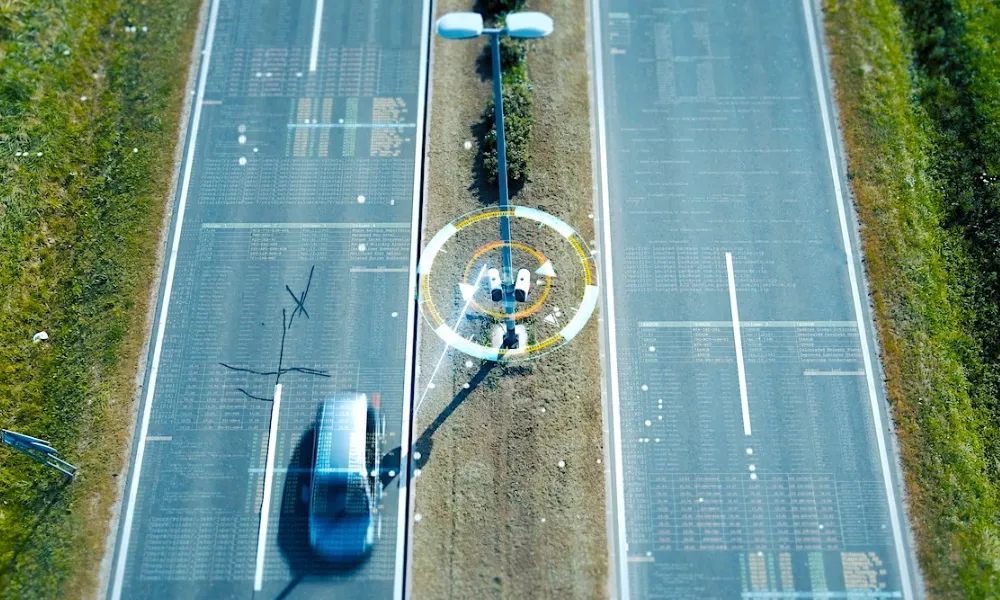

The Transport Ministry is preparing to use artificial intelligence cameras to detect drivers holding mobile phones behind the wheel, as part of a broader push to improve road safety in Cyprus.
The announcement by Transport Minister Alexis Vafeades was one of the main points raised on Thursday during the first meeting of the new parliamentary Transport Committee, where MPs also discussed traffic congestion, school buses, major infrastructure projects, public transport, vehicle recalls and staffing shortages at the Department of Road Transport.
Presenting the ministry’s priorities, Vafeades said road safety remains high on the agenda, with mobile phone use by drivers becoming one of the main factors behind serious road collisions. He said the ministry is moving ahead with AI-powered cameras capable of identifying drivers who are holding a phone while driving.
Changes are also being prepared for the traffic camera system. According to the minister, the intention is for mobile camera vans to be deployed mainly inside cities, where most fatal crashes are recorded. On motorways, the ministry is examining the use of average speed cameras, with cameras placed at the start and end of a given route.
“Mobile phones are a scourge. We see drivers even using TikTok for ten seconds while driving. We are moving ahead with AI cameras that will detect anyone holding a phone. We have no other choice,” Vafeades said.
The minister also referred to the recently implemented Mousiouttas Law, under which the fixed penalty for stopping on a pedestrian crossing at a camera-monitored junction was reduced from €300 to €85.
Traffic congestion remains a major concern
Traffic congestion dominated interventions by MPs, who described it as a problem that is worsening year by year. DISY MP Charalambos Pazaros said several road projects have been under discussion for decades without being completed, adding that the existing road network is making daily life increasingly difficult for citizens.
“The problems will become even greater,” he said, calling for faster implementation of projects and better planning.
Responding, Vafeades said around 12,000 new vehicles are added to Limassol’s roads every year, making it necessary to combine new infrastructure with traffic management measures. He said a list of around 60 projects has been prepared and will be prioritised according to need and available funding.
The minister also referred to the opening of Argyroupoleos Avenue, which he said has had a positive impact on the area, adding that a similar intervention is being promoted for Stavrou Avenue.
On the northern bypass of Limassol, Vafeades said the aim is for the project to be put out to tender by the end of the year. He noted, however, that completion would take three to four years, meaning interim solutions are also being examined.
School buses under scrutiny
Particular attention was also given to school buses, following developments in recent weeks. The chair of the Transport Committee, ELAM MP Sotiris Ioannou, said the issue will be discussed in detail at the next meeting, after several MPs asked for answers on the inspections carried out and the role of private vehicle testing centres.
The matter is expected to remain high on the committee’s agenda, especially after Vafeades acknowledged that there had been suspicions that private testing centres “were not doing their job as they should have”. That, he said, led the ministry to carry out additional state inspections on school buses.
Infrastructure, public transport and staffing gaps
The committee also discussed delays in major projects, including the Paphos to Polis Chrysochous road and Larnaca Marina, while MPs requested updates on the shortage of bus drivers and the training of new professional drivers.
Staff shortages at the Department of Road Transport were also raised. Vafeades said around a quarter of posts remain vacant, describing the department as particularly demanding and noting that several officials choose to move to other services.
The shortages, he said, affect both driving tests and service to the public.
Takata recalls, taxis and electric vehicles
MPs also requested an update on vehicle recalls linked to Takata airbags, while the issue of taxi licences was also raised.
According to Department of Road Transport Director George Louka, 3,764 recalls involving Takata airbags are currently pending. Of these, 2,503 vehicles have already been immobilised, while the remaining 1,261 continue to circulate legally because the eight-month period allowed for completion of the recall has not yet expired.
The ministry also said it will present its plans for the new Taxi Licensing Authority in early July. The new body is expected to address long-standing problems in the sector.
Vafeades also signalled changes to the state’s policy on electric vehicle subsidies. He said the new plan up to 2030 will provide stronger support to “the middle class and below”, ending grants for the purchase of expensive electric cars.
“No more subsidies for cars costing €80,000,” the minister said, adding that final decisions on the new schemes will depend on the state’s financial capacity.