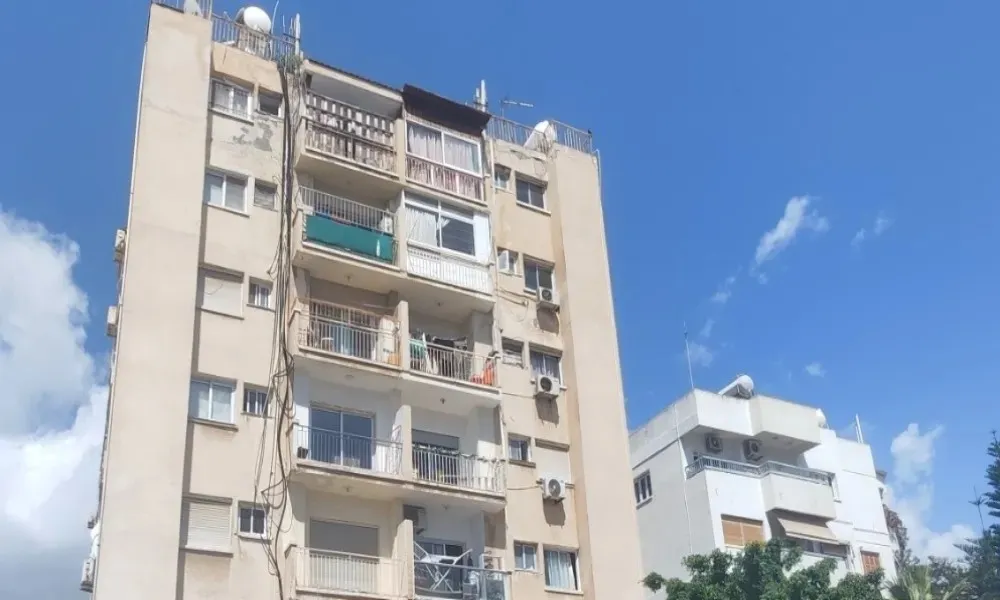

The Madona Court block of flats, with 24 apartments in the Faneromeni area, has been identified as the first building to be immediately evacuated after being classified as a “dangerous structure” following on‑site inspections by the Larnaca District Self‑Government Organisation and the Cyprus Scientific and Technical Chamber.
On Wednesday morning, officials posted formal notices ordering the immediate evacuation of the building on Vasileos Othonos Street. Residents have been given three days to leave their homes. A ground‑floor shop is also affected by the evacuation order.
The notice states that, due to serious and immediate risks to the safety and physical integrity of residents and the public, and the visible danger of collapse, occupants are required to vacate the building without delay.
Residents have been warned that if they fail to comply, authorities will proceed with a forced evacuation and secure the premises. A similar notice is expected to be posted today for another apartment block in the Chrysopolitissa area, with 17 flats, which has also been deemed dangerous.
The Ministry of Interior said Civil Defence will assist local authorities in finding temporary accommodation for residents who cannot secure alternative housing. Given the tourism season, this arrangement will last for a few weeks, allowing affected residents time to make their own housing arrangements until repairs are completed.
Lifting the risk
The coming summer is expected to be challenging for the Larnaca District Self‑Government Organisation, as the issue of dangerous buildings emerges as a major concern inherited from previous years.
The Organisation has already decided to reallocate resources and staff to its enforcement sector, particularly the department dealing with dangerous structures, in order to cope with the workload.
Referring to the two buildings requiring immediate evacuation, the organisation’s president Angelos Hadjicharalambous clarified that being classified as dangerous does not necessarily mean demolition.
“Owners will decide whether to demolish the buildings or proceed with the necessary improvement works,” he said.
He added that around 14 buildings have been initially identified as potentially dangerous across all municipalities in the Larnaca district. These cases will also require intervention to remove risk, although evacuation will not necessarily be required in every instance.
A clearer picture of how all cases will be handled is expected by early next week.
“Unaware of the 900 buildings”
Mr Hadjicharalambous acknowledged that unsafe buildings currently represent a major challenge for the organisation, stressing that efforts are focused on preventing another tragedy similar to the one in Germasogeia at Easter.
“Unfortunately, the organisation has inherited many problems and long‑standing weaknesses that were not part of its original planning. These are issues that were not properly addressed by the previously responsible departments,” he said.
He added that when the organisation began operating in the summer of 2024, authorities had no knowledge that more than 900 potentially dangerous buildings existed across the Larnaca district.