
A Cypriot researcher took part in an international scientific project on brain activity and consciousness which was later linked to funding from Jeffrey Epstein, according to an investigation by the Cyprus Investigative Reporting Network (CIReN).
The researcher says he was not aware of the full picture at the time of his involvement. The project, presented in some contexts as research into “telepathy”, extended from Cyprus to London and has since become the focus of serious ethical questions.
CIReN reports that the case is documented through testimonies, records and the accounts of people involved, showing how a scientific initiative developed into a wider controversy over transparency, consent and the role of Epstein-linked funding in research.
The full CIReN report follows below.
On weekends in a laboratory in Cyprus, long after the experiments themselves had ended, Dr. Andreas Ioannides sat alone analyzing brain data that, in his own words, revealed “something exceptional.”
“I was only sent the data and I spent six months on them, doing the analysis during the weekends,” he recalled in an interview with CIReN.
At the time, in 2016, he was unaware of the controversy that would later engulf the project he was participating in. “Had you told me the name Jeffrey Epstein back then, I would have said, ‘Who is that?’”
Epstein was convicted in 2008 for soliciting prostitution, including from a minor, and was arrested again in July 2019 on charges of conspiracy and sex trafficking of minors. He died in prison the following month.
What has since emerged – through documents released by the US government, and interviews with those involved – is an international effort that stretched from Cyprus to London, involving prominent academics working on an ambitious scientific project on telepathy, under patronage from the infamous sex offender and financier Jeffrey Epstein.
An email exchange between Epstein and academic philosopher and scientist Gino Yu, who, at the time was at the Hong Kong Polytechnic University, suggests that the collaboration started in September 2016. In that email, Gino Yu introduced Epstein to the late British neuroscientist and consultant neuropsychiatrist Peter Fenwick describing the latter as a “mentor.”
Within a couple of weeks, a meeting – ultimately held online – was arranged between Epstein and Fenwick. By December, the tone had shifted from introductions to ambition.
Fenwick wrote to Epstein outlining a research vision centered on “hyperscanning,” a technique enabling the simultaneous measurement of brain activity in two people. He spoke of understanding “how we control or influence each other.”
Fenwick, who held prominent academic positions at the King’s College London and Southampton University, was at the time widely regarded as a leading authority on near-death experiences. His research focused on consciousness and its relationship to the brain, particularly “transcendent experiences which convince us that whatever science says, we are more than just the physicality of neural transmission,” according to his obituary published in the Journal of Near Death Studies.
Fenwick died in 2024
By January 2017, efforts were underway to give the project an institutional form.
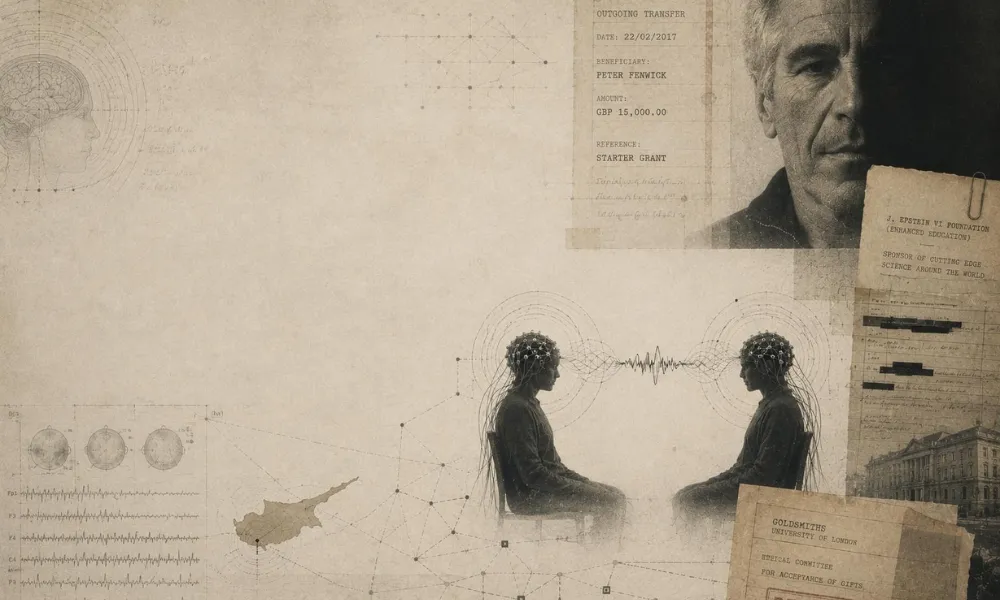
Draft agreements show involvement between the UK-based public university Goldsmiths, University of London, and Epstein via his US Virgin Islands-based foundation “Enhanced Education,” which was officially registered as J. Epstein VI Foundation and described as a sponsor of “cutting edge science around the world,” according to the now-archived webpage.
The draft agreements proposed funding a study examining the brain activity of French spiritual teacher Alain Forget and his pupils, who report experiencing light or “induced light experiences” – a visual phenomenon – during meditation.
The proposal entailed the sum of GBP85,000 be paid to Goldsmiths that would then undertake to pay Ioannides, the Cypriot scientist, the sum of GBP20,000.
The project listed cognitive neuroscientist Dr. Joydeep Bhattacharya as the principal investigator, Fenwick as a collaborator, and Ioannides as a co-investigator.
“I was approached in connection with the possibility of conducting EEG experiments,” which detect abnormalities in the brain waves, or in the electrical activity of the brain, Bhattacharya told CIReN in an email exchange, explaining that “the proposed study aimed to investigate neural and physiological correlates of reported light experiences during meditation.”
The idea was built on a small pilot study conducted earlier between two meditators – work he stressed “had no connection whatsoever to Epstein.”
Epstein, he added, “had no role in designing the experiments or in any scientific aspects of the proposed study as detailed in the draft contract.”
Yet, messages between Fenwick and Epstein suggest the latter’s role was not entirely passive.
In one exchange, Epstein proposed new experimental directions: “I think you should try doing the brain of a really serious actor – to see changes with different characters.”
In others, he criticized the project’s methodology.
“Sorry but hardly rigorous…his lack of controls and sloppy statistics were very troubling,” wrote Epstein.
To Ioannides, reviewing such comments years later, the tone stood out.
“This was a clever man,” he said. “From what I understand from some of the comments he made on our work – it was spot on.”
At the same time, he viewed Epstein’s broader motivations with caution.
“I think Epstein was interested in funding science experiments and specifically from top universities as a means of washing his name,” Ioannides said. “But maybe he was interested in this field for other reasons. I don’t know.”
While the agreement was still being processed by Goldsmiths and Enhanced Education’s VP Darren Indyke, research linked to the project had already taken place.
On February 22, 2017, Epstein transferred GBP15,000 to Fenwick as a “starter grant,” even as Goldsmiths considered the larger proposal.
In early March, Ioannides issued his first invoice to Fenwick for GBP6,500, covering his analysis of EEG data from scans of guru Forget and two of his students.
Throughout this period, he said, he remained largely unaware of the funding structure behind the work.
“I did not know who the funders were,” he said.
Ioannides’ involvement in brain research dates back decades to his background in nuclear physics.
He described Fenwick, whom he had known since 1986, as “unique.”
“He truly was. As a human being and as a scientist. An open mind.”
The pilot experiment aimed to investigate what was occurring in the brains of both the meditation students and Forget when the students reported being influenced by him during their sessions.Some reported seeing an aura around his head. The design was controlled: at intervals, the teacher was instructed to “send” or “not send” signals while brain activity was recorded.
“[When he would send,] there was something special going on [in his brain],” Ioannides said.
He observed “very, very intense” activity in high-frequency gamma bands, with statistically significant differences between conditions.
For Ioannides, the findings did not point to telepathy in a mystical sense.
“It is not telepathy”, “it is light emission,” he explained.
Such experiences, he noted, have long been reported. “You see that in religious art.”
At the same time, he pointed to measurable phenomena: “The fact that around the head there is a field is obvious because we measure a magnetic field around the head, so therefore it exists, though minuscule.”
In late March 2017, Fenwick informed Epstein in an email that Goldsmiths had rejected the donation.
In a statement issued after CIReN contacted them for comment, Goldsmiths acknowledged a funding offer was made to support an ongoing research project by an entity linked to Jeffrey Epstein called Enhanced Education.
It stated that “the matter was referred to Goldsmiths Ethical Committee for Acceptance of Gifts, who took the decision to refuse the funding”.
The fallout was evident in emails between Fenwick and Epstein. “Goldsmiths rejected the gift!! (I could wring their necks),” Fenwick wrote.
What followed was an effort to salvage the project. Fenwick proposed alternative routes, including channeling funds through an educational trust known as “The Network,” working through another university, or arranging direct payments.
Bhattacharya said he declined an offer to continue the research independently.
For Ioannides, the episode raised difficult questions about Fenwick’s motivations.
He speculated that Fenwick may have felt bound by obligations tied to the project, including commitments to students.
“[Fenwick] possibly in his desperation reached out to him [Epstein] knowingly. It is the only logical explanation I can give but I do not know for a fact.”
At the same time, Ioannides emphasized Fenwick’s character.
“He was a gentleman and an aristocrat — in the good sense. He was honorable even with the simplest people.”
He also pointed to a deeper intellectual curiosity.
“Maybe Peter [Fenwick] was intellectually curious to see who this monster was,” he said.
“With Peter we were also interested in studying the criminal mind — how any of us can turn into a criminal.”
Fenwick’s prior work at Broadmoor Hospital, studying sex offenders, he suggested, may have informed that interest.
By 2018, the patronage had broken down completely. Epstein, increasingly frustrated, wrote:
“I have received many accountings of my foundation money, but can say, none as poor as what was presented by your team.”
“Payments only made to individuals without documentation, willy nilly.”
“As I am sure you are aware, it has dictated a clear no further funding notice.”
What remained was a fragmented body of work – spanning London, Cyprus and beyond – without the institutional backing needed to continue.
For Ioannides, the science remains unfinished.
“We have something objective. Physical,” he said. “And we can observe its activity.”
But without further resources, the work stopped short.
“There was something there,” he said. “Something to study further.”