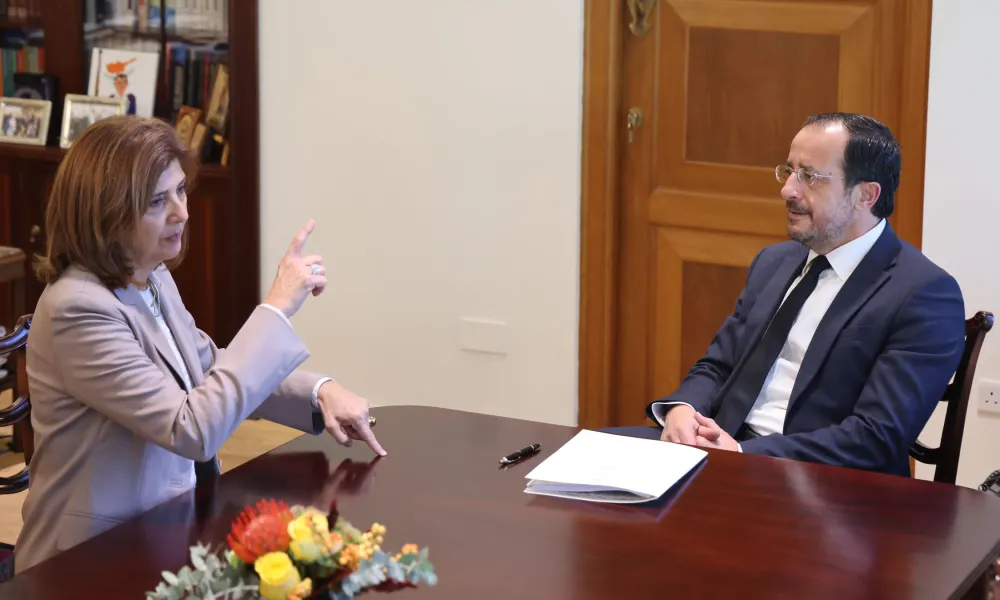

President of the Republic Nikos Christodoulides expressed his strong displeasure to the UN Secretary-General’s Personal Envoy, María Ángela Holguín, over her meeting with Turkey’s “ambassador” in the north. Government Spokesman Konstantinos Letymbiotis said the meeting was in conflict with UN Security Council Resolution 550. He also said there was room for progress ahead of the joint meeting on 9 November.
Second meeting at the Presidential Palace
Letymbiotis was answering journalists’ questions on Tuesday afternoon after President Christodoulides met Holguín at the Presidential Palace at her request.
According to the government spokesman, the brief meeting was the second between the two, after the one held the previous Friday, 30 October. The issues discussed on 30 October were raised again, along with clarifications that had been requested following Holguín’s meeting with Turkish Cypriot leader Tufan Erhürman.
Government cites Security Council Resolution 550
On Holguín’s meeting with Turkey’s “ambassador” in the north, Letymbiotis said it “is in conflict with UN Security Council Resolution 550, and UN officials, the representatives of the United Nations, should be the first to act on the basis of Security Council resolutions.”
“The explanation given is that it was requested by the Turkish side in order to pass on a message, to give a message to Ms Holguín, and that was the reason for the meeting,” he said. He stressed that “in any case, it was an action we consider unacceptable and an unfortunate moment.”
The message from Ankara
According to sources, the message Holguín received came from Turkish Deputy Foreign Minister Mehmet Kemal Bozay. Asked about its content and whether it pointed in the right direction, Letymbiotis said that “every message is in the right direction, every message is assessed, particularly at a time when efforts are intensifying even further.”
He added that the message “was such that Ms Holguín’s contacts would continue, that both today’s and tomorrow’s meetings would be requested, and of course that we would proceed towards the joint meeting on 9 November.” However, he said that “in any case, real will and real intention are assessed through the achievement of agreements.”
Holguín briefs President on talks with Erhürman
Letymbiotis said Holguín’s intention at Tuesday’s meeting was to “brief the President on what was discussed at her meeting yesterday with the Turkish Cypriot leader, ahead of the joint meeting that has been set for 9 November.”
“In this context, the issues raised at President Christodoulides’ first meeting with Ms Holguín were of course discussed,” he said. “We hope for a positive response from the other side, which could lead to progress on all three pillars set by the UN Secretary-General, on all three of which President Christodoulides has submitted proposals.”
Government sees scope for agreement
Asked whether the meeting indicated that an agreement was possible, Letymbiotis repeated the government’s position “that on many of the points there can be progress, there can be agreement, provided the necessary political will also exists on the other side.”
He said there could be progress on a number of the issues raised after Holguín’s meeting with Erhürman on Wednesday, and even more so after the joint meeting. “We await Ms Holguín’s meeting tomorrow, and even more so the joint meeting,” he said.
“The only thing I will keep repeating is that we will attend every meeting with the same constructive approach, and this was also one of the reasons why President Christodoulides, at his first meeting with Ms Holguín on Friday, put forward his own approach that we should have another joint meeting,” he said.
Clarifications and the other side’s thinking
Asked what kind of questions the President had been called on to answer, Letymbiotis said that “there are obviously issues the other side has raised regarding clarifications on the matters submitted by our side, so that we can achieve the progress we want, and it is certainly for this reason that we considered, and still consider, that the joint meeting would be even more helpful.”
He said the joint meeting “will offer an opportunity for a thorough discussion on all three pillars, precisely so that we can respond as soon as possible to what the UN Secretary-General himself has set as a goal, and which we agree with.”
Asked whether the other side had made a counterproposal to the President’s suggestions, he replied that “there are thoughts from the other side, which are certainly being discussed.” He declined to elaborate, saying the Presidential Palace does not intend to negotiate in public and that this is why the meetings take place.
“What is important is that this effort is under way. What is important is that our side, the President of the Republic, has submitted very specific proposals, which are currently under negotiation and under assessment,” he said.
“It is positive that the UN Secretary-General’s Personal Envoy herself has been in our country for days. It is positive that these meetings are regular. We hope for a positive outcome at the next joint meeting,” he added.