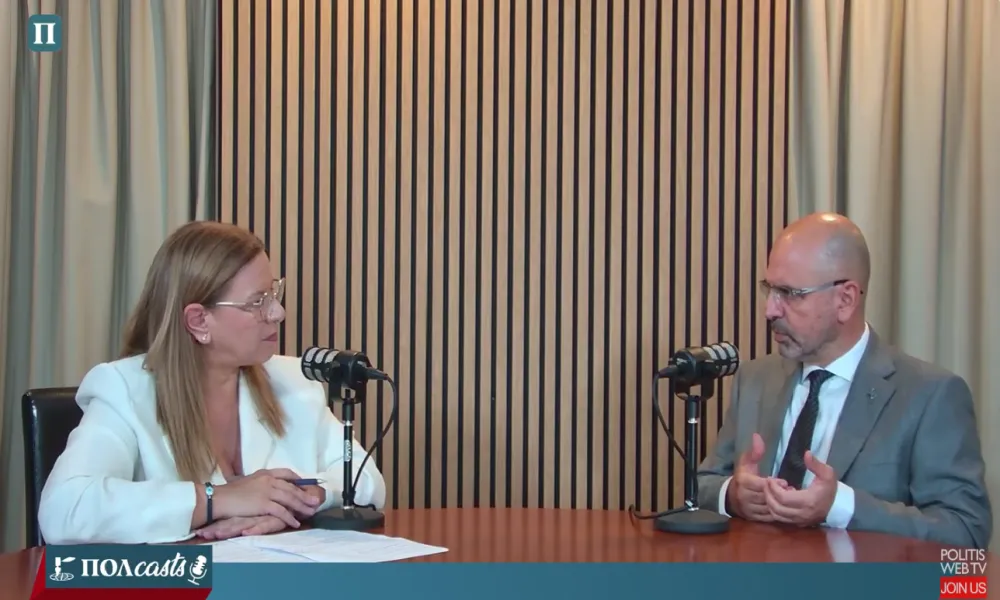

The bill for natural gas that never arrived now stands at more than €1 billion for the Republic of Cyprus, while the energy issue remains without a definitive solution. The Audit Office is preparing a study that seeks to establish the real economic cost of the delays and to record responsibility for the decisions that led the country to this financial loss. Speaking on Politis' POLcast, Auditor General Andreas Papaconstantinou said the sums involved can no longer be treated as just another routine energy matter.
Cost passed on to households and businesses
According to the Auditor General, the benefit the country would have gained from natural gas would have been passed on to households and businesses, although there is currently no formula for how that benefit would have been distributed.
"We thought it would be good this way for the purposes of statistical analysis, but also to understand what this delay means. We are talking about large amounts, but because we have discussed the natural gas issue so many times, it has become routine for us," Mr Papaconstantinou said.
He noted that millions cannot be lost without anyone being moved by it, particularly when attention is often given to matters far less significant than the loss caused by the natural gas that has not arrived.
Evidence handed to the European Public Prosecutor's Office
The Auditor General also referred to the investigation being carried out by the European Public Prosecutor's Office (EPPO) into the natural gas project, which he said has lasted more than two years. He explained that some investigations require time and that this should not be questioned.
Mr Papaconstantinou said that all the evidence held by the Audit Office was passed to EPPO. Asked about the matter, he explained that the Audit Office's investigations focused on the financial aspect. The evidence it had gathered pointed in the direction of corruption, he said, adding, however, that the Audit Office did not examine the credibility of certain information.
Asked whether there appeared to have been misuse of public money, the Auditor General replied that the findings were of interest in themselves, but that the motive and seriousness of the person who filed the complaints still need to be examined.
Audit Office letter to DEFA
According to information obtained by Politis, the Audit Office sent a letter to the Natural Gas Public Company (DEFA) expressing concern over the procedure it followed in issuing a call for expressions of interest for the construction of the jetty at Vasilikos and the completion of the onshore facilities.
As recorded in the Audit Office's findings, there is already a significant difference in the construction cost of the project, which is now being split into two parts. Under the earlier procedure, the contractor was responsible for both building the project and maintaining it for a set period.
Changes to the tender process
Under the new procedure, interested parties are asked to inspect the project at the stage it has reached, study the assessment carried out by Technip and continue the work from where it was left, under their own responsibility. The new tender does not provide for maintenance over a specific period.
In its letter, the Audit Office warns of risks and asks why the project is being divided into two parts. In response, it was told that there is time pressure and that the construction part of the Vasilikos project is already moving ahead.
Evaluation criteria and tender deadline
In evaluating applications, priority will be given to the contractor that meets the criteria set, including previous experience and expertise in similar projects, as well as other terms included in the tender documents. A separate procedure will then follow for maintenance.
DEFA's tender closes on Friday, 9 October.