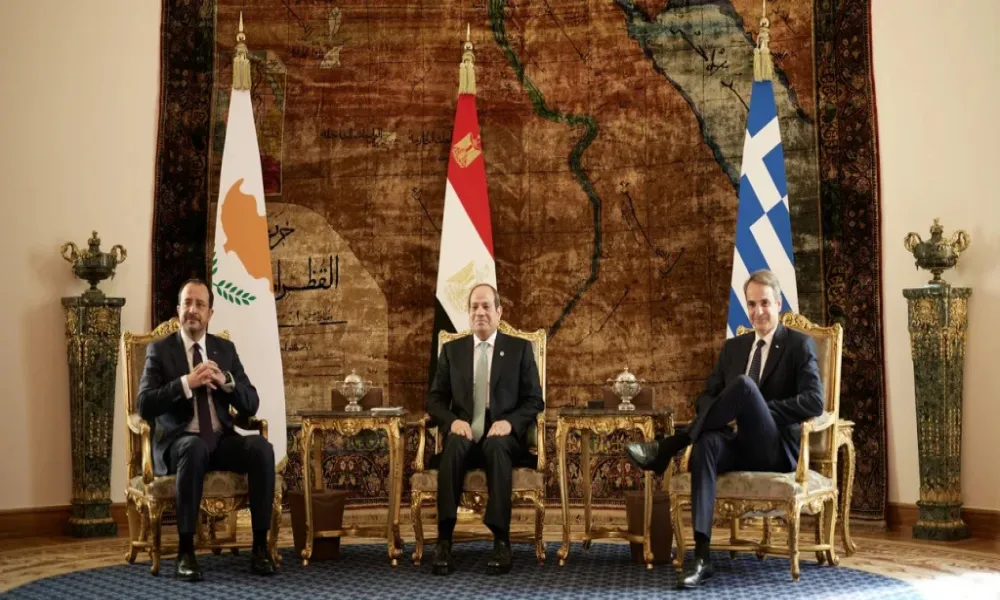



The leaders of Cyprus, Greece and Egypt agreed to strengthen their cooperation in support of peace and security in the Eastern Mediterranean and the Middle East, in a joint declaration issued after their trilateral summit in El Alamein.
President Nicos Christodoulides, Egyptian President Abdel Fattah el-Sisi and Greek Prime Minister Kyriakos Mitsotakis reaffirmed their commitment to deepening cooperation between the three countries, with the stated aim of promoting peace, security, stability and prosperity across the region. Speaking at a joint press conference following the summit, Christodoulides described the meeting as "informal in form. But strategic in substance," noting that the three countries have spent more than a decade building a framework of mutual trust structured around four pillars: stability, connectivity, security and cooperation across the wider region.
Strategic cooperation and international law
The declaration underlines the growing importance of the Eastern Mediterranean at a time of intense geopolitical challenges, with the three countries committing to continue their consultations and coordination. Greece, Cyprus and Egypt described the trilateral cooperation mechanism, established in Cairo in November 2014, as a successful model of regional cooperation and expressed their intention to develop it further.
The three leaders repeated their shared position in favour of resolving disputes and crises through political and diplomatic means, and rejected actions that increase tension or threaten regional peace and security. Particular emphasis was placed on respect for the sovereignty, independence and territorial integrity of states, as well as full adherence to international law and the United Nations Charter. Mitsotakis put it directly, saying "we are united by our commitment to international law and especially the Law of the Sea," and to respect for the sovereign rights of states, adding that Greece "threatens no one," but pursues stability through functional good neighbourly relations, which he said does not equate to concessions or tolerance of fait accompli actions. Sisi, for his part, said stability and security must be grounded in respect for international law and the sovereignty of states.
The three countries also reaffirmed that any agreements or memorandums on the delimitation of maritime jurisdictions should be concluded in accordance with international law and the UN Convention on the Law of the Sea, a point Christodoulides referenced in relation to Cyprus's own maritime disputes with Syria.
Support for efforts to solve the Cyprus problem
The declaration makes a significant reference to the Cyprus problem, with the three leaders welcoming the efforts of the UN secretary general and his personal envoy, and expressing support for the continuation of efforts to achieve a comprehensive settlement within the framework of the United Nations and in accordance with relevant Security Council resolutions.
Mitsotakis expanded on this at the press conference, saying the leaders had reaffirmed "full support" for what he called a just and viable solution to the Cyprus problem, always within the UN framework and consistent with Security Council resolutions. Such a solution, he said, would be "an extremely significant contribution to peace, stability and prosperity" across the entire Eastern Mediterranean, describing Cyprus as an EU member state, a partner in the trilateral mechanism, and "a country with a pivotal role in a highly sensitive region." Christodoulides thanked Egypt for its "steady and consistent support" for efforts to end the Turkish occupation of Cyprus and reunify the island on the basis of UN resolutions, calling Egypt's backing in regional and international forums "of particular importance" to Cyprus.
Gaza: support for a two state solution
The three countries reaffirmed their unwavering support for the legitimate rights of the Palestinian people and the need to achieve a just, lasting and comprehensive peace on the basis of a two state solution. They backed the creation of an independent and sovereign Palestinian state within the borders of 4 June 1967, with East Jerusalem as its capital, in accordance with United Nations resolutions.
Christodoulides said directly that Cyprus "cannot accept any forced displacement of Palestinians," pointing to the island's role, given its geographic proximity to Gaza, in complementing land routes for humanitarian aid from Egypt and Jordan through a maritime corridor. Mitsotakis thanked Christodoulides for what he called the building of "this extremely important maritime corridor," adding that Egypt's role on Gaza remains "irreplaceable." Sisi said the leaders had discussed the situation in the Middle East and the need for full and unimpeded humanitarian access.
The declaration also stresses the need to advance the second phase of President Donald Trump's comprehensive plan to end the conflict in Gaza, as approved under UN Security Council Resolution 2803, with the aim of beginning Gaza's reconstruction and recovery while preserving the unity of Palestinian territory. The three leaders expressed deep concern over the humanitarian situation in Gaza and reaffirmed the geographic, political and legal continuity between the West Bank and the Gaza Strip, rejecting any attempt to separate them, including policies aimed at the forced displacement of the Palestinian population.
Support for Lebanon and calls to implement Resolution 1701
Greece, Cyprus and Egypt reaffirmed their support for Lebanon's stability, sovereignty and territorial integrity, underlining the need for full implementation of UN Security Council Resolution 1701, calling for an end to all attacks on Lebanon and the withdrawal of Israeli forces from Lebanese territory. Christodoulides described Cyprus's support for Lebanon's sovereignty and territorial integrity as "steadfast," extending it explicitly to the Lebanese president, government and institutions. The declaration also stresses the importance of strengthening Lebanon's state institutions, particularly the Lebanese Armed Forces, so that they can fully exercise their responsibilities and safeguard the state's sovereignty across its entire territory.
Libya: support for the political process
On Libya, the three countries reaffirmed their support for the country's sovereignty, territorial integrity and national unity. They backed an inclusive political process led and owned by Libyans themselves, without foreign interference, called for the withdrawal of all foreign forces and mercenaries from Libya, and backed UN efforts to hold simultaneous presidential and parliamentary elections as soon as possible.
Energy: focus on electricity interconnection and natural gas
Energy security is described in the declaration as a shared interest and a key pillar of the trilateral cooperation. The three countries expressed their intention to continue developing electricity interconnection projects, including GREGY, which is expected to strengthen energy security and help connect the Eastern Mediterranean with European markets.
Christodoulides singled out the recent final investment decision on the Cronos gas field in Cyprus's exclusive economic zone as "a very significant milestone" in cooperation between the two countries, saying it marks Cyprus's transition into exporting natural gas to continental Europe through Egyptian infrastructure and confirms the Eastern Mediterranean's potential as a reliable alternative energy corridor for Europe. Sisi confirmed the talks had covered cooperation with Cyprus on developing gas resources for eventual export to Europe, while Mitsotakis said the leaders had reaffirmed their strong support for the electricity interconnection project and discussed the prospects opened up by gas cooperation.
Particular emphasis was also placed in the declaration on strengthening cooperation in the natural gas sector for the benefit of regional and European energy security, with the three countries welcoming recent developments in connecting Cypriot natural gas deposits with Egyptian infrastructure and facilities, and calling for the completion of the relevant procedures as soon as possible.
Water and the Nile
A separate reference is made to water security and the sustainable management of water resources, given the region's growing challenges, including water scarcity and climate change. The three countries recognised Egypt's particular dependence on the Nile and reaffirmed their support for its water security, underlining the need for full compliance with international law in the Nile basin, including on matters concerning the Ethiopian dam. The declaration stresses that cross border water resources should serve as a tool for cooperation rather than a source of conflict, repeating the need to uphold the principle of not causing harm, along with cooperation, prior notification and consultation, and the avoidance of unilateral actions that could negatively affect Egypt's water needs and use.
Economy, trade and investment
The three leaders placed particular importance on strengthening economic, trade and investment cooperation, with the stated aim of turning strong political relations into tangible economic opportunities for the peoples of the three countries. Sisi said the trilateral talks had covered strengthening economic and trade relations directly, alongside a wide range of other areas including innovation, industry, infrastructure, and security and defence cooperation aimed at addressing regional challenges. The declaration notes that the geographic position and competitive advantages of Greece, Cyprus and Egypt can create new opportunities for the private sector and strengthen economic interconnection, while encouraging closer contacts between business communities and partnerships in priority sectors aimed at sustainable growth and job creation.
Migration and legal employment
On irregular migration, the three countries underlined the need for a comprehensive and balanced approach combining security, development, economic and social policy considerations. They also expressed support for expanding cooperation on legal migration and creating organised employment opportunities for Egyptian workers in Cyprus and Greece, in line with existing legislation and bilateral agreements.
Egypt-EU strategic relationship
The three countries underlined the importance of further strengthening the Comprehensive Strategic Partnership between Egypt and the European Union, which they said contributes to the stability, development and prosperity of Egypt and the wider region. Christodoulides said Cyprus and Greece have worked consistently for stronger EU support for Egypt, an effort he said is "now bearing fruit" in Brussels, and welcomed the planned release in coming months of the next tranche of EU economic assistance to Egypt, first announced in March 2024 during a visit to Cairo by the president of the European Commission. He recalled hosting Sisi at the informal European Council in Nicosia in April, describing the participation of regional leaders at that summit as "historic," since it marked the first time EU heads of state and institutions had the chance to discuss the region's situation directly at that level. Mitsotakis said Greece and Cyprus had "led the way" in strengthening EU-Egypt relations, and the leaders welcomed progress on implementing the partnership's six pillars, reaffirming their intention to coordinate closely to advance shared interests and strengthen connectivity between the two shores of the Mediterranean.
Permanent secretariat in Nicosia
The three countries reaffirmed their commitment to further strengthening and developing the trilateral cooperation mechanism, through regular monitoring of the implementation of agreements and closer coordination between governments, institutions and the private sector. They also recalled the commitment made at the 10th trilateral summit to establish a permanent secretariat for the Greece-Cyprus-Egypt trilateral mechanism, based in Nicosia.
Christodoulides pointed to a busy diplomatic calendar ahead, with a sixth trilateral meeting of defence ministers due in Cairo within two weeks, and a meeting of foreign ministers to follow in New York in late September, ahead of Cyprus hosting the 11th trilateral summit. Mitsotakis added that Greece's presidency of the UN Security Council in October will include initiatives to highlight the importance of freedom of navigation, a priority he said the three countries share as maritime states.
At the end of the summit, the three leaders repeated their unwavering commitment to the Egyptian-Cypriot-Greek partnership and their determination to keep working toward a more secure, stable and prosperous region. The President of the Republic and the Greek prime minister thanked the president, government and people of Egypt for hosting the summit.