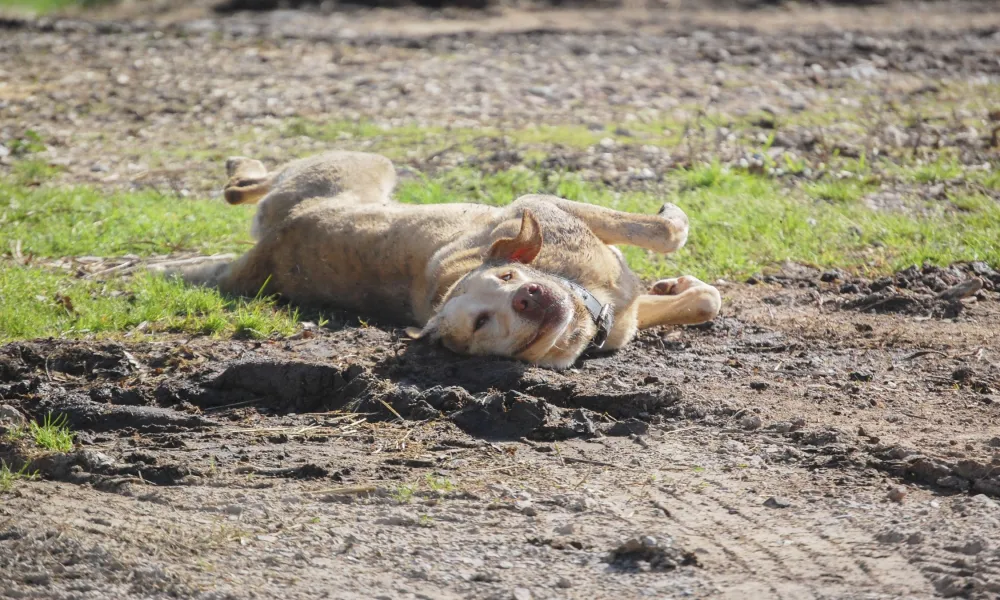

Few habits frustrate dog owners more than watching a pet enthusiastically roll in animal faeces or another foul-smelling substance. Despite thousands of years of domestication, scientists still do not fully understand why dogs are drawn to such odours.
Researchers studying wolves, foxes and domestic dogs say the behaviour may be an inherited trait from their wild ancestors, although several competing theories attempt to explain it.
An instinct inherited from wild ancestors
One widely accepted theory is that scent-rolling is an evolutionary remnant of life in the wild. Wolves have frequently been observed rolling in the faeces of other animals and even in carcasses, behaviour that some scientists believe may once have served a practical purpose.
Researchers have suggested that scent-rubbing may have acted as a form of olfactory camouflage, helping predators conceal their scent while hunting. However, a study published in the Canadian Journal of Zoology found that captive wolves often showed greater interest in unusual scents such as perfume and motor oil. The same research found wolves were particularly attracted to the faeces of other carnivores rather than herbivores, raising questions about the camouflage theory.
Communication within the pack
Another explanation is that scent-rolling serves as a form of communication.
Research conducted on captive wolves found they were selective about the smells they chose to roll in, showing particular interest in unfamiliar odours. Scientists behind the study suggested the behaviour may allow wolves to gather information from their environment and communicate it to other members of the pack.
Wildlife researcher Simon Gadbois has also observed that when one wolf begins rolling in a strong scent, other pack members often follow, suggesting the behaviour may help establish a shared group scent.
Protection from predators
Some researchers believe scent-rubbing may offer protection, particularly for smaller members of the canine family.
A study published in the Journal of Ethology documented grey foxes repeatedly visiting locations marked by mountain lions and rubbing themselves against those scent markers. Researchers suggested the foxes may be using the scent of a larger predator as a form of camouflage against threats such as coyotes.
While this theory may explain the behaviour of smaller canids, it does not fully account for why wolves and other larger predators engage in scent-rolling.
Social bonds and group identity
Researchers have also linked scent-sharing to social behaviour within animal groups.
African wild dogs have been observed rolling in the urine of members of groups they are attempting to join, while individuals within established packs frequently rub against one another's scent glands. Scientists believe this behaviour may strengthen group cohesion, social acceptance and identity.
Some experts suggest dogs and wolves may similarly use scent-rolling as a way to reinforce their place within a social group.
Do dogs simply enjoy it?
A less complicated explanation is that dogs may genuinely enjoy strong smells.
Animal behaviour specialist Michael Fox has suggested that dogs might collect scents for pleasure in much the same way humans wear perfume. Psychologist Stanley Coren has also proposed that dogs may find odours enjoyable even when humans find them unpleasant.
Supporting this idea, brain-imaging research has shown that areas associated with reward and recognition become active when dogs encounter familiar and meaningful scents.
No definitive answer yet
Despite decades of research, scientists have not identified a single explanation for why dogs roll in faeces and other pungent substances.
Current evidence suggests the behaviour may serve several functions, including communication, social bonding, scent-sharing, camouflage and sensory stimulation. It is also possible that different motivations apply in different situations.
For now, the answer remains uncertain, leaving dog owners with a mystery that is almost as enduring as the smell itself.
Source: BBC