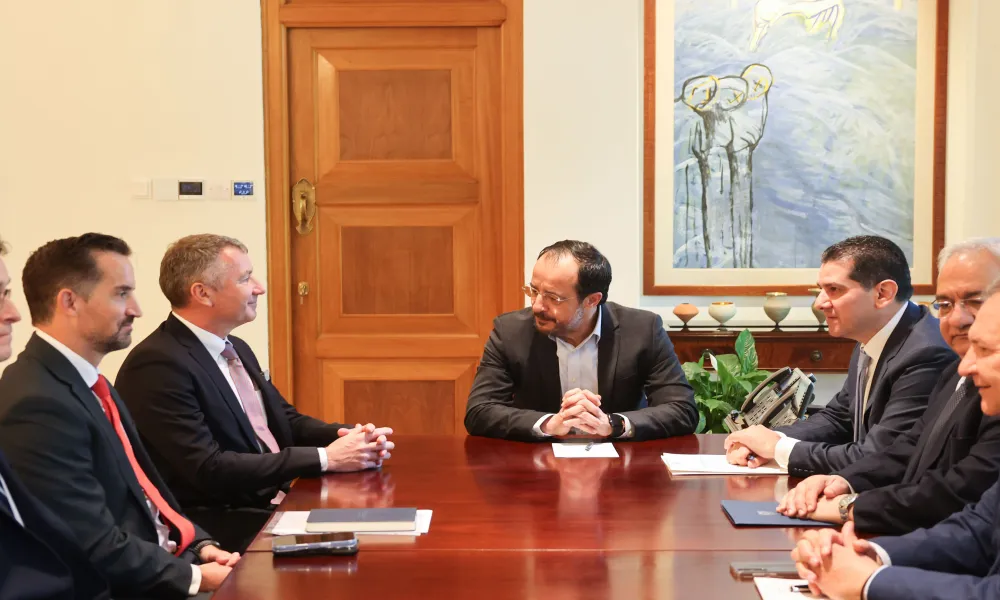
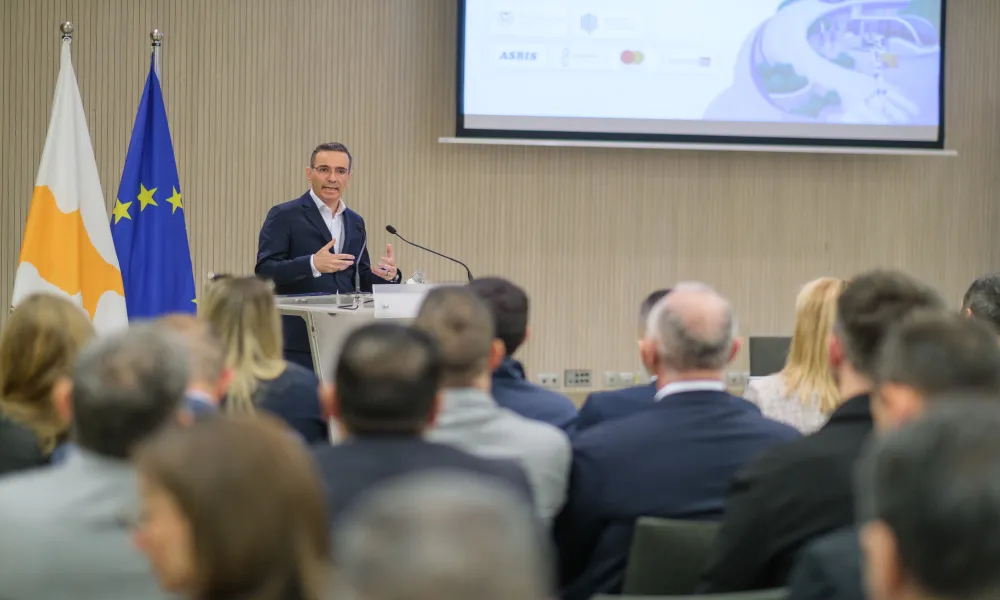

The Council of Ministers on Tuesday afternoon approved the new National Strategy for Artificial Intelligence 2026-2032. Its central aim is for Cyprus to be recognised as the leading AI hub in the Eastern Mediterranean, placing the technology at the core of both the country’s digital and wider development policy. This is according to a written statement by Deputy Minister of Research, Innovation and Digital Policy Nicodemos Damianou.
The targets for 2032
The strategy sets measurable national targets:
- Business use of AI to rise from 9.3% in 2025 to 75% in 2032
- At least 3,000 specialised AI professionals by 2032
- National productivity to improve by up to 15% through the cross-cutting impact of AI
- GDP to grow by up to 12% by 2032
According to the deputy minister, meeting these targets requires clear investment and effective implementation of the strategy. They concern all public and private bodies, not only the government. Progress will be assessed and measures adjusted accordingly.
Cyprus as a regional hub
Mr Damianou said the strategy is guided by the government’s ideological and political framework of social liberalism. It aims for a strong, competitive economy and a modern, efficient and socially responsible state.
He described the goal for 2032 as making Cyprus a leading regional AI hub and a trusted European jurisdiction for developing, testing and expanding AI solutions and services internationally. Cyprus would also act as a bridge between the European Union and neighbouring regions.
Cyprus, he noted, does not seek to compete with larger international ecosystems on scale, whether in infrastructure or very large AI models. “Our approach focuses emphatically on the application and adoption of artificial intelligence where it can create the greatest value for the country,” he said.
Public sector first, then five key industries
The strategy makes the public sector its main priority. The aim there is to increase productivity, reduce bureaucracy and speed up administrative procedures.
It also identifies five sectors of the economy as key areas of focus:
- financial services and FinTech
- health
- tourism and hospitality
- legal services
- shipping and maritime transport
According to the deputy minister, these are sectors where Cyprus has institutional knowledge and there are significant prospects for growth through AI.
Five research fields
Research and innovation remain a catalyst. The strategy provides for developing research activity and capabilities in five fields:
- energy and environment
- autonomous systems
- security, defence and space technologies
- health and life sciences
- next-generation wireless networks
Among other things, it aims to create specialised sandboxes for developing and testing innovative AI solutions.
AI literacy from age 6 to 18
People are another central pillar. The strategy aims to build the knowledge, skills and attitudes people need to understand AI, assess it critically and use it responsibly, boosting productivity rather than quietly replacing workers.
A national AI literacy programme, run by the Ministry of Education, is planned for four age groups from 6 to 18. The aim is to measure skills development and improved learning outcomes through the use of AI, not simply how often it is used.
Mr Damianou said the framework will be designed in detail with the relevant bodies, with the Ministry of Education playing the main role.
Retraining 1,000 workers
The strategy also addresses the need to retrain adult workers, with sector-specific skills for particular professions. One of the main actions is the FutureAI CY micro-credentials programme, which aims to train 1,000 workers during its pilot phase. A dedicated training programme for civil servants is also planned.
A National AI Skills Observatory will be set up so that policies and practical decisions keep programmes in line with labour market needs and technological developments.
Cyprus also aims to become a regional centre for AI education and training. Universities, research institutions and training providers will be used to attract talent and internationally recognised specialist institutions. They will also help develop high-quality educational programmes with international appeal and a focus on practical applications of AI.
Computing infrastructure and 12 flagship programmes
The strategy includes investment in computing infrastructure, along with technical and operational support for ministries and public bodies, to speed up the development and use of AI solutions in public administration. It also provides for specialised structures offering expertise and the capacity to develop, test and evaluate innovative applications.
Twelve flagship programmes are proposed for completion by 2032. They will be defined in detail and prioritised together with the relevant ministries and bodies under a three-year rolling action plan, which will also set out the necessary sources of funding.
How the strategy was drawn up
The new strategy was finalised on the basis of recommendations from the National Specialised Committee on Artificial Intelligence, led and chaired by Chief Scientist Demetris Skourides. Mr Damianou thanked him, the committee members and everyone who took part in the public consultation.
Source: CNA