

The gross minimum wage is no longer sufficient to cover the cost of average rent in the majority of European Union capital cities, according to data released in a comprehensive trade union analysis. The study highlights a severe disconnect between statutory lower-tier earnings and the inflationary surge in urban property markets, indicating that housing costs are actively driving low-income workers into systemic poverty.
Housing and utility bills currently constitute the largest single expenditure category for European households, accounting for 23.6 per cent of all domestic spending across the bloc. However, for individuals earning the statutory minimum wage, the cost of securing a standard two-bedroom flat in major metropolitan areas now routinely consumes their entire monthly income, requiring significant secondary revenues just to avoid deficit.
Prague and Lisbon emerge as most expensive capitals
The structural disparity between rental markets and statutory compensation is most severe in the Czech capital. In Prague, the average monthly rent for a two-bedroom flat stands at €1,710, whereas the national gross minimum wage is fixed at €924. Consequently, a worker would require an amount equivalent to 185 per cent of their total monthly salary simply to meet rent obligations.
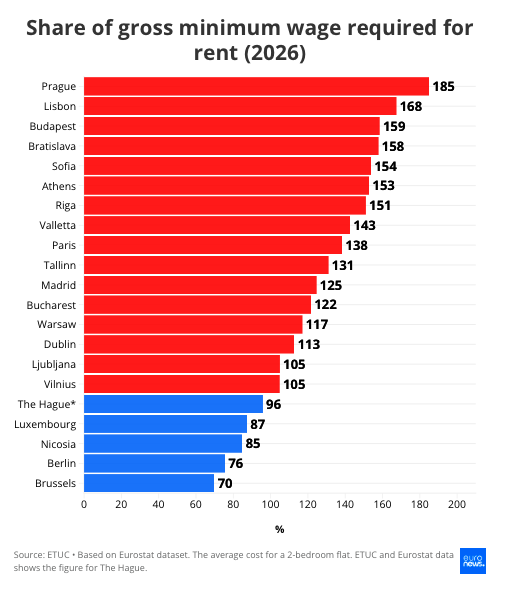
Lisbon ranks as the second most unsustainable capital for low-income earners, with rent costs absorbing 168 per cent of the gross minimum wage. The monthly equivalent gross minimum wage in Portugal is €1,073, contrasted against an average capital city rent of €1,710.
The proportion of gross minimum wage required to cover basic rent also exceeds the 150 per cent threshold in several other Eastern and Southern European capitals, including Budapest (159 per cent), Bratislava (158 per cent), Sofia (154 per cent), Athens (153 per cent), and Riga (151 per cent). In these jurisdictions, minimum wage earners must spend their entire salary on accommodation and still find more than half a secondary income to clear the balance.
Furthermore, rent outpaces the national minimum wage in a broader tier of major European capitals, exceeding 100 per cent of gross earnings in Valletta (143 per cent), Paris (138 per cent), Tallinn (131 per cent), Madrid (125 per cent), Bucharest (122 per cent), Warsaw (117 per cent), and Dublin (113 per cent). In Paris, for example, the average rent is €2,523 against a minimum wage of €1,823, while Madrid records an average rent of €1,721 against a wage of €1,381.
Brussels and Berlin offer maximum affordability
Conversely, Brussels represents the most financially viable EU capital for minimum wage earners seeking accommodation. Gross minimum wages in Belgium cover the average rent with a surplus, as rent costs consume 70 per cent of basic earnings. The average rent for a two-bedroom flat in Brussels is €1,476, while the national minimum wage stands at €2,112.
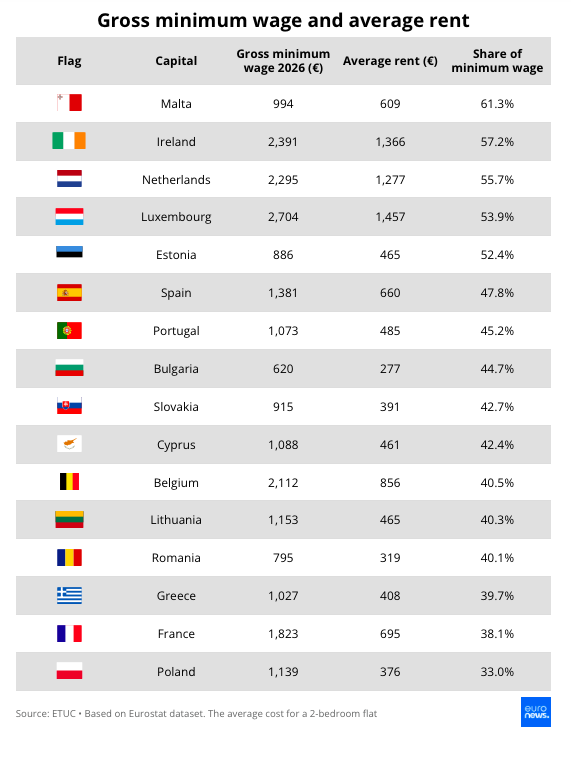
Berlin follows as the second most affordable capital, with average rent taking up 76 per cent of the German minimum wage. In Nicosia, the share of the gross minimum wage required for an average capital city flat is 85 per cent, followed by Luxembourg at 87 per cent and The Hague at 96 per cent.
The European Trade Union Confederation (ETUC) warned that the current disconnect between housing costs and basic pay is completely unsustainable. Institutional leadership noted that when rising food and energy costs are factored in, working citizens are left with zero disposable income, forcing many to borrow capital to cover basic necessities.
Regional divergence and policy demands
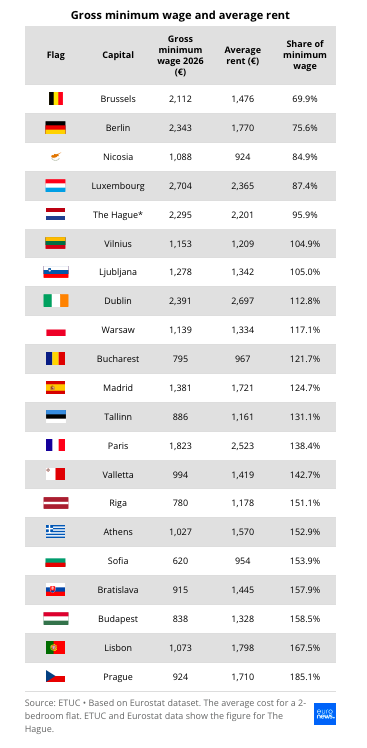
When analyzed at a broader national level rather than focusing exclusively on capital cities, housing costs appear more manageable. In many EU states, the national average rent falls below the gross minimum wage, though it still demands a significantly higher proportion of income than the standard household average. Among the 16 EU countries analyzed, national rent costs relative to minimum wages range from 33 per cent in Poland to 61 per cent in Malta. Outside of Athens, Greece offers more affordable options, with national average rents at €408 compared to a minimum wage of €1,027.
To address the growing housing crisis affecting approximately 13 million minimum wage workers across the EU, the ETUC has urged member states to adopt immediate policy interventions:
- Complete implementation of the EU minimum wage directive to actively promote collective bargaining.
- Mandatory inclusion of regional housing costs by governments when evaluating the adequacy of statutory minimum wages.
- Substantial public investment in social housing initiatives through EU investment instruments and a formal revision of state aid regulations.
Source: Euronews Business