
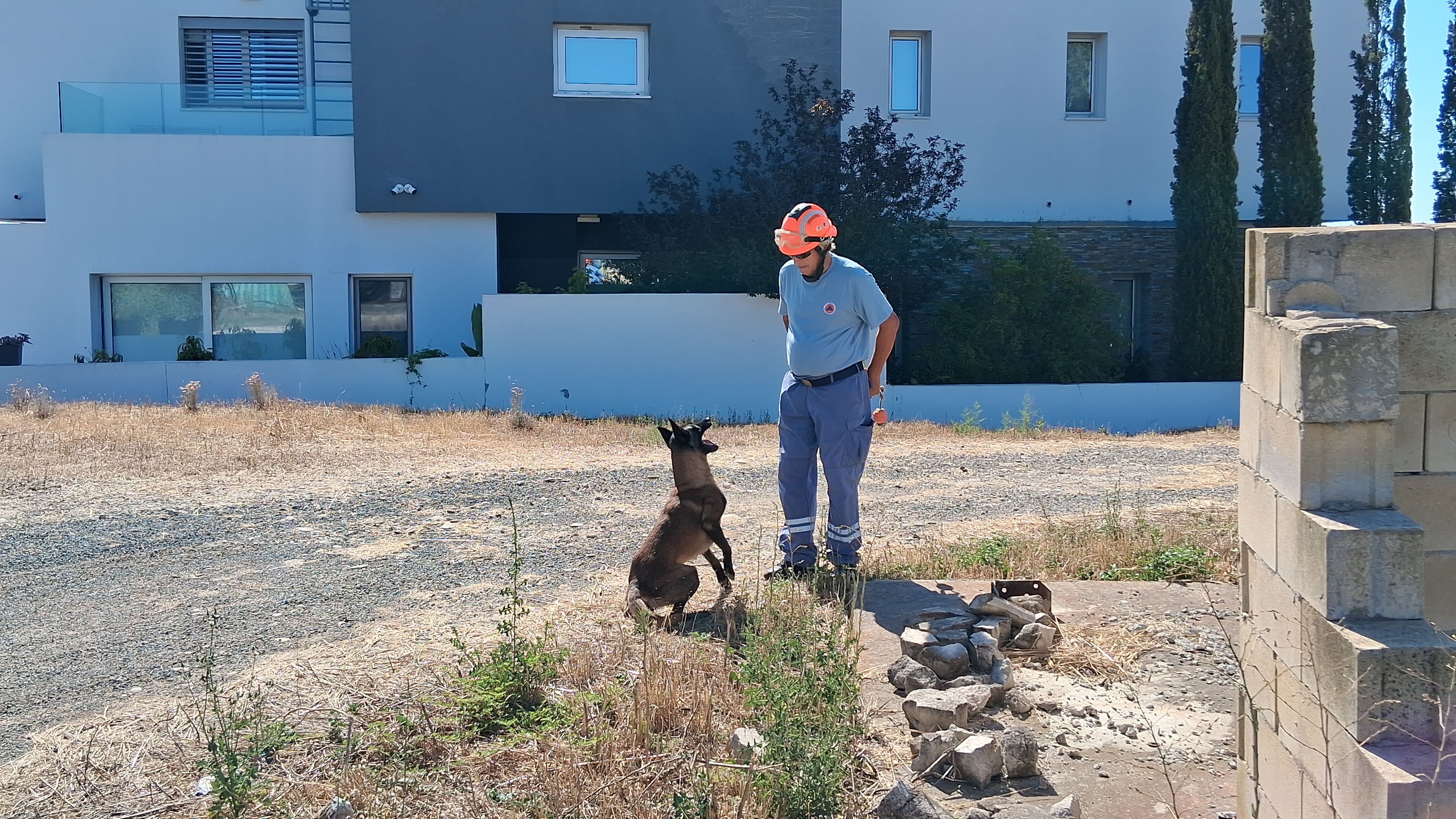
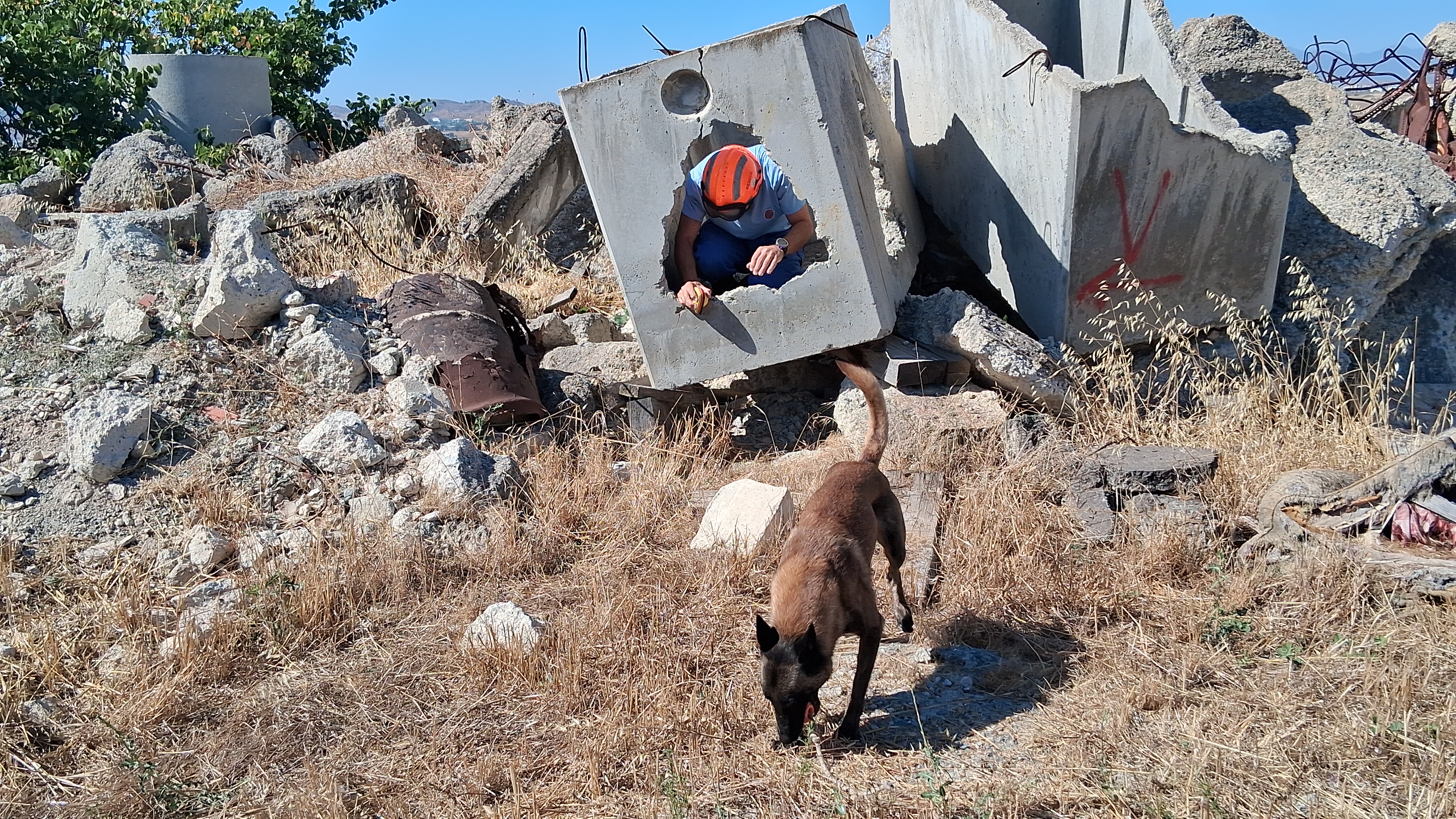
"Trapped" beneath rubble, in a setting designed to simulate a real earthquake, Alexis Alexandrou waited patiently for the moment he would be found. Pepper, a German shepherd, was released by her owner and handler, Ilias Psiloinis, and began running toward the piles of debris. Before reaching one of the mounds, where the "missing person" lay, she paused every so often to sniff the air, circled two or three times, and pushed her nose into gaps in the rubble.
When barely 15 metres separated them, her whole manner suddenly changed. Crouching low, like a cat stalking a bird, she began closing in centimetre by centimetre. But before she could reach the top of the pile, she threw her head back and broke the silence with repeated barking, full of triumph and satisfaction. This is the signal rescue dogs give their handlers when they locate a human life. In the end, Pepper went and stood close to Alexandrou, wagging her tail energetically.
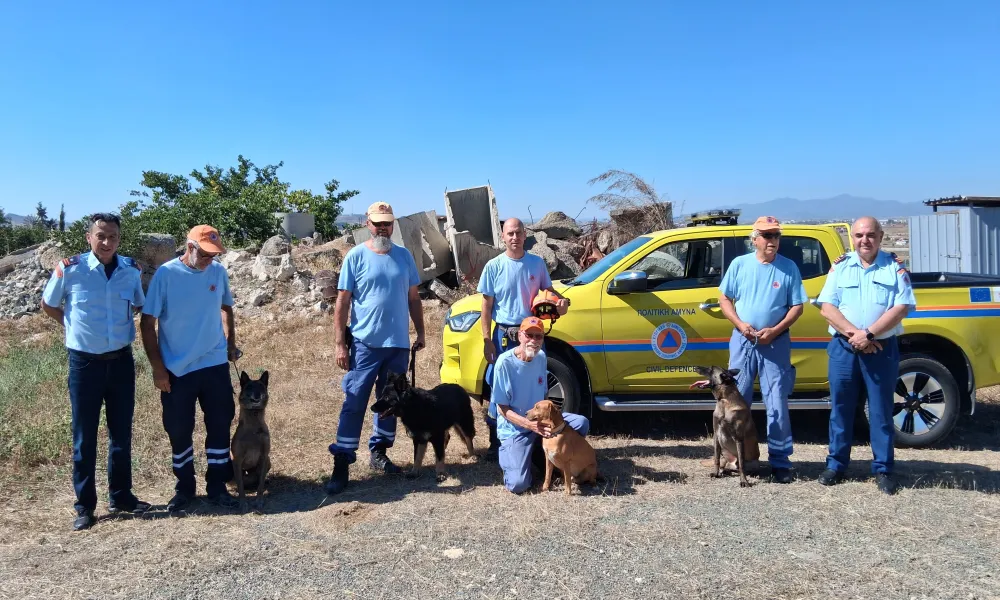
This was another training exercise for Civil Defence's volunteer team of search and rescue dogs and handlers, this time at the Strovolos training ground.
A decisive role
The recent earthquakes in Venezuela and Colombia, which left thousands dead and injured, once again highlighted the decisive role search and rescue dogs can play, particularly in the first hours after a disaster, when every minute can prove critical to saving a human life.
As Civil Defence officers and volunteers explained to Politis, dogs can cover very large areas in a fraction of the time and detect signs of human presence far faster than any technical equipment. They can reach points where rescuers cannot yet safely enter, and alert their handler the moment they detect a possible survivor. This allows rescue teams to direct their efforts straight to the right spot, saving valuable time and significantly increasing the chances of a successful rescue.
Dogs with a gift
Civil Defence currently has five fully trained detection dogs, with a sixth at the early stage of training. The goal over the coming period is to grow the team to eight dogs, which is why, through Politis, they are letting it be known that they are open to assessing the dog of any interested volunteer.
Christos Papadopoulos, the team's leader and one of its founders back in 1999, said they accept dogs for training from the age of nine months, noting that only around 20% of dogs have the "gift" for search and rescue work. These, he stressed, are exceptionally intelligent dogs, though trainability alone is not necessarily the selection criterion. According to Civil Defence, volunteer dog owners receive a subsidy every six months toward food and vaccinations.
"If we compare Cyprus' numbers with those of much larger countries, the current number of dogs is considered satisfactory, especially since there is also another team in Cyprus, that of EMAK (the Fire Service), which meets the country's operational needs. At the same time, we have properly trained handlers, who train continuously alongside their dogs, so that each handler-dog pair functions as a single operational unit," Civil Defence added.
Cyprus' first team
For the record, the first organised search and rescue dog team in Cyprus was set up by Civil Defence in 1999. The Fire Service's corresponding team, under EMAK, was established afterward, and the two work together on joint exercises as well as during operational deployments when required.
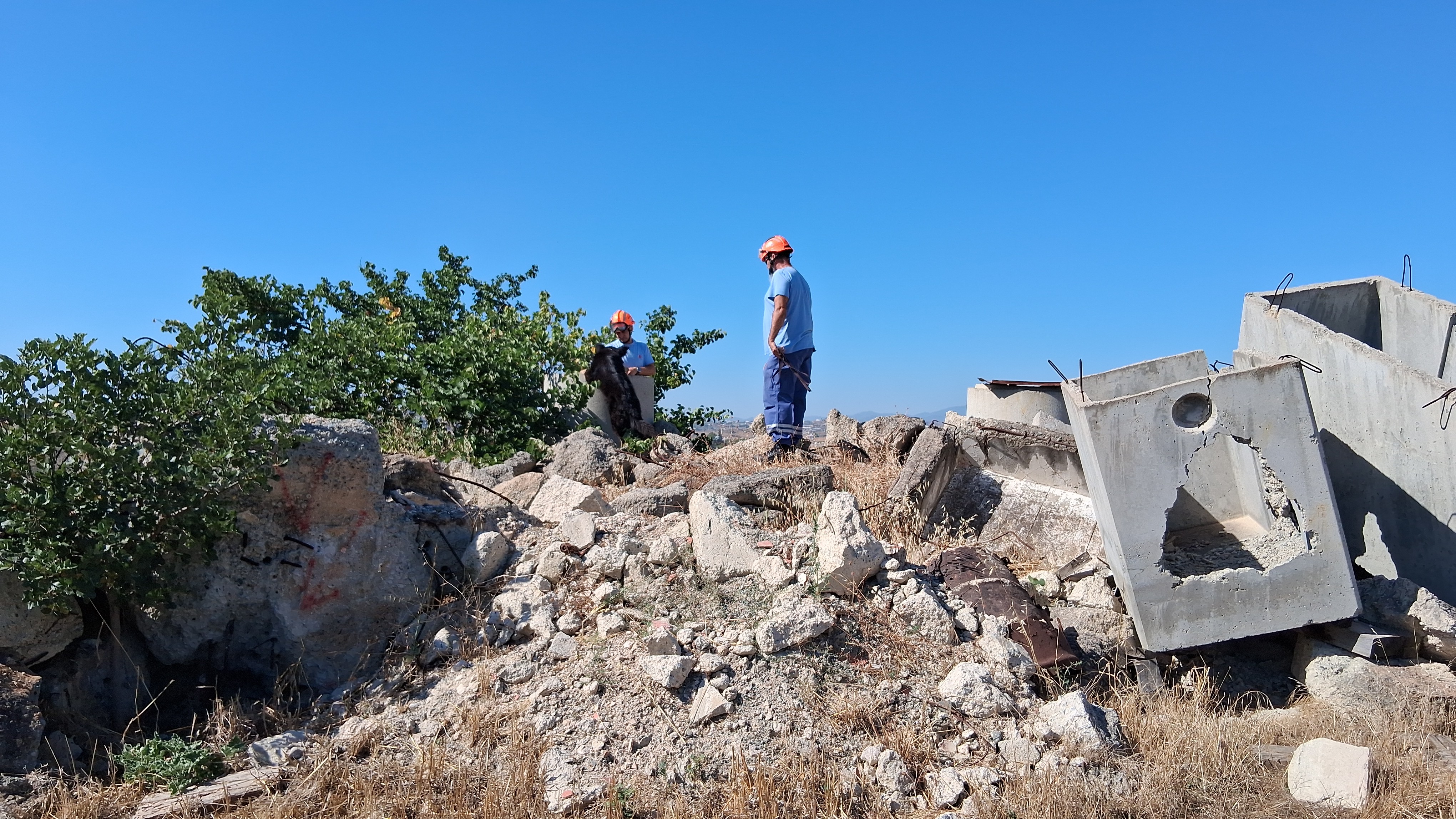
Civil Defence's dogs are trained mainly for the search and rescue of people. Specifically, they can locate people trapped under rubble after earthquakes or building collapses, as well as missing persons in open areas. In essence, they are deployed in any incident where there is a need to quickly locate a human life.
Unforgettable cases
Speaking with members of the team, who span the full age range, with older members passing on valuable knowledge to younger ones, we heard their accounts of unforgettable cases, since their dogs have often been called upon, whether in natural disasters or in other incidents requiring the location of missing persons.
Volunteer Stelios Antoniou, who has served with Civil Defence for 27 years, recalls his dog locating a British man in Ayia Napa after a nine day search. In that case, he noted, because the missing man was found dead, his dog did not bark to give the usual signal but instead, visibly upset, went and sat close to the body.
He also recalls locating a young woman's body in Kissonerga, after her car fell into a river. Another unforgettable operation for the team came after severe weather, during which the detection dogs made a substantial contribution to locating and rescuing a missing person in particularly difficult conditions, amid debris and heightened danger in the field. As they stress, such operations are a reminder of just how important a properly trained dog's contribution can be, when every minute counts.
As for missions abroad, there have been cases where the team was called on to take part in international deployments, though specific circumstances made it impossible to travel on those occasions. Volunteer Yiannis Mappouras, who has served with Civil Defence with seven dogs to date, recalls his dog's outstanding performance at a major European exercise in Crete in 2011, giving 23 indications (rescues), outperforming large European countries, which reached between 15 and 19.