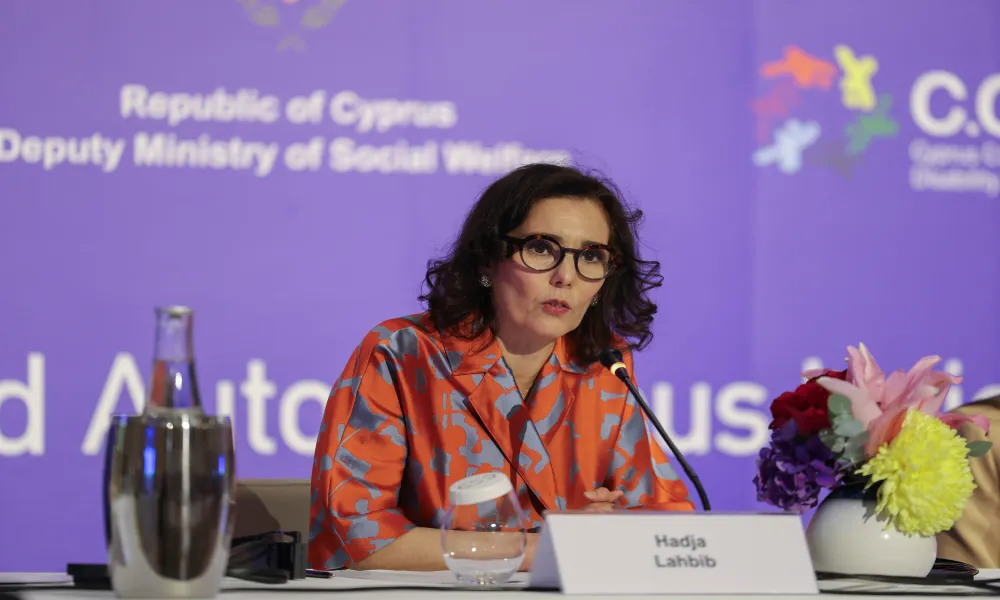



The European Commissioner for Preparedness, Crisis Management and Equality, Hadja Lahbib, has acknowledged progress Cyprus has made on disability rights and equality but flagged persistent and serious shortcomings, including the country's last place ranking in the EU's Gender Equality Index and the continued absence of a national action plan against racism.
Speaking in an interview ahead of a high-level conference on the inclusion of persons with disabilities, Lahbib said the EU's Disability Rights Strategy, launched in 2021, had produced concrete results across member states, citing the European Disability Card and the European Parking Card for Persons with Disabilities as examples of tools that now guarantee recognition of disability status and access to services across the EU. She said the Commission was "working with, not for" people with disabilities.
Cyprus' record
On Cyprus specifically, Lahbib welcomed the new National Disability Strategy 2024-2028, describing it as a meaningful step forward in expanding services, promoting independent living and supporting social enterprises. She also praised Cyprus' 2023 decision to criminalise conversion practices targeting sexual orientation and gender identity.
However, she was direct about the gaps. Cyprus remains last in the EU Gender Equality Index, and Lahbib said improvement requires a clear focus on work-life balance and women's leadership in both politics and the private sector. She noted that Cyprus was required to have transposed the EU directive on gender balance on corporate boards by the end of 2024 and has not yet done so. Under that directive, Cyprus must achieve 40% women among non-executive board members and 33% across all board positions by June 2026.
Cyprus also lacks a national action plan against racism, despite widespread concern about discrimination on grounds of national origin, Lahbib said. "Progress is real but must accelerate," she added.
She highlighted the upcoming conference in Nicosia on 17-19 May 2026 on preventing online gender-based violence as a sign of genuine commitment, referencing the Grok deepfake scandal as an example of why the issue demands urgent attention. "This is a criminal matter and we must act decisively together," she said.
The Cyprus firefighting hub
On climate and wildfire resilience, Lahbib described the Mediterranean as the region most at risk, noting that fires had already broken out in Germany, Italy, the Netherlands and the Czech Republic by early May. She said the Commission's new integrated approach to wildfire risk management, presented in March 2026, provides guidance on prevention, preparedness, response and recovery.
She described the EU firefighting hub in Cyprus, based at Paphos, as a flagship project under the Mediterranean Pact, designed to strengthen cooperation between EU member states and ten partner countries in North Africa and the Middle East. The hub will provide joint training and access to emergency support from its six stationed firefighting aircraft. Following the fires and extreme heat of July 2025, the Commission also provided Cyprus with a €2.3 million advance from the EU Solidarity Fund to restore infrastructure, fund rescue services and clean up affected areas.
Lahbib said preparations for the hub are complete and its launch is imminent. The 2026 fire season will serve as a pilot phase, allowing the Commission to assess operational effectiveness and refine cooperation models. "During my visit to the facilities, I saw that the Cypriot authorities have done remarkable work in establishing and hosting the hub in such a short time," she said.