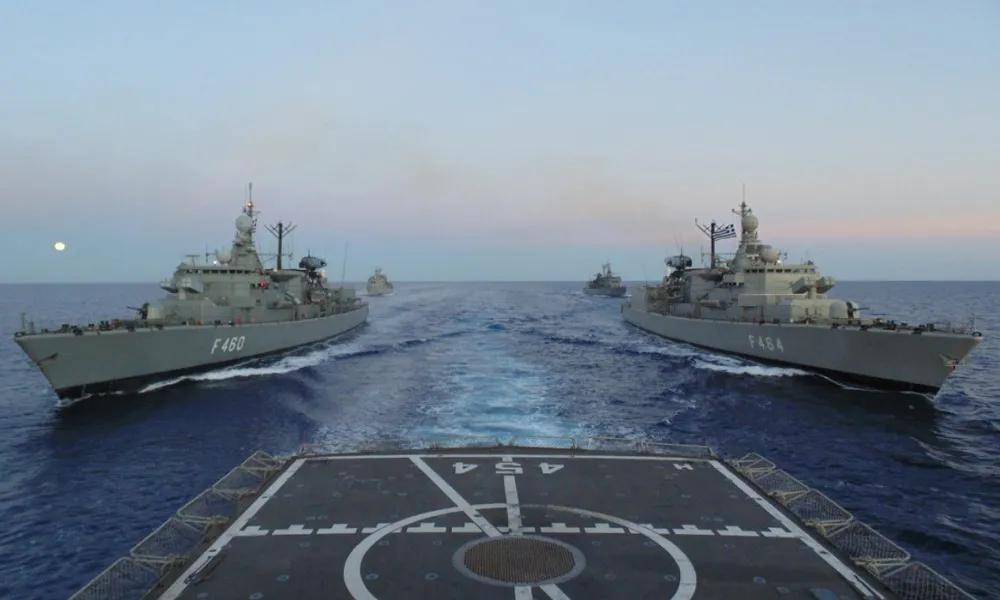



A large concentration of naval and air forces has been deployed south-west of Cyprus, forming what officials describe as a powerful European security shield around the island, even 15 days after the outbreak of war involving Iran.
Warships from six countries are operating in the area, equipped with advanced air defence and surveillance systems designed to intercept aerial threats. In combination with two pairs of upgraded Greek F-16 Viper fighter jets, the deployment has created what military sources describe as an almost impenetrable defensive umbrella protecting the territory of the Republic of Cyprus.
The mobilisation followed rising security concerns in the region, including an earlier drone strike targeting the British sovereign base areas on the island, particularly RAF Akrotiri. Security measures have also been reinforced at the Dhekelia base.
Although Iranian officials have stated that Cyprus itself is not a target, the presence of British military facilities on the island has heightened the strategic importance of defensive deployments in the eastern Mediterranean.
Layered defence and coordination
Military sources told Politis that when multiple naval assets operate in the same area, operational planning relies heavily on coordination and layered defence.
In practice, this means that different platforms complement each other’s capabilities. Through coordinated command structures, specific vessels or aircraft are designated to respond when an aerial threat is detected.
Such large-scale deployments require extensive preparation both operationally and logistically. Warships must be supplied with fuel, provisions and technical support, while additional planning is required to sustain the personnel serving on board.
Similar preparations were made for the temporary deployment of four Greek F-16 Viper fighter jets, which are currently stationed at the Andreas Papandreou Air Base in Paphos.
Personnel and fleet capacity
Modern naval vessels operate with large crews to ensure that all operational functions are covered.
For example, the Greek frigate Kimon, a Belharra-class vessel considered among the most advanced warships currently entering service, carries a crew of more than 100 personnel. Another Greek frigate operating in the region, Psara, has a crew of approximately 150.
Meanwhile the French nuclear-powered aircraft carrier Charles de Gaulle operates with a permanent crew of around 1,200 to 1,350 personnel, a number that can rise to as many as 2,000 depending on the mission and the aircraft deployed on board.
At the air base in Paphos, personnel from the Hellenic Air Force are supporting the operations of the Greek fighter jets. Additional pilots have also been deployed to allow rotation schedules that ensure adequate rest periods.
Fuel autonomy and logistical support
Despite their long operational range, naval vessels deployed in the region have logistical arrangements in place to ensure sustained operations.
Limassol port has been designated as a potential refuelling point if required, while additional supplies can be transported by helicopters supporting naval operations.
The Kimon frigate, for example, is designed for extended missions and can remain at sea for more than 30 days depending on operational conditions and sailing speed.
Operational planning also includes provisions for replenishment at sea or in port so that the defensive umbrella created by the naval coalition remains uninterrupted even during a prolonged crisis.
Command and control
Representatives from the participating countries maintain continuous coordination regarding the role and responsibilities of each deployed asset.
According to Defence Minister Vasilis Palmas, the General Staff of the Cyprus National Guard has overall operational coordination for the interception of aerial threats and other defensive operations carried out by the forces deployed around Cyprus.
All radar systems of the National Guard’s air defence network have been activated and are actively participating in the detection of potential airborne threats.
However, ground-based surface-to-air missile systems have not been deployed as part of the current arrangement. According to the operational planning, interceptions are expected to be carried out primarily by naval air defence systems or by the Greek F-16 fighter aircraft.
Officials say this decision is partly based on cost considerations, as intercepting smaller threats such as drones with high-value missiles is significantly more expensive than using other defensive systems.
Anti-drone system “Centaur” to strengthen National Guard
Meanwhile the Cyprus National Guard is being reinforced with units of the anti-drone system “Centaur”, a Greek-developed electronic warfare platform designed to detect, track and neutralise unmanned aerial systems.
The system is being supplied through the European SAFE programme, with the National Guard expected to initially receive four units.
Developed by the Hellenic Aerospace Industry in cooperation with Greek universities, the Centaur system uses electronic jamming techniques to disrupt the control and navigation signals of drones, severing the connection with their operators without revealing the system’s own location.
The system has already been deployed on Greek Navy frigates such as Psara and Hydra and has been used operationally against hostile drones during missions in the Red Sea.
The acquisition of the Centaur anti-drone system has also been confirmed by the Ministry of Defence.