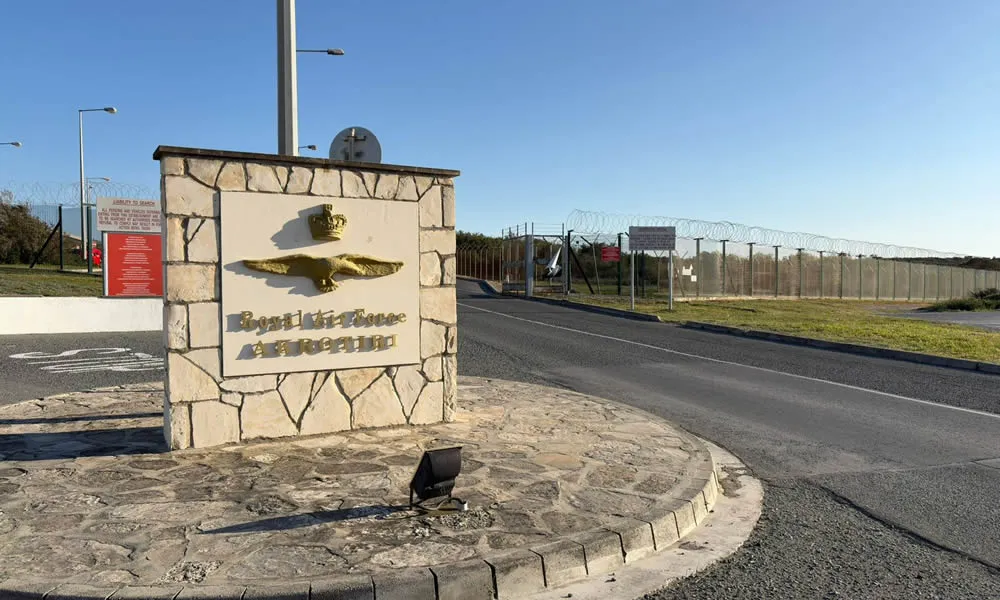



The recent drone attack on the military airfield at the British base in Akrotiri, carried out in retaliation for the US-Israeli strikes on Iran, has pushed the role and status of the British Bases in Cyprus back into the spotlight. At a time of renewed geopolitical instability in the Middle East, questions are once again being raised about whether their presence strengthens or undermines the security of the Republic of Cyprus. Speaking to Politis, Costas M. Constantinou, professor of International Relations at the Department of Social and Political Sciences of the University of Cyprus, examines the historical, legal and political dimensions of the issue, as well as possible future scenarios for the Bases and comparisons with other post-colonial cases. He also puts forward an interesting proposal concerning villages in the buffer zone.

Could the British Bases drag Cyprus into regional conflicts?
According to Constantinou, that possibility is always there. The British Sovereign Base Areas, or SBAs, have for decades been used directly or indirectly in wars across the region. Under the Treaty of Establishment, the Republic of Cyprus does not have the power to exercise sovereign control over the Bases or to close its airspace to them if it wishes to remain neutral or uninvolved.
As a result, he argues, Cyprus can end up being wrongly targeted for actions it cannot itself control, as happened after the 1986 bombing of Libya and again today. Even if hostile actors are primarily aiming at British military facilities, Cypriots live and work next to them. If the Republic of Cyprus is seen as linked to military operations in the region, the risk increases further.
For a territorially small country such as Cyprus, where infrastructure is geographically concentrated, he warns, only a few long-range strikes could paralyse the country as a whole.
A source of insecurity rather than security
Constantinou says the Bases are often presented as strategically useful for Cyprus’s security, and he acknowledges that they played a stabilising role during the intercommunal violence of 1963-64 before the arrival of UNFICYP. He also notes that they provided shelter and humanitarian support to both Greek Cypriots and Turkish Cypriots in 1974.
But at the critical moment of the Turkish military intervention and the island’s de facto partition, he says, the Bases remained uninvolved. In the broader regional context, he argues, they are a source of insecurity and instability for Cyprus because they act independently and without accountability and are not here on the basis of a specific defence alliance with the Republic.
He points out that the 1960 Treaty of Alliance is vague and, because of the Cyprus problem, effectively inactive. The United Kingdom is not even a party to that treaty.
“An ingenious evolution of colonialism”
Are the British Bases sovereign? Constantinou says that under the Treaty of Establishment they are indeed recorded as sovereign. Cyprus may have politically contested that over time, but it accepted and signed that terminology in 1960.
He notes that the Bases were not incorporated into the EU in 2004, even when the United Kingdom was still an EU member, because London asked for them to be excluded. This stands in contrast to the occupied areas, which are technically part of the EU but under suspension of the acquis.
For Constantinou, the Bases are an overseas territory marked by the same pathologies as similar territories that remained under the control of European imperial powers such as France, the Netherlands, Spain, Denmark, the United Kingdom and, in different ways, the United States.
What defines such territories in practice, he says, is limited and graduated sovereignty. Depending on the case, external sovereignty remains with the metropolitan state, especially on defence and security matters, while much of the internal administration is left to the local community, provided this does not affect the overall functioning of the regime. “It is an ingenious evolution of colonialism,” he says.
Similarities with Chagos
Constantinou sees clear similarities between the British Bases in Cyprus and the Chagos Islands. In both cases, territory was detached from a colony in order to create a sovereign military base, coercion was involved, and the creation and recognition of the post-colonial state was legally tied to the simultaneous creation of the base.
He says the Chagos case is more tragic because it involved the violent displacement of a population, something that did not happen in the same way in Cyprus. There is also the issue of Chagossian self-determination, which both the United Kingdom and Mauritius have largely sidestepped and which may become more prominent in future. Chagossians have already begun returning without Mauritian consent, even though Mauritius does not favour an unstructured return or separate negotiations between Chagossians and the British.
More broadly, Constantinou says the Chagos advisory opinion by the International Court of Justice offers hope for a form of decolonial justice for nations and peoples historically marginalised in the international system. He stresses that decolonisation in many parts of the world was itself deeply damaging and in some cases more destructive than colonialism. It often produced rushed and artificial states within borders inherited from European colonial powers, with little logic beyond imperial bargaining, strategic calculations and territorial penetration.
In places such as North and South America, Australia and New Zealand, he argues, decolonisation effectively legitimised settler colonialism and the dispossession of indigenous peoples in the name of the concentrated sovereignty of the post-colonial state. These are not simply colonial remnants, he says, but transformations of colonial forms of governance with far-reaching social, political and ecological consequences that the international community still fails to recognise properly.
The first partition of Cyprus
Asked whether there is still something post-colonial in the Cyprus-UK relationship over the Bases, Constantinou argues that the SBAs can be seen as the evolution of a colonial system of governance. In essence, he says, they amount to the first partition of Cyprus, one that is not usually perceived as such because it resulted from an international agreement and a de jure division rather than the de facto partition that followed in 1974.
That, he says, is precisely its success. British sovereignty is exercised in a softer form, with the UK retaining territorial title and jurisdiction without carrying the political and social burden of governing local populations. In other words, it is sovereignty with rights and privileges for the UK, but with fewer obligations than those usually borne by sovereign states.
Because the residents of these areas are citizens of the Republic of Cyprus, the burden of governance is in practice shifted largely onto the Republic, where they enjoy full rights. The laws of the Republic are, to a large extent, aligned with the legal framework of the Bases, and in practice there is no hard border or systematic control of movement between the Republic and the SBAs. A resident or visitor therefore feels as if they are anywhere else in Cyprus, even though the areas remain governed by military regulations and restrictions and have their own courts and institutions.
Can the status of the Bases be reopened?
Constantinou says that if the issue of the Bases is to be raised meaningfully, it would require careful study and extremely delicate legal and political handling. On one level, there is the legal dimension: the status of the Bases is entrenched through the Treaty of Establishment, and any attempt to denounce the treaty would open a broader discussion that could potentially affect the international status of the Republic of Cyprus itself.
Legally, he says, Cyprus could seek an advisory opinion from the International Court of Justice through the UN General Assembly, as happened in the Chagos case. But there is also the political dimension. Because the issue is linked to the unresolved Cyprus problem, it is almost certain that the Turkish Cypriot community would seek to become involved, quite possibly with encouragement from the UK, since it too was a party to the treaty framework.
For that reason, although the issue could be raised now, Constantinou believes it is highly complex and would in practice create additional problems. He does not believe it can be resolved in a comprehensive and meaningful way before an overall settlement of the Cyprus question.
Has the presence of the Bases been legitimised?
To some extent, yes, he says. Their legitimacy has been built through relationships of transaction and mutual benefit, although periods of crisis also produce renewed delegitimisation.
Over time, relationships of coexistence and dependency develop between the Bases and local communities. Villages inside or adjacent to the SBAs derive economic benefit from them through employment and the provision of services. This is not unique to Cyprus. Around the world, foreign military bases are contested or entrenched depending on circumstance and the benefits they provide.
He cites Djibouti as the clearest example of a state built around foreign military bases, with the country deriving substantial economic and political gains from their presence. Alongside the United States, France and Italy, Djibouti also hosts bases belonging to China, Japan and Saudi Arabia.
Cyprus, however, has an additional dimension. Some areas that might otherwise have ended up under occupation remained outside it because they fell under British sovereignty in 1974. He points to Dasaki Achnas, which remained outside occupation unlike the village of Achnas nearby, whose residents were displaced. In that sense, the question of legitimacy operates very differently in the day-to-day lives of local communities, depending on the context, the damage they bear or the benefits they receive.
Three possible future scenarios
If an international discussion were to begin today on the future of the British Bases in Cyprus, Constantinou sees three broad scenarios.
The first would be the preservation of the current status quo with limited practical adjustments, such as another memorandum of understanding between the Republic of Cyprus and the UK that would satisfy some longstanding demands, including development in certain areas or forms of institutional consultation over how they are used.
A second scenario would involve a gradual revision of the status of the Bases, with the return of some land or the conversion of part of the territory into facilities for European use, potentially involving the EU and perhaps NATO. He says this is difficult but not impossible in a period of geopolitical realignment, when bases in strategic locations have acquired renewed significance.
The third and most far-reaching scenario would be the complete abolition of the sovereign base regime and the return of the territory to the Republic of Cyprus, possibly followed by a long-term lease arrangement similar to what has been discussed in Chagos. Constantinou does not see this happening before an overall Cyprus settlement, because he believes the Turkish Cypriot side would make claims over land in the Dhekelia area where there is no buffer zone. That, he says, complicates matters and naturally works in Britain’s favour.
The buffer zone villages as a coexistence experiment
Constantinou was also asked about the ceasefire line, which has functioned for decades as a de facto border. He said the so-called buffer zone initially ended hostilities after the 1974 invasion and created a framework of relative stability. That stability made possible the economic and social recovery of communities and the gradual restoration of normal daily life after the war.
At the same time, however, it entrenched a powerful reality on the ground. Over time, the existence of the line tends to normalise division, reinforcing the belief that the Cyprus problem cannot be solved or that the present state of affairs has become, under the circumstances, an acceptable de facto solution.
For Constantinou, the line produces contradictory feelings. It offers a sense of security, especially given fears over what might happen if the buffer zone ceased to be controlled or if the United Nations were to withdraw. But it also remains an open wound and a source of insecurity because of the problems that arise in its management.
He says the buffer zone has played an important role in preserving peace and has also been used by citizens and organisations for cooperation projects such as the Home for Cooperation in Nicosia. Other ideas, such as joint solar parks or environmental initiatives, have also been discussed.
But there is no commonly accepted official map of the zone, which frequently leads to disputes over its limits and use. These disagreements do not arise only between the Greek Cypriot and Turkish Cypriot sides, but also between the two sides and UNFICYP. The United Nations regularly records violations from both communities, while the management framework itself rests largely on a UN memorandum rather than a formal written agreement. In his view, the recurring tensions in places such as Denia and Pyla show that this arrangement is not sustainable.
Beyond confidence-building measures
Constantinou argues that the term “confidence-building measures” no longer adequately reflects the reality of the Cyprus problem. Since the opening of the crossing points in 2003, trust has already been tested in practice. Those who want contact and cooperation pursue it, while others remain suspicious. Both attitudes, he says, deserve respect.
Trust is fragile and can easily collapse after a single negative incident. What is needed now, he argues, is not more rhetoric about confidence-building, but “partial justice measures” for people who have waited decades for specific and meaningful remedies that have still not arrived.
By this he means measures that would substantially improve people’s lives and resolve specific, smaller aspects of the Cyprus problem that nonetheless matter deeply to those affected.
Beyond the prospect of a return to Varosha, for which there is already a relevant UN Security Council resolution, he suggests that abandoned villages which are no longer inhabited or used by the Turkish military could be considered for return. These include Achnas, Asomatos and Ayia Marina. In the case of the Maronite villages, he notes, the Turkish Cypriot side has in the past expressed a positive attitude towards a possible return.
He also says there could be a parallel return of abandoned Turkish Cypriot villages in areas controlled by the Republic, some of which are now in ruins or reduced to a few surviving buildings. Examples include Ayios Sozomenos, Kataliontas and Ayii Ilyofotou, with the latter two having almost disappeared. Other Turkish Cypriot villages are used today as livestock farms. The situation on both sides, he says, is provocative and continually justified by reference to the unresolved Cyprus problem.
Small but meaningful steps
Could the gradual resettlement of buffer zone villages serve as an experiment in coexistence between the two communities? Constantinou believes it could provide a realistic step towards justice for displaced communities.
He says the Greek Cypriot villages of Varisia and Ayios Nikolaos Soleas, the mixed village of Ayios Georgios Soleas and the Turkish Cypriot village of Petrofani could, under the right conditions, be resettled. Because they lie in areas controlled by the UN, the process would be relatively straightforward, and UNFICYP could play a role in facilitating a return under normal conditions in line with UN Security Council Resolution 186 of 1964.
The community of Varisia submitted a request to the United Nations in 2019, but the response was that such a move was “not possible at this time”. Since then, the displaced have continued to wait, raising the obvious question of when the “right time” for solving such humanitarian issues will ever come.
At the same time, Constantinou notes, it seems that even on the Greek Cypriot side these villages have effectively been written off. Even the website of the Union of Cyprus Communities lists them as Occupied Communities of Nicosia, although they are in the buffer zone. These are small but self-evident and important steps, he says, that should be claimed on behalf of people who have been waiting more than fifty years for a solution.
Cooperation does not cement division
Asked whether the daily functioning of the crossing points reinforces partition in people’s minds, Constantinou rejects that view. In his opinion, what cements partition is not the operation of crossing points but the failure to solve the Cyprus problem, and even more so the continued existence of closed crossing points.
The ability to move and maintain contact between the two communities keeps alive an everyday relationship that would otherwise disappear. Cooperation matters, he says, because any future settlement will ultimately have to be implemented by people themselves. In that sense, the accumulated practice of cooperation can form part of the foundation for applying a future solution.
He also rejects the idea that people necessarily or always think in binary terms such as “them over there and us over here”. Human beings are capable of rethinking old assumptions. Through movement to the “other side”, through recognising the island’s shared natural and cultural heritage, and through common care for shared spaces, people’s understanding broadens and a more mature view of coexistence and the possibility of an overall settlement becomes possible.
Can small problems lead to a larger solution?
Constantinou says Cyprus failed to achieve a comprehensive settlement of its national problem, but it did succeed in transforming the conflict into a non-violent one. That, he says, is particularly significant when set against the protracted conflicts that continue to generate violence and instability across the wider region and internationally.
In that context, he sees scope for a more gradual approach to a Cyprus settlement through resolving specific aspects of the problem and building conditions for cooperation. Such an approach would require practical diplomacy not guided exclusively by the logic of big “national goals”, which often collide and prolong confrontation.
Alongside national objectives, he says, Cyprus needs practices that recognise smaller side issues, cultivate an ethic of care, and, where possible, deliver justice to people directly affected by the conflict.