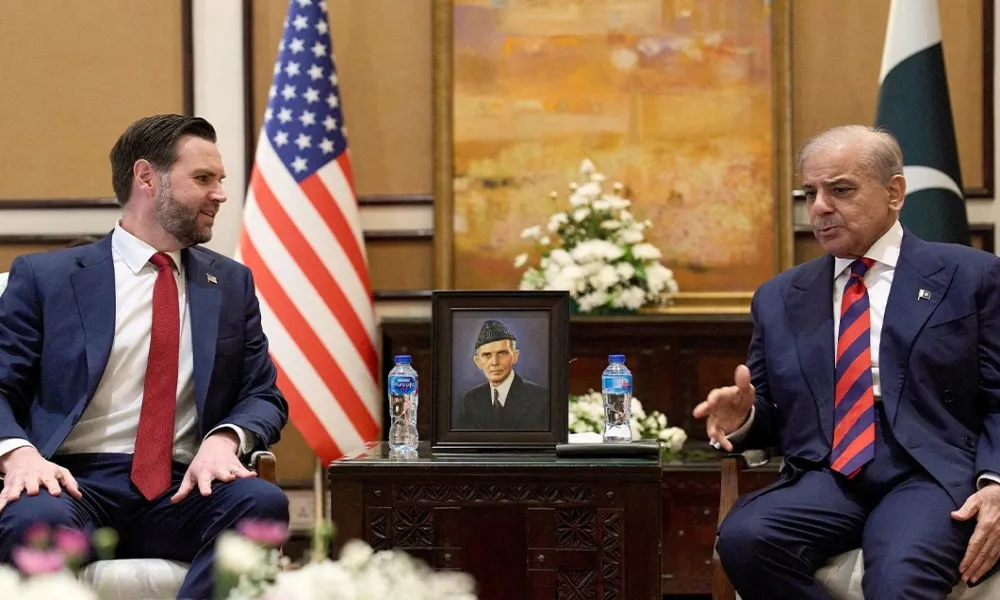
Delegations from the United States and Iran failed to reach an agreement to end the war in the Middle East following marathon talks in Islamabad, US Vice President JD Vance said on Sunday.
Vance departed for Washington after submitting what he described as the “final and best offer” the US could make to Iranian representatives.
“We will return to the US without having reached an agreement,” he said during a brief press conference in Islamabad, noting that American and Iranian officials negotiated for 21 hours, from Saturday through to the early hours of Sunday.
“I think this is worse news for Iran than for the US,” he added.
'Unreasonable demands'
Vance criticised Tehran in particular for failing to provide an “explicit commitment” to abandon its nuclear programme, a key demand of US President Donald Trump, who launched the war alongside Israeli Prime Minister Benjamin Netanyahuon 28 February. The conflict has since cost thousands of lives and triggered major disruption to the global economy.
“We are leaving after submitting a very simple proposal — our final offer and the best we could make,” Vance said, adding that the US had made its “red lines” clear. “We will see whether the Iranians choose to accept our terms.”
Tehran confirmed the end of the negotiations, attributing their failure to what it described as “unreasonable demands” by the US, according to a report by state broadcaster IRIB.
More time
The talks, mediated by Pakistan, were held at an unprecedented level since the Iranian Revolution.
They followed the announcement of a two-week ceasefire on Wednesday and were aimed at reaching an agreement for a lasting truce.
On the US side, Vance was accompanied by White House envoy Steve Witkoff and Jared Kushner. Iran was represented by Parliament Speaker Mohammad Bagher Ghalibaf and Foreign Minister Abbas Araghchi, among others. The delegations reportedly included around 70 members.
Before the breakdown of the talks was announced, Iranian foreign ministry spokesman Esmail Baghaei said discussions had covered “various components of the main issues under negotiation”, including the Strait of Hormuz, Iran’s nuclear programme, the lifting of sanctions, and a definitive end to the war against Iran and in the wider region.
Vance indicated that Washington would allow some time for Tehran to consider the US proposal.
Formal commitment
He insisted that the US was seeking a formal commitment from Iran that it would not pursue nuclear weapons or acquire the capability to build them quickly.
“The fact is we need a formal commitment from their side that they will not seek nuclear weapons and will not seek the means that would allow them to develop them rapidly,” he said.
“The question is simple: will we see a formal commitment from the Iranians that they will not develop nuclear weapons — not just now or in the coming years, but in the long term? We have not seen that yet. We hope we will.”
Vance focused on the nuclear issue as the central reason for the failure of the talks and did not address the Strait of Hormuz during the press conference.
The strategic waterway in the Gulf, which is vital for global energy supplies, has effectively been closed since the start of the US-Israeli war against Iran, with serious knock-on effects for the global economy.