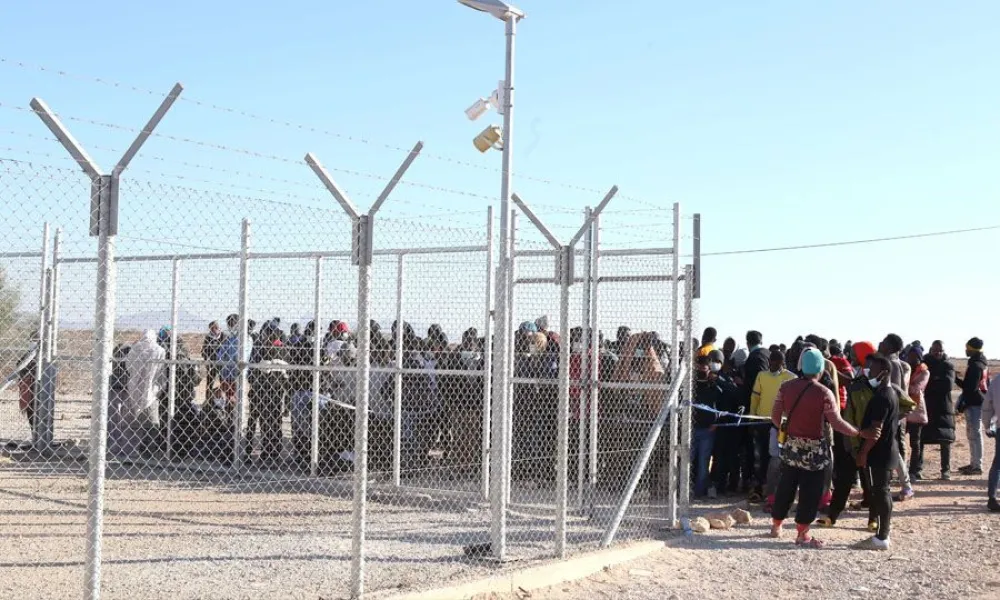
African departures towards Europe and the Gulf have continued despite tighter EU border controls, with migration routes becoming longer, riskier and more adaptable, according to a report by the International Centre for Migration Policy Development.
European efforts to curb irregular migration from Africa have not reduced overall movement, but have instead redirected it along alternative routes, according to a report seen by Euronews.
The report by the International Centre for Migration Policy Development, which works with the EU and European governments on migration policy, says recent patterns across Sub-Saharan Africa show that tougher controls tend to reshape mobility rather than suppress it. In many cases, this means migrants are pushed towards more dangerous journeys.
In recent years, Brussels has stepped up migration partnerships with countries including Tunisia, Egypt, Morocco, Senegal and Mauritania. These agreements generally involve stronger local border enforcement aimed at limiting departures towards Europe, in exchange for EU funding and broader development cooperation.
At the same time, the bloc has overhauled its internal migration system through the Asylum and Migration Pact, which sets common rules for handling irregular arrivals and harmonises border procedures across member states.
The report says those measures have helped lower arrivals to Europe in the short term, but warns that the broader pattern of mobility remains intact and could produce new routes in 2026.
Routes may change again
According to the document, further tightening of controls along major migration corridors is likely to alter routes again next year without fundamentally reducing mobility levels.
That could also have implications for Europe. The report notes that instability in the Middle East may influence migration decisions in Africa, and says it cannot be ruled out that some migrants who might otherwise head to Gulf countries could look instead towards Europe in 2026.
One of the busiest corridors remains the route from the Horn of Africa through Somalia and Djibouti towards the Gulf. Data from the International Organization for Migration shows departures from Sub-Saharan Africa to Gulf countries rose by 34% between 2024 and 2025.
Structural pressures remain
The report argues that stronger border controls do little to address the deeper forces driving migration. These include prolonged conflict, insecurity, rapid population growth, weak labour markets, climate shocks and recent cuts to humanitarian assistance by the United States and European governments.
While arrivals to Europe have fallen, the drop appears uneven across routes. Frontex said irregular crossings at the EU’s external borders fell by 26% in 2025.
The sharpest decline was recorded on the West African route, which the report links to recent EU partnerships with Morocco, Senegal and Mauritania. But it says departures towards the Canary Islands have not stopped. Instead, some have shifted south, with more boats leaving from Gambia and Guinea, making the Atlantic crossing longer and more dangerous.
Frontex also reported a smaller overall decline on the Eastern Mediterranean route. The corridor linking eastern Libya to Crete remained active and, according to the report, tripled in 2025.
Source: Euronews