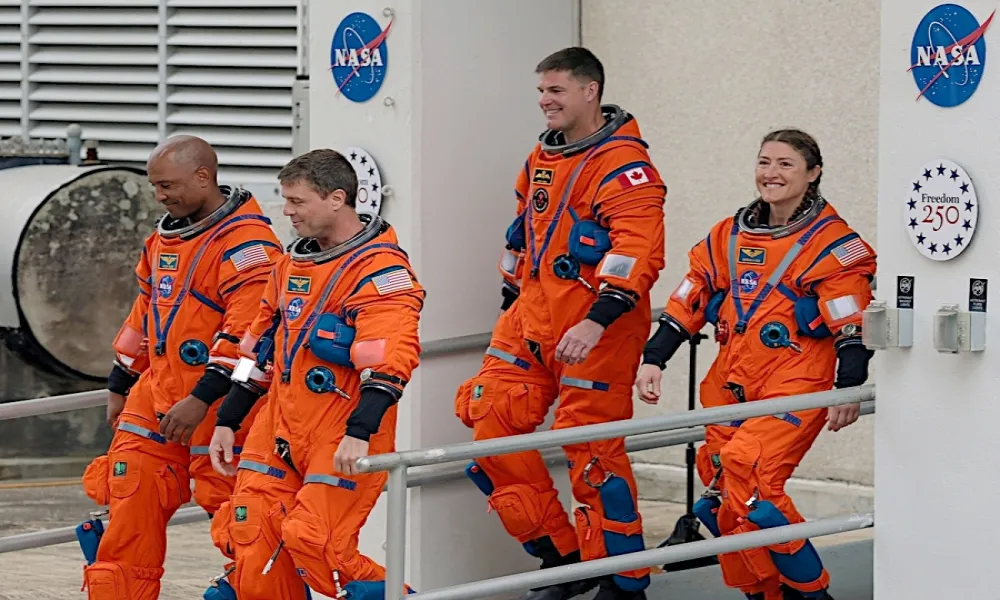

The four astronauts of NASA's Artemis II mission set a new spaceflight record on Monday, travelling 252,756 miles from Earth as they completed a six-hour flyby of the moon's far side, the first crewed voyage to the vicinity of the moon since the Apollo programme ended in 1972.
The crew, comprising US astronauts Reid Wiseman, Victor Glover and Christina Koch along with Canadian astronaut Jeremy Hansen, surpassed the previous distance record of roughly 248,000 miles set in 1970 by Apollo 13, when a near-catastrophic spacecraft malfunction forced the crew to use the moon's gravitational pull to return to Earth. That mission's commander, Jim Lovell, who died last year at 97, had recorded a message for the Artemis II crew that was played as they awoke on Monday. "Welcome to my old neighbourhood," Lovell said. "It's a historic day, and I know how busy you'll be, but don't forget to enjoy the view. Good luck and Godspeed."
🌞🌕🧑🚀
— NASA (@NASA) April 7, 2026
Right now, the Orion capsule is passing behind the Moon, so the Sun is entirely eclipsed from their perspective. During this time, they will view a mostly darkened Moon and will use the opportunity to analyze the solar corona. pic.twitter.com/PWDPfZKxGh
Impact flashes and unseen terrain
The far-side flyby, which brought the Orion spacecraft to within 4,070 miles of the lunar surface, yielded direct visual observations of meteor impact flashes on the darkened, heavily cratered terrain, phenomena reminiscent of what some Apollo astronauts had described but never so closely documented. About two dozen scientists monitoring the mission from NASA's Johnson Space Center in Houston recorded the observations in real time. Hansen told mission control that the crew had seen lunar features "no human has ever seen before, not even in Apollo."
Not gray… I’m full of color 😏 Surprised? #ArtemissII pic.twitter.com/VoeVZbQbSN
— MOON (@DailyMoonX) April 7, 2026
The flyby also produced a striking celestial image: as Orion swung around the far side, the astronauts photographed Earth, diminished by the record distance, rising and setting against the lunar horizon, a reversal of the moon-rise familiar from Earth. Because the moon rotates at the same speed as it revolves around Earth, its far side permanently faces away from our planet and has only ever been seen directly by Apollo and now Artemis crews.
New record🥇
— NASA Earth (@NASAEarth) April 6, 2026
The Artemis II astronauts are now farther from Earth than humans have ever been! At 1:57 p.m. EDT, they broke the record set by Apollo 13 in 1970.
Their journey around the far side of the Moon today will take them a maximum distance of 252,752 miles from Earth. pic.twitter.com/P5Swojpn0n
Personal moments in deep space
En route to the far side, the crew spent time assigning provisional names to previously unnamed lunar features. Hansen proposed naming one crater Integrity, after the crew's Orion capsule, and another Carroll, in honour of mission commander Wiseman's late wife, who died of cancer in 2020. "A number of years ago we started this journey, our close-knit astronaut family, and we lost a loved one," Hansen said, his voice breaking as he described the crater's position. "It's a bright spot on the Moon, and we would like to call that Carroll."
The crew endured a 40-minute communications blackout as the moon blocked contact with NASA's global antenna network during the flyby. After re-emerging, they spoke by audio link with US President Donald Trump from the White House. Koch told Trump that her most unforgettable moment had been "coming back from the far side of the moon and having the first glimpses of planet Earth again." Asked how the blackout felt, Glover said: "I said a little prayer, but then I had to keep rolling."
Artemis II is a crewed dress rehearsal ahead of future lunar landings. The programme aims to return astronauts to the moon's surface by 2028 and ultimately establish a long-term US lunar presence, with a moon base envisioned as a staging point for eventual missions to Mars.
Source: Reuters