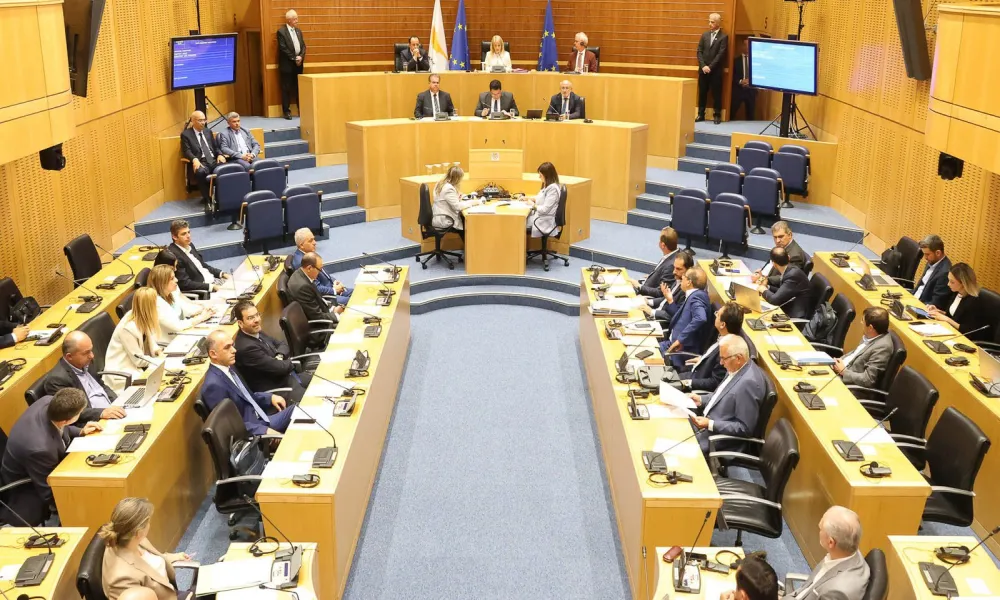
Two government bills and 19 legislative proposals concerning the management of non-performing loans and foreclosures will be put to a vote today during the final plenary session of the House of Representatives with its current composition. Both the government and the Central Bank have expressed opposition to provisions that would effectively lead to a blanket suspension of foreclosures.
The fate of the two government bills and the 19 legislative proposals on the management of non-performing loans and foreclosures will be decided today, Holy Monday, up to the very moment of the vote. The final plenary session of the House of Representatives in its current composition is scheduled to begin at 11:00, with the issue of foreclosures dominating the agenda.
The proposals form a broad package of legislative initiatives on foreclosures, the number of which could lead to significant changes to the existing framework. Although the political aim of the proposals is to strengthen borrower protection, the government and the Central Bank have voiced opposition to measures that would in practice result in a horizontal suspension of foreclosures.
One such proposal, submitted by AKEL, provides for the suspension of foreclosure proceedings if the borrower files a court application seeking verification of the debt. The counter-argument by the government, the Central Bank, banks and credit-acquiring companies is that the current framework, combined with state schemes such as Estia, Mortgage-to-Rent, and Oikia, already provides a balanced system. According to available figures, 70% of cases are resolved through consensual arrangements, while foreclosures, though sometimes unavoidable, are not the norm.
The government bills, which are considered likely to pass — with expected support from DISY and parties in the governing coalition — aim to strengthen the role of the Financial Ombudsman in the restructuring process. They upgrade the existing debt verification mechanism and link it directly to loan restructuring. In addition, decisions of the Financial Ombudsman would become binding in disputes involving amounts of up to €20,000.
On the other hand, the legislative proposals address a range of issues, including borrowers’ access to justice, the strengthening of guarantors’ rights, the temporary suspension of foreclosures, and the introduction of a ceiling on how much a loan may increase after interest calculations — potentially up to double the original principal amount.
The balance of forces within parliament does not allow for reliable predictions regarding the outcome of the vote. According to information, some opposition parties appear to be converging on certain positions, although there is no full alignment on all individual issues.
On Saturday, the parliamentary group of DIKO met to assess its position and decided not to support AKEL’s proposals. Attention is also turning to DIKO’s proposal to suspend foreclosures until the end of 2026, which, depending on how the parliamentary session unfolds, could be approved, possibly in amended form.
The government and the Central Bank have avoided escalating rhetoric over the potential consequences of overturning the current framework. However, officials acknowledge that the day after such a development would not be without repercussions.