The Rosicrucians trace their origins to the earliest years of the Christian Knights. Before that, we were living in the age of the dinosaurs. It was then that Christians established the first military orders, which later evolved into brotherhoods and fraternities, living in lodges and manor houses, always united by a single point of reference: the Cross.
In Cyprus, we came to know the Knights through the Crusades and Richard the Lionheart. Some of them, like Guy de Lusignan after the Third Crusade, stayed on as a rather permanent fixture, the Lusignan dynasty ruling our country until 1489. Rough men in white aprons, thick chainmail stockings, sharp swords, red and black crosses on their chests, killing all infidels in the name of Christ.
Time passed, of course, and a certain refinement set in, beginning with the dandyish Venetians and the lavish Queen Catherine Cornaro, who also launched the famous Cypriot décolleté across the courts, streets and alleys of Europe. The Brotherhood of the Rosicrucians consequently evolved into a considerably more cheerful fraternity. Still in white aprons, but now dressed by contemporary couturiers in silk garters (optional), with pink crosses and red roses as standard. This was the evolution, the gay, meaning joyful, metamorphosis of the hardened liberators of Jerusalem from Saladin's Mamluks. The Rose-Cross and Rose-Petal Knights became the people of intellect, meditation, and of course mysticism and intrigue.
Cyprus
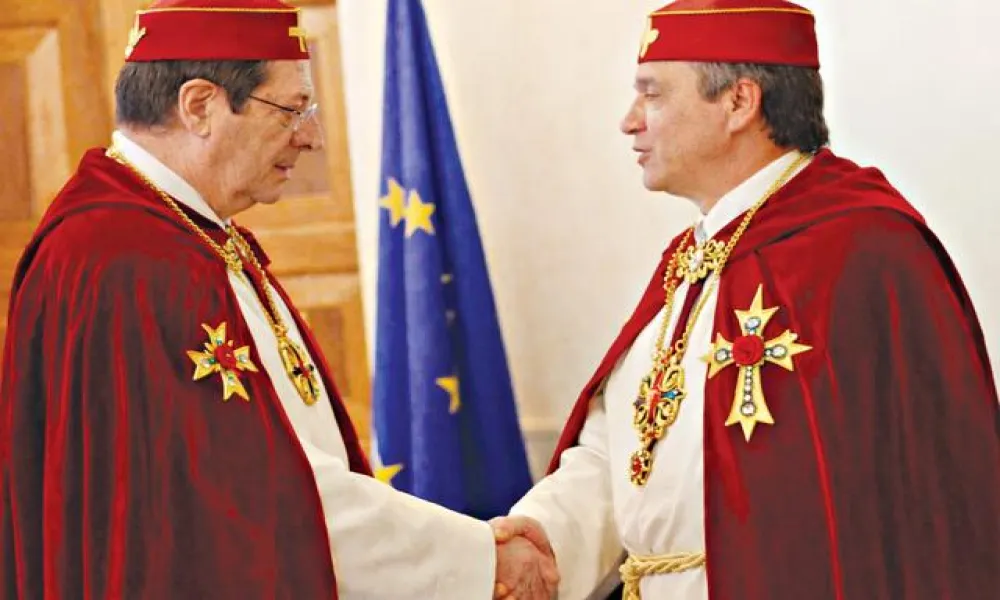
In our country, we did not know that such a modern brotherhood was operating until recently. We only knew of the Order of the Chair-Centaurs (A satirical Cypriot coinage for the political class that clings to power, literally "those who are centaurs of their chairs," meaning inseparable from their seats of office), an elite order of 1960. Also very well known was the popular Order of the Bell-Ringers (translation of Καμπανόγαροι, a Cypriot slur), which was embraced by the masses. Today we learn of yet another elite sub-variant of an order, through claims that certain highly placed compatriots are members of the Brotherhood of the Pink Knights, whose symbol is the rose. We do not know, of course, whether the Rosicrucians gather en masse as the Freemasons do, whether they wear special robes at their assemblies, whether they hold skulls, slaughter roosters or anoint themselves with warm blood. As we said, the Brotherhood of the Rosicrucians-Rosepetals is far more genteel and refined, and is headquartered in Greece. They presumably have some kind of uniform. Keeping with tradition, they too will wear those white robes, with a pink cross at the centre. Optional white garters, and a paper or plastic sword. Most of them, incidentally, claim to be ageless, which is why they dye their hair jet black.
Hierarchy
In the earliest Rosicrucian texts, there is no detailed hierarchy as many imagine. There are, however, basic roles within the fraternity, which counts as its founder Christian Rosenkreuz, regarded as the supreme master. On the second tier are the Brothers and Sisters, the Fratres. In Cyprus, this category could include some very prominent names: Judge Christodoulou, also known by his own preferred title of Godfather; the Rosicrucian of Pera Pedi, Nikos Anastasiades, otherwise known as "I Give My Word"; and the Rose-Petals Nikos Tornaritis, Knight of Kourkouna in the fiefdom of Agios Epifanios (Nikos Tornaritis deeply adores the fish kourkouna - red mullet), and George Savvides, known as the Confidant (Επιστήθιος φίλος -which appears in the alleged texts- in Greek means intimate confidant). The hierarchy also includes a small circle of "elect" members who hold secret knowledge. Into this group could be placed, again according to the claims circulating, Papadakis, Morfakis and all surnames ending in -akis. Finally, we have the students and initiates, who are trained in a range of subjects including banking operations, foreclosures, relaxations of land development coefficients, and other such matters. Those interested in becoming Rosicrucians-Rosepetals may apply and be accepted. The instruction of new Rose-Petals is undertaken by the Bishop Neophytos of Morphou.
Why the rose?
The rose is perhaps the most symbolically loaded flower in human history. Its meaning shifts according to colour, context and tradition. The red rose is, as everyone knows, a symbol of love and passion. It is also associated with sacrifice and blood. In Christianity, it frequently evokes martyrdom. The rose also carries connotations of mysticism, which is where the concept of sub rosa originates: "under the rose" meaning something said in confidence. In Cyprus, sub rosa, they have generally taken us to the cleaners. They sheared us, they impoverished us, and now they throw the poor who lost their homes out onto the street. There is of course also the rose with thorns, which carries a duality: it combines beauty and pain, reminding us that love can wound and that beauty is not always safe. In religion there is also the unfading rose, meaning Christ, whom the Virgin Mary, she who alone caused to bloom, brought into the world.
Among the Rosicrucians specifically, the rose upon the cross symbolises the union of matter and spirit, and initiation and revelation.
Socialists
You may well wonder: is it a coincidence that a number of socialists in Cyprus present themselves as Rosicrucians? The rose has long been used as the symbol of socialist and social-democratic movements. With a rose in hand and his hair swept back, Vasos Lyssarides, the Rose-Petal himself, founded a party in 1967 that flourished until the parliamentary elections of 2016. After that, the rose withered and EDEK filled up with informers and defectors.
The War of the Roses
Wars were fought in the name of the rose too. In England, from 1455 to 1487, there was the War of the Roses. The House of Lancaster, with the red rose as its symbol, fought the House of York, with the white rose, for the throne of England. In the end, Henry VII united the two houses and the two roses.
The Harvest
In Cyprus we have no War of the Roses but a Gathering of the Roses. Every year in Agros, the pure-hearted Cypriots celebrate the Rose Festival. There all the Rosicrucians gather for the distillation of roses. They also ensure that every morning all the little children drink rose-infused milk. When the Rosicrucians move through party offices, courtrooms and businesses, you can tell them by their scent. They carry that rose fragrance combined with the smell of mahalepi (a traditional Cypriot cold drink made from orchid starch or cornflour, rose water and mastic) from the coffee shops, or of lizos (Cypriot dialect for a type of carob-based sweet or a sticky, treacly substance), but when the rose wins out and the smell hits you in the nose, you know. In general, the Rosicrucians in Cyprus project a certain financial comfort, in contrast to the Order of the Bell-Ringers, who belong to the lower income brackets.
Editorial note: This is a satirical column. The names of public figures appear in a fictional and humorous context, as in the original Greek text published in Politis.